

Competition exposed decades of economic failure.
On October 12, 1960, Soviet Premier Nikita Khrushchev pounded his shoe on the podium during a speech at the United Nations General Assembly, yelling at the capitalist countries: “We [the socialists] will bury you!” Within 30 years, socialism, not capitalism, was dead and buried in Eastern Europe. The USSR disappeared from the maps.
Why was the Russian leader so confident in the victory of Marxism? Why was his prediction so wrong? The answer lies in the nature of socialism as a way to organize production and exchange. Capitalism relies on entrepreneurial profit-seeking and market price signals. Socialism relies on benevolent controls and the wisdom of experts.
Within five years of occupying Eastern Europe, Moscow entangled the economies of Albania, Bulgaria, Czechoslovakia, East Germany, Hungary, Poland, and Romania with the USSR in the Council for Mutual Economic Assistance (abbreviated as Comecon or CMEA). By 1978, this pact integrated Mongolia, Cuba, and Vietnam.
Private property was expropriated. Business initiative was criminalized. Profit became a dirty word. Everyone was employed by the state. Market mechanisms were replaced with central planning. Setting wages and prices became guesswork for bureaucrats in government agencies. The result was shortages and shoddy products.
CMEA members were ordered to specialize in producing something that the others would buy. Consumer preferences could not be revealed to determine what to make. The cost of resources could not guide the producers in finding the most efficient ways to manufacture the goods. Equalizing wages destroyed incentives to work.
Hungary made Ikarus buses—many more than what Mercedes-Benz produced in West Germany. Uncomfortable, noisy, with toxic exhaust fumes getting inside (where the passengers were either freezing or getting roasted), they were unsafe and needed constant repairs. Yet, hundreds of thousands were shipped across the CMEA.
East Germany made Wartburgs and Trabants. Those were almost as reliable as the first car made in 1769. With a cardboard coupe! How did they compare to the Volkswagen Beetle? As a hot dog to filet mignon. Customers could not buy from the West. So they had to wait 15 years for permission to buy these technological marvels.
Poland shows how specialization based on political rather than market principles could become a trap. The country became one of the world’s largest coal producers, peaking at 200 million tons in 1979. Coal exports (second only to the US) kept the lights on in other CMEA members and supplied the country with valuable capitalist currencies.
The system depended on unrealistic estimates of ever-increasing production. Overworked and underpaid, the miners went on strike in 1980. Coal production and exports plunged. The socialist economy could not generate enough revenue to service its debts to Western banks. No new credit meant no import of machinery and parts.
The Polish economy went into a deep recession that led to a coup d’état. It did not suddenly run out of coal, but exports to CMEA countries dropped 80% in just two years. The industry had pursued political priorities instead of profits. After decades of planning with ideological blindfolds, the day of reckoning was here.
When Stalin took Czechoslovakia, the country inherited one of Eastern Europe’s most advanced industrial bases. It became a major supplier of equipment to the Soviet Union and other CMEA members. Socialist specialization, however, meant no competition. This tends to preserve old technology rather than encourage innovation.
State factories had guaranteed customers. They faced no market pressure to reduce costs, improve quality, or catch up with the West. When CMEA collapsed, the former socialist managers discovered that the products they had been manufacturing for decades had no customers willing to buy them at market prices.
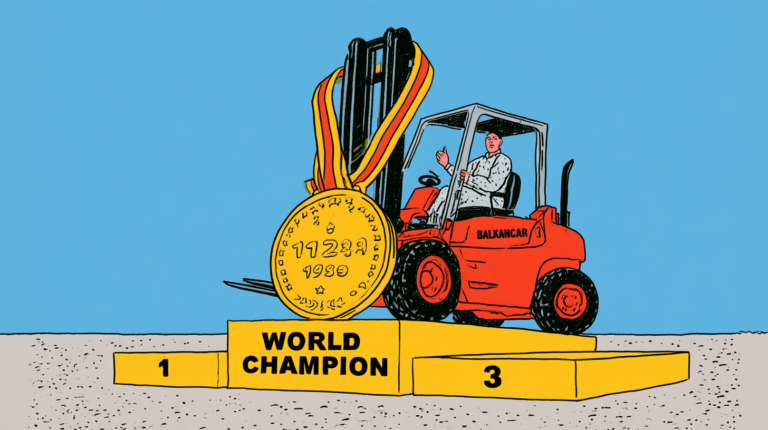
The most telling example comes from Bulgaria, where they made Balkancar forklifts, sturdy as World War II tanks. State propaganda loved these “achievements.” They were number one in the world! Not really. CMEA members bought them. They had no alternatives. Some were sold in the West—at a loss—to pay for high-quality capitalist imports.
Before he was shot by his people in the Revolutions of 1989, Romania’s dictator Ceaușescu tried to make Romania economically independent of Moscow. The government invested heavily in oil, steel, chemicals, machinery, electricity, and other heavy industries. The government repaid its debt to capitalist banks by almost starving its people.
During the last years of the socialist regime, the country was exporting manufactured products and agricultural goods to obtain hard currency while rationing electricity, gasoline, food, and other necessities at home. It had replaced dependence on the Kremlin and CMEA with dependence on the decisions of its own brutal masters.
The Soviet economy provided its customers a lower standard of living than Depression-era Americans. Want a color TV? Pay up, and come back next year. Just tell the government what color you prefer. Want a car, but don’t want to wait a decade for your turn to buy it? Sure, have this Zaporozhets, almost as good as Fred Flintstone’s vehicle.
In the 1980s, a Russian had to pay three years of his wages to buy a lousy Moskvich. Under the skin, those cars were the same as the models from 25 years earlier. An American worker could buy a Ford—five times better with five times less effort. While the United States cities suffered from too much traffic, Moscow’s streets were almost empty.
Soviet citizens could not simply walk into a showroom and choose an Audi, Fiat, or Toyota instead. There was no competitive market to punish the manufacturer for making junk. The customer had to take whatever the state produced—whether sausages, shoes, or shower curtains—and be grateful that they were available at all.
The workers pretended to work. The government pretended to pay them. Ordinary citizens waited years for a mediocre Lada. Privileged members of the “nomenklatura” (party leaders and factory directors) could use a government-owned Volga, often with a driver. Everyone was said to be equal, but some were more equal than others.
Finally—Cuba. Even 37 years after the fall of socialism in Europe, that island nation still suffers the consequences of embracing Marxist ideas. After joining CMEA in 1972, Cuba specialized in producing cane sugar while the Soviet Union supplied oil, machinery, and food—all at prices that had little connection to world-market conditions.
Of Cuba’s exports, 80% went to CMEA. Favorable terms of trade allowed the population to consume far more than it produced. Despite Moscow’s subsidies, they remained poor. When the Soviet Union collapsed, Cuban GDP fell by roughly one-third. The economic shock was more severe than the effects of the Great Depression.
These are just a few examples demonstrating the impossibility of constructing a rational economic order based on socialist principles. Without real prices and competition, CMEA’s orders could make a country a major producer of coal, machinery, buses, forklifts, or sugar while paving the way for economic collapse.
In 1991, the former socialist countries moved toward settling their trade in convertible currencies at global rates. The old trade relationships had been built around political priorities. Once buyers were allowed to choose and sellers had to compete, many industries discovered that their products were too expensive, too outdated, or too shoddy.
GDP numbers presented to Khrushchev created an illusion of economic strength. Socialist countries built factories, trained engineers, and made vast quantities of industrial goods. They produced impressive statistics, but failed to produce value for the consumers. Thus, socialism’s inherent inefficiencies sow the seeds of its destruction.
CMEA organized production without competition and trade without market prices. It even subsidized entire countries through distorted terms of exchange. Balkancar became a world champion because the government allowed only one player on the field. And with every forklift it made, Bulgaria became poorer, and socialism got closer to its demise.