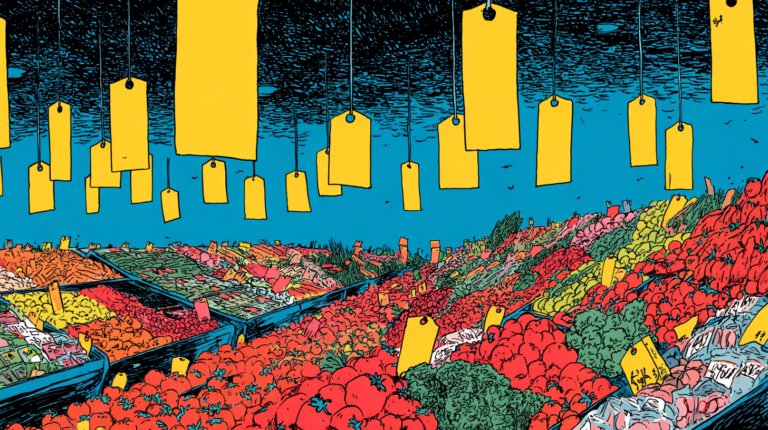

Capping prices would reduce incentives to continue or restore production.
For thousands of years, governments have been tempted to respond to inflationary pressures by imposing caps on prices. Diocletian’s AD 301 Edict on Maximum Prices is a famous early example, but there were repeats throughout the ages. By the 1970s, prices and incomes policies were being used by many governments to try to counter inflation. And this has not been solely a practice of left-wing governments. In 1982, the right-wing National Party Prime Minister of New Zealand, Robert Muldoon, announced a nationwide freeze on wages and most prices, which lasted for the next two years.
It sounds so simple. If consumers are suffering because prices are going up, then forbid that. Who could object, beyond greedy firms profiteering by pushing prices up? This notion that price rises are “profiteering” or “price gouging” has in recent years become particularly associated with the supermarkets sector. There were complaints of profiteering when supermarkets raised the prices of products that ran out or ran short during Covid, such as hand sanitiser. In the US, alleged “price gouging” by supermarkets and how to curtail it was a significant plank of Kamala Harris’ 2024 Presidential campaign. Similarly, New York Mayor Zohran Mamdani is establishing a system of state-owned (specifically, city-owned) supermarkets in response to what he describes as “price gouging.”
A key SNP manifesto pledge for the 2026 Scottish Parliament elections was that it would impose a legal cap on 20–50 essential everyday items sold in large supermarkets. Now it appears the UK Government has been negotiating a similar arrangement, seeking to get supermarkets to agree to caps on the prices of 20 items in exchange for some temporary relaxation of cost-raising regulations.
The talk of “price gouging” or “profiteering” is rather revealing. The thought seems to be that supermarkets have raised prices in response to the shocks of recent years—Covid, the energy price shock following the Russian invasion of Ukraine and now the Iran war. These price rises have maintained supermarket profits and in some cases may even have increased those profits. This is somehow regarded as unjust.
In economic theory, “price gouging” has no specific technical meaning. However, the scenario in which economists would generally be most sympathetic to restrictions being imposed on something describable as “price gouging” would be roughly as follows. Imagine there has been some natural disaster such as an earthquake, and that this disaster has destroyed most of the productive capacity for an industry—e.g., suppose there were only one beer production plant left. Then the remaining producer has temporary monopoly power. Prices of beer will naturally and appropriately rise because of the shortage—economists would not accept that being legitimately criticised as “price gouging.” But in addition to this natural shortage-driven rise, there is also the potential for a further rise associated with the newly-obtained significant market power of the one remaining beer producer.
Let us be clear here: most economists—perhaps even the overwhelming majority—would argue that price controls would be a mistake even in this case. Allowing the monopoly pricing would provide very powerful incentives for new production to be set up, speeding the process of recovery and getting production back to normal. Capping prices would reduce incentives to restore production and perhaps mean recovery was much slower. Nonetheless, even many economists that felt price caps were a mistake in this situation would at least concede that they had a meaningful rationale: the curtailing of temporary market power.
But what conceivable rationale could there be for capping supermarket prices in the UK today? The groceries sector has been subjected to multiple reviews—frequently on the basis of claims that its prices are too low because supermarkets exploit monopsony (big buyer) power to squeeze prices to their suppliers such as farmers. No monopoly power has ever been identified. Supermarkets are highly competitive.
Indeed, large supermarkets are a marvel of the modern age, on a par with wonders such as the Internet. We have a cornucopia of goods available, allowing us to buy almost anything we could want in multiple variants, from around the world. These are provided to us via the automatic responses of thousands of economic agents to thousands upon thousands of prices, in a web of interactions far beyond the ability of any human mind or machine to duplicate. Tampering with that process is so obviously potentially harmful that only a fool, or a desperate politician, would contemplate it.
If the government caps the prices of supermarket products, that will make those products unprofitable for the supermarket to stock and also mean that consumers have to pay less for them than their economic value, the consequence being that they will sell out and not be available. Why would I, as a consumer, want key products to be unavailable in supermarkets?
The SNP has attempted to get around this by saying that the cap applies to one product in a product class and that if that product stocks out, the supermarket then has to sell a different product in the class at the cap. This turns supermarkets from businesses into charities—forced to sell goods unprofitably. The most likely consequence is that the supermarket will increase the price of other products to sustain its profitability. So if the price of bread and potatoes are kept artificially low, the prices of biscuits and watermelons will rise to compensate—shoppers’ overall basket will end up with the same inflation. It’s just that there will be inefficient cross-subsidy. If the government wants to avoid any prices going up it will have to set up its own supermarkets, New York-style, to sell at below cost.
Supermarkets are highly competitive. If their prices rise that is because their costs rise or because consumers have increased their appetite for certain products—and in due course more of those more-desired products will be produced and their prices will fall back.
Setting the prices of key products in an efficient manner has been the hubristic ambition of central planners for thousands of years. But the government does not, and cannot (even in principle) know better than supermarkets what the socially optimal prices of their products should be.