
How gambling built a tax-free paradise.
At a time when gambling is increasingly treated by governments as a vice to be regulated or restricted, it is worth recalling a curious episode in European economic history: a casino once saved a country. In the 19th century, Monaco went from being a virtually bankrupt state to the playground of millionaires that we know today.
In the 19th century, the Principality of Monaco lost the territories of Menton and Roquebrune, which were annexed by France in 1861. With this territorial loss, the small principality was left with almost no tax base, since much of its revenue had come from taxes on agricultural production, particularly olive oil and fruit.
It was in this context of near bankruptcy that the Monegasque government made an unexpected decision: to bet on gambling.
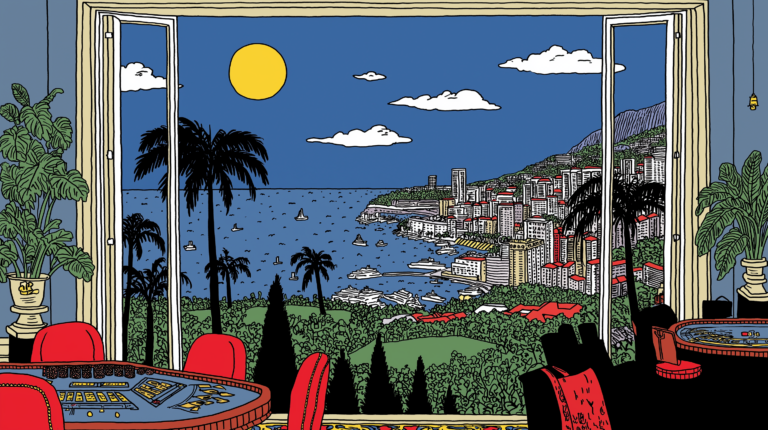
The idea was to create a luxury casino capable of attracting the European elite and generating new revenue. Across much of continental Europe, gambling was prohibited or heavily restricted, which made Monaco a particularly attractive destination for aristocrats and wealthy visitors seeking entertainment.
The casino proved so successful that it allowed investments in infrastructure such as hotels, roads, and railway connections, gradually transforming Monaco into an increasingly luxurious destination.
By 1869, casino revenues had grown so large that Prince Charles III abolished all direct taxes for Monegasque citizens, a policy that remains in place today.
This story becomes particularly interesting when we consider how many governments view gambling today, primarily as a moral vice that should be limited.
John Stuart Mill, in his essay On Liberty, argued that the state should only limit individual freedom when there is direct harm to others. Activities that involve personal risk, even when imprudent, do not in themselves justify government intervention.
For Mill, private betting between consenting adults can be tolerated. He acknowledged that restrictions on public gambling houses might be justified if they exploit vulnerable individuals or cause serious social disruption. However, he rejected general prohibitions or punitive taxation as forms of paternalism.
In Monaco, the approach diverged from modern trends in a nuanced way. Rather than imposing broad restrictions or heavy “sin taxes” on gambling for moral reasons across the entire population, the principality strategically liberalized access to non-residents and visitors, attracting those already seeking such entertainment elsewhere, while maintaining a longstanding paternalistic ban on its own citizens entering the gaming rooms.
This prohibition dating back to the 19th century, and initiated to protect locals from financial ruin, remains strictly enforced today.
The result was sustained prosperity funded by voluntary foreign participation, rather than coercive taxation on citizens.
The principality also became an example of tax competition and low taxation. Over time it attracted wealthy residents, international banks, and businesses, transforming a tiny territory into one of the most prosperous places in the world, with GDP per capita exceeding $250,000 in recent years.
Today the casino contributes only a modest share of government revenue, roughly 4–7% in recent years, according to reports from the Société des Bains de Mer and industry analyses. However, it was the initial catalyst.
Monaco’s economy eventually diversified into luxury tourism, financial services, and high-end real estate, all supported by a light tax regime that encourages wealth creation.
While many modern governments expand regulations, maintain state monopolies over lotteries, or impose sin taxes on gambling, the case of Monaco suggests that a strategic liberalization can sometimes generate more collective prosperity than decades of prohibition or paternalistic policy.
This is not about glorifying gambling, which can be destructive for some people. The real question is whether the state should decide for responsible adults what counts as a “vice” and punish it through taxation or intervention.
Freedom also includes the freedom to make mistakes, as long as one person’s choices do not harm others. This principle sits at the core of the classical liberal tradition.
For this reason it is worth reflecting on the growing powers that governments claim in the name of protecting citizens from gambling addiction, powers that often go far beyond targeted safeguards and extend to broad restrictions on consenting adults.
In the United States, proposals such as the SAFE Bet Act include mechanisms like financial affordability checks and advertising bans that are concerning from the standpoint of privacy and market interference.
Mill would likely recognize the lesson implicit in Monaco’s experience. When risk is assumed voluntarily and without direct harm to others, individual freedom, including the freedom to offer and consume risky entertainment, can generate unexpected positive outcomes such as economic innovation and lower tax burdens.
The history of Monaco shows that activities often treated as marginal can, when approached pragmatically, become unexpected engines of prosperity.