
Retelling Leonard Read’s story for the 21st century.
When Liberty International in collaboration with Libertarianism.org engaged me a year ago to apply the insights of Leonard E. Read’s famous 1958 essay, “I, Pencil,” to the smartphone, I eagerly accepted the challenge. All of us involved in the project believed that it was time to “update” the essay by adapting its message to a product everybody uses today. Why? Because, we thought, pencils are fading into memory, overtaken by a growing number of competing writing implements.
Then I ran across some information that surprised me. Global pencil production is actually setting records year after year. This article asserts that 14.5 billion pencils were produced in 2024 and that by 2032 the figure will jump to 31.9 billion! Furthermore, it explains:
A primary driver for the market remains the global education sector, where rising literacy rates and school enrollment in emerging economies particularly in the Asia–Pacific region ensure a steady demand for basic writing tools. Despite the rise of digitalization, pencils maintain a unique competitive advantage due to their erasability, reliability, and lack of reliance on ink or electronic power.
According to the World Atlas, more than 82,000 trees are cut down annually to make pencils (each tree yielding enough wood for about 170,000 pencils). Every year, more trees are planted than logged, so there is no need to lament the loss of the 82,000; as long as demand for tree products exists, entrepreneurs will plant trees. Similarly with graphite. A couple centuries ago, most of it came from Great Britain, but now it is mined on every continent but Antarctica.
The number of pencil factories in America has shrunk over the years, but 60 miles south of Nashville, Tennessee, the Musgrave Pencil Company churns out 70 million pencils annually! And all over the globe, other substances sometimes replace traditional wood to encase the graphite, including seaweed. China is the world’s largest producer of pencils, followed by India and Germany. Check out the links listed below for a treasure trove of fascinating facts about this ubiquitous tool.
So for now, the pencil is not endangered. But the case for building on “I, Pencil” to produce “I, Smartphone” is nonetheless compelling. Leonard Read explained in his essay that nobody in the world knows how to make a pencil entirely on his own. I explain in my new essay that the same is true for the smartphone.
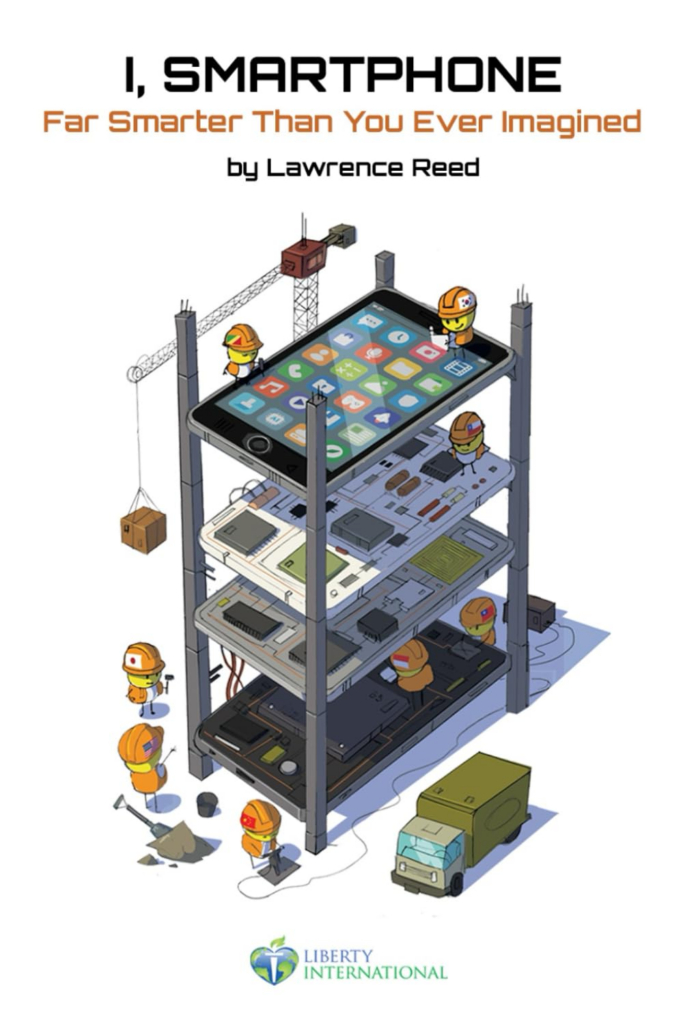
Walking the reader through the making of either object illuminates remarkable aspects of the amazing marketplace: spontaneous order, the diffusion of knowledge, the power of incentives and the profit motive, entrepreneurial alertness, coordination of diverse interests, the signals transmitted by free prices, and more. How it all happens without a single, controlling mastermind is more mind-blowing than you might imagine.
“The world will never starve for want of wonders,” wrote G.K. Chesterton, “but only for want of wonder.” The more we know about pencils and smartphones, the more we realize the scope of what we take for granted. We are smothered in jaw-dropping marvels without ever noticing how inscrutable they are.
For the moment, you may put your pencil down and set your smartphone aside. Enjoy the story of how and why you and I could never in a thousand years make either one entirely on our own.
Sources and Additional Information
Faith in Free People by Lawrence W. Reed
I, Smartphone by Lawrence W. Reed (Liberty International)
I, Smartphone: The Power of the Free Market (Libertarianism.org podcast)
Pencils Market Size and Forecast by Verified Market Research
Leonard Read’s Classic Now in the Telugu Language by Lawrence W. Reed
“I (Identify As), Pencil” by Lawrence W. Reed – a satirical version of the famous essay
See Inside One of America’s Last Pencil Factories by Danny Freedman
How Innovations in Pencil Manufacturing Are Revolutionizing Sustainability
Secret Pencil Stats: How Many Are Made Each Year? (You’ll Gasp!)