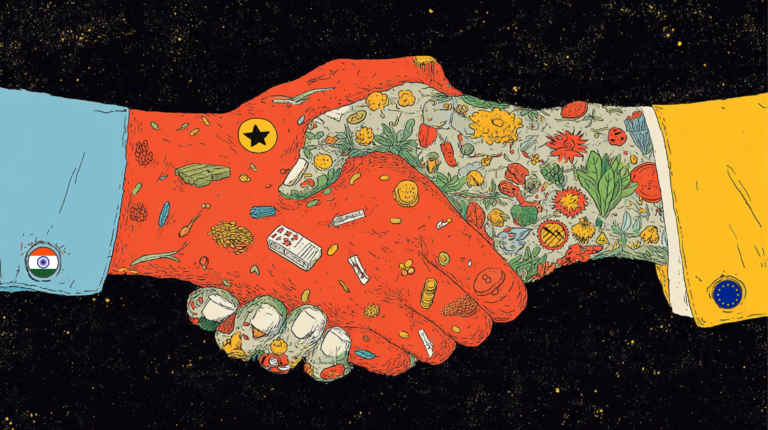

Delhi and Brussels finally have a trade agreement.
After nearly two decades of halting, stumbling talks, India and the European Union (EU) have at last concluded a free trade agreement (FTA) that both sides are describing as economically consequential and strategically necessary. Exposure to global volatility has shaped India’s economic geostrategy in 2025 and looks to do so in 2026 just as much, meaning that a reliable trading partner is highly sought after; while the EU has been left feeling bruised over trade relations with the United States.
Delhi has emphasized the scale of the deal, with commerce minister Piyush Goyal stating that the agreement places India “at the high table of international geopolitics,” with it covering 99% of Indian exports and 97% of EU exports. Likewise, European officials have praised the deal, stating that this is a “historic, ambitious, and commercially significant free trade agreement, the largest such deal ever concluded by either side.”
For producers in India, the principal gain is access to a reliable and vast, high-income market. As the Financial Times notes, EU tariff elimination would remove up to €4 billion ($4.77 billion) in duties on European exports to India, but the reciprocal effect is arguably more transformative for Indian exporters seeking scale and certainty.
As India remains a developing nation, with as much as 45% of the workforce engaged in agriculture and connected industries, accounting for nearly 18% of its GDP, access to such a large economy that is dependent on food imports is a major boon. Moreover, labor-intensive sectors such as textiles, garments, footwear, engineering goods, and processed food stand to benefit most.
For these industries, tariff reduction is not merely about margins; it enables deeper integration into European supply chains that are increasingly focused on diversification, resilience, and regulatory compliance. Indian exporters, particularly small and medium-sized firms, gain a steady and stable global market.
That access, however, comes with discipline. As Reuters has noted, EU market alignment brings stricter enforcement of environmental, labor, and product standards, all of which were stumbling blocks in finalizing this FTA. And as Reuters consistently points out, non-tariff barriers can shape outcomes just as much—if not more than—headline tariffs. For Indian producers, compliance costs will rise alongside market access, meaning that the gains may be cut down significantly.
Yet for Indian consumers, the impact is more visible but politically sensitive; tariff reductions on EU automobiles, wine, spirits, and industrial goods will increase competition in markets that have historically been protected. While a greater share of Indian consumers will now have access to, for example, European cars that previously faced tariffs as high as 110%, this is a meaningful shift in a sector closely linked to domestic manufacturing and, consequently, employment.
But greater competition should, and will, mean more choice, higher quality, and—over time—downward pressure on prices, particularly in premium segments, such as wine and other spirits that have remained until now a preserve of the wealthier elite.
For EU producers, the benefit is significant: improved access to a market of over 1 billion consumers can only be a good thing. Not only that, but the deal removes uncertainty, encourages long-term contracts, and increases diversification of export markets. India remains one of the world’s most tariff-protected large economies, and the customs complexity, regularity unpredictability, and high duties have been a bugbear of European producers for a long time.
And, as much as prices are expected to fall for Indian consumers, increased access to Indian products should help reduce prices or at least prevent them rising for European customers, especially in the clothing, household goods, and light engineering sectors where Indian producers excel. The EU has explicitly linked the deal to strengthening supply chains and reducing dependency on single sources—perhaps a veiled critique of the US. Regardless, over time, this should translate into stable prices, as much for EU consumers as it will for Indian consumers.
Ultimately, for each side, the deal is part of a broader effort to mitigate the fragmented and fragmenting global trade system; for EU producers, improved access to the Indian market reduces EU dependence on riskier markets.
This is not to say that all of the frictions in trade between the European Union and India are going to disappear overnight; there is still legal scrubbing, the ratification of the deal itself (especially difficult in the proto-federal structure of the EU), rules of origin to resolve that may prevent the benefits from materializing. Real market access is not as simple as the removal of tariffs.
In fact, this deal may expose existing inefficiencies, but sunlight is the best disinfectant. In this sense, the EU–India deal is not just about trade flows; it is a stress test of whether two large economies can use liberalization to build resilience in an increasingly fragmented global system.