
How capitalism gave consumers an exit.
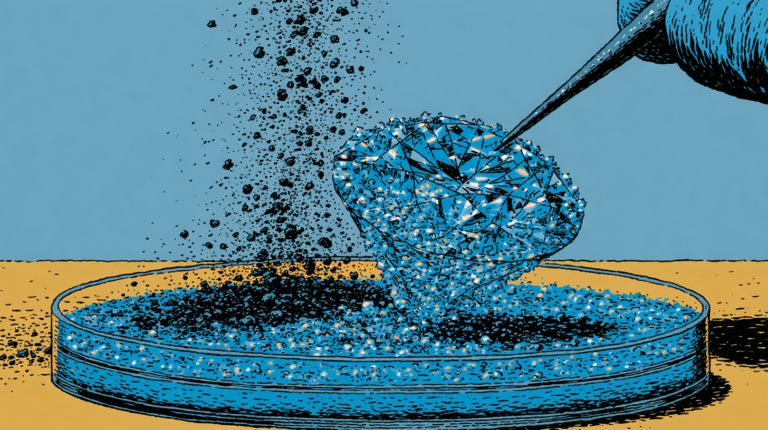
From De Beers’s 1940s slogan “A Diamond Is Forever,” to “Every Kiss Begins with Kay” and “He Went to Jared,” the diamond industry had already done its most important work before anyone chose a ring. It had written the rules of romance: what love looked like, what it cost, and what it said about someone who spent less. Those rules were not ancient traditions. The industry manufactured not diamonds, but desire. Even in popular culture, Rihanna gave us the song “Diamonds.” The more interesting economic story, however, is not the diamonds in the sky, but the diamonds in the lab. Desire has not gone anywhere. For the first time, it has a better offer.
Whether in the Imperial Crown of the Holy Roman Empire or the British Imperial State Crown, these jewels did not merely decorate rulers. They performed authority, with every gem communicating prestige. This symbol of power eventually moved from palace to household. Diamonds became not just about monarchy, but also about romance, marriage, and status. This transformation was no accident.
Entering the Kimberley diamond fields in the 1870s, Cecil Rhodes quickly learned that the real power was not merely in finding diamonds, but in controlling their supply. Rhodes established De Beers Consolidated Mines Limited in 1888. By the 1890s, De Beers controlled an estimated 90% of the diamond market, leveraging the Diamond Syndicate in the British Isles to maintain dominance. From mines to merchants, De Beers commanded a monopoly. Yet fearful of competition, Rhodes reportedly warned shareholders that the company’s “only risk is the sudden discovery of new mines, which human nature will work recklessly to the detriment of us all.” His fear was not that diamonds would become too rare, but that they would become too common.
The diamond market’s legacy was built on supply-chain domination, business consolidation, and the careful prevention of abundance.
The combination of enormous value, artificial scarcity, and weak political institutions created lucrative illicit markets. In the post-Cold War era, blood diamonds financed some of Africa’s deadliest civil wars. In 2007, Amnesty International reported that “3.7 million people have died in Angola, the Democratic Republic of Congo (DRC), Liberia, and Sierra Leone in conflicts fuelled by diamonds.” At their peak, these diamonds may have represented as much as 15% of global diamond trade, while some estimates place the true figure closer to 20%.
The international response was the Kimberley Process, launched in 2003 to certify rough diamonds as conflict-free: “By enforcing rigorous certification protocols and compliance assessments, the KP ensures that all participating countries maintain high standards that keep conflict diamonds out of the international market.” These formalities failed to reach the reality of the diamond fields.
Devastating evidence of this failure was the 2008 slaughter of roughly 200 people by Zimbabwe’s government in the Marange diamond fields. Remarkably, those diamonds were still Kimberley Process-certified because the system was designed to police rebel groups, not governments acting as warlords. Human Rights Watch recounts the experience of one child laborer: “Every day, I would carry ore and only rest for short periods… We always started work very early in the morning before eight and finished when it was dark after six. All I want now is to go back to school.”
More recently, the US Department of Labor’s 2024 TVPRA List shows that the broader problem has not disappeared. Diamonds from several African countries remain listed as goods produced with both child labor and forced labor. The KP may certify a narrow category of “conflict-free” diamonds, but the labor evidence shows a thriving black market. The International Labour Organization reports that this illegal mining contributes to 20% of the global diamond supply.
Political economist Albert O. Hirschman argued in Exit, Voice, and Loyalty that people respond to declining institutions in two ways: they can use voice, attempting reform from within, or exit, leaving for an alternative. The Kimberley Process represented voice. It tried to make the diamond supply chain cleaner through meetings, definitions, and certificates. Its limitations left consumers searching for an exit.
Exit requires something more than dissatisfaction. It requires somewhere else to go.
Joseph Schumpeter explained where those alternatives come from. Through creative destruction, entrepreneurs continually replace old arrangements with new ones. Lab-grown diamonds did not reform the incumbent institution. They reduced consumers’ dependence upon it.
Lab-grown diamonds have existed in industrial applications since the 1950s, but they reached consumers in meaningful quantities in the 2010s. The Federal Trade Commission’s 2018 Jewelry Guides acknowledged that lab-grown diamonds have “essentially the same optical, physical, and chemical properties as mined diamonds,” while still requiring sellers to disclose that they are not mined stones.
For the consumer standing in a jewelry store, it is the same stone. Everything behind it has changed.
A lab-grown diamond does not require a rebel mine, a smuggling route, or a questionable certificate from an international body. It is produced through technology, capital, energy, and scientific knowledge. According to Fortune Business Insights, “The global lab-grown diamond market size was valued at USD 29.46 billion in 2025. The market is projected to grow from USD 33.54 billion in 2026 to USD 91.85 billion by 2034.” Each lab-grown diamond purchased is one less purchase supporting a supply chain historically associated with conflict and child labor.
Consumers have driven this shift. According to The Knot’s 2026 Real Weddings Study, 61% of engagement rings purchased in 2025 featured lab-grown center stones, a 239% increase since 2020. Buyers spent less, received larger stones, and increasingly cited ethical sourcing as part of their decision. Consumers are not merely expressing moral concern—they are putting their money where their mouth is. Economists call this revealed preference.
This is capitalism solving a moral problem through innovation. Rather than asking consumers to become experts in African mining, international certification, or export law, entrepreneurs built an alternative. Markets changed the moral choices available to millions of ordinary people.
Diamonds may glisten, but they are not unique in capitalism’s moral market.
When petroleum replaced whale oil in the 19th century, consumers became less dependent on whales for illumination. Synthetic ivory competes directly with poached ivory, reducing demand for elephant tusks. Streaming services accomplished more to reduce digital piracy than years of litigation by making legal entertainment easier than illegal downloading.
This is creative destruction viewed through a moral lens. Markets rarely solve ethical problems by making existing industries virtuous. More often, they solve them by making those industries less relevant. Lab-grown diamonds are not just a better deal—they are another demonstration of one of capitalism’s least appreciated strengths: to expand the range of ethical choices available to ordinary people.
De Beers once taught the world that a diamond is forever. Lab-grown diamonds taught consumers something even more valuable: no monopoly is beyond competition. By creating better alternatives, markets made participation in exploitative supply chains increasingly unnecessary. Perhaps that is capitalism’s greatest moral contribution: not that it forces people to do the right thing, but that it makes doing the right thing easier.