
The EU–US trade deal makes it through.
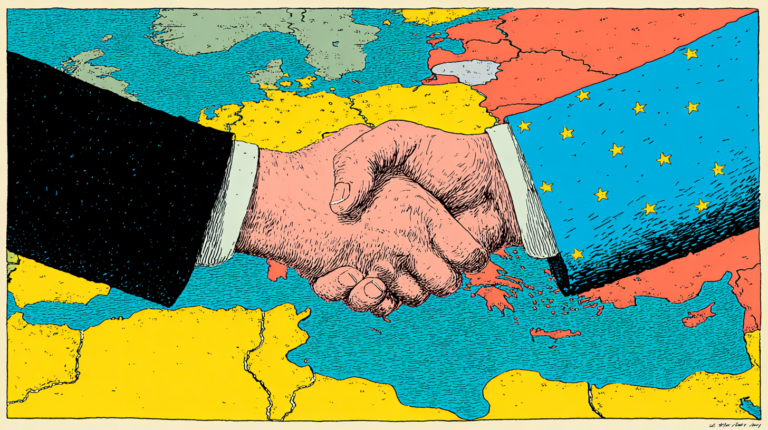
“Strong, if not perfect” was European Commission President Ursula von der Leyen’s verdict on the trade deal hammered out between the United States and the European Union (EU) and signed at Turnberry, Scotland, in July 2025. Nothing is perfect, of course—but the carefully hedged endorsement has appeared increasingly prophetic as the deal overcame hurdles and was finally voted through by the European Parliament’s International Trade Committee on March 19, 2026, by 29 votes to 9, and by the wider Parliament on March 26, by 417 votes to 154.
The road to passing was not a smooth one. Formally titled the Agreement on Reciprocal, Fair, and Balanced Trade, the inclusion of “reciprocal” has attracted skepticism, and the deal has lurched through suspension, legal crisis, and political tug-of-war in the last year. After the deal passed a full plenary vote on March 26, Rapporteur Bernd Lange (S&D, DE) said:
With today’s vote, we have a strong mandate for negotiations with the Council and we intend to make the most of it. MEPs will only be able to sign up to the trade terms of the deal if the regulation contains very strong and clear safeguards, and only after the US has fully respected the terms of the deal. I intend to defend this mandate firmly in the negotiations.
Tensions on either side of the Atlantic have hampered the deal’s progress: in the States, in late February, SCOTUS struck down the executive’s use of the International Emergency Economic Powers Act, the legal mechanism underpinning Washington’s ability to hold tariffs at the agreed 15% ceiling with the EU. Even prior to this, however, in January the European Parliament’s trade committee halted work in protest at President Trump’s rhetoric over Greenland.
But President Trump was not the only factor at play. Internally, EU politics surrounding the deal have been as turbulent as the external pressures. Two major obstacles presented themselves: the structure of the deal’s approval; and strong industry lobbies at work across the Continent. The European Parliament made it very clear that the deal would not be rubber-stamped, owing to resentment toward the way the Commission structured the legislation that would implement the trade deal. In essence, the legislation might only require Council approval for any tariffs, bypassing the Parliament altogether. Meanwhile, given the strength of the agricultural industry across the Continent, this put many Members of the European Parliament (MEPs) in a tight spot, as suspicions were aroused toward increased access for US pork and dairy, and any potential softening of EU food standards.
Skepticism is justified—the deal is fundamentally asymmetrical. SCOTUS ruling notwithstanding, the US imposes a 15% tariff on all EU exports, which is a sort of rationalization of the pre-existing patchwork levies imposed on specific sectors. Michael Oakeshott warned against rationalism in politics, however, for the simple reason that rationalism undermines the knowledge matrix that is generated in the spontaneous, free-flowing interaction of individuals and consumers. In the market context, this means that a rationalization of tariffs ignores the reason for the variation between tariffs in the first instance. Nevertheless, the 15% minimum exists, while the EU, in exchange, agrees to eliminate tariffs on most US industrial and agricultural goods.
Beyond tariffs, the EU has made a series of broader regulatory commitments, such as ensuring its Corporate Sustainability Due Diligence Directive (CS3D) and the Carbon Border Adjustment Mechanism (CBAM), which do not create undue trade barriers for US companies. Both sides have committed to working toward mutual automotive standard recognition—“cooperation on standards plays a crucial role in enhancing the transatlantic marketplace,” the EU’s memorandum states—while the EU has promised an increased investment in American manufacturing, as much as $600 billion.
The consequences are already being felt for Europeans; the mutual recognition of standards for the automotive industry could reduce compliance costs for exporters, yet the 15% tariff quickly cuts any benefits found. German and Swedish cars are already feeling their margins squeeze, and are tempted to accelerate their localization processes, even if such moves are “capital-intensive and could take years to yield results.”
For the agricultural sector, the picture is mixed: access to the American markets, no matter how qualified, offers great expansion opportunities for existing farmers. On the other hand, of course, their skepticism remains somewhat validated, as improved access for US pork and dairy products is seen as a threat. Alarm bells have rung even louder at the promise in the deal to “revisit EU agricultural standards,” as many European food products are points of national and cultural pride, rather than mere economic exports. Champagne is only champagne if it is from the Champagne region, after all.
Strictly speaking, the deal is not legally binding, but is rather a statement of political intent and not an enforceable treaty. Friends of Europe have criticized the deal as yet further indication of “Europe’s waning international influence” and, perhaps most importantly, flagged that the deal may be “illegal under the World Trade Organisation’s laws that the EU has always defended. Article 1 of the General Agreement on Tariffs and Trade (GATT)—the Most Favoured Nation (MFN) clause—states that any tariff concession offered to one country must be extended unconditionally to all other WTO members.”
There are, inevitably, indications that the EU Parliament does not trust that this deal will be respected, due to its inclusion of a “sunset clause” in the March 19th vote, which reinstate EU tariffs after 18 months should the agreement not be renewed. Likewise, there is a “sunrise clause,” which makes the tariff cuts conditional on Washington meeting its commitments (such as the mutual recognition of automotive standards).
Regardless, the deal has been given “conditional” approval by the European Parliament. A “one-year health check” of the deal has been set for July 2026, by which time the sunset and sunrise clauses will either come into effect if Washington has not met its side of the deal.
At its heart, the problem with the deal is that it is structurally unsustainable, especially now that SCOTUS has ruled against the executive instruments upon which it was built. On the European end, the parochial interests are entrenched enough to place the burden of proof on Washington rather than Brussels, meaning that many MEPs will seek any reason to find fault. This trade deal might signal a new era of stability; or it might be a pause in an ongoing trade war.