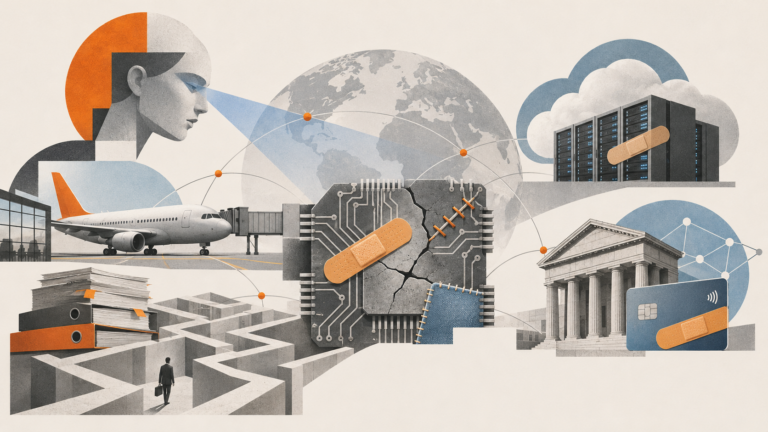

Everything seems to be breaking down all at once. We had the Microsoft 365 outage one week, followed by the FAA’s nationwide ground stop, the freeze at JPMorgan Chase and other major banks, the Delta Air Lines weight system delays… And this all happened within a couple of weeks. You don’t have to be a conspiracy theorist pulling threads across a corkboard to suspect that these were not completely isolated incidents. Something seems to be up, and that something sounds a lot like AI. Are we living through the Great Hacking of 2026? Is this the moment hackers finally weaponized superintelligent AI against the rest of us?
Not yet. In fact, it seems that something closer to the opposite is happening. We are living through the Great Patching of 2026.
Since news cycles focus on the negative, most commentary on AI and cybersecurity looks at the risk of infrastructure attacks. The offensive threats posed by powerful AI are a legitimate concern. But that concern is also a reason to remember that artificial intelligence is a powerful tool for cyber defense. Since the world’s frontier models are being built in the US and deployed first across American companies and critical infrastructure, the US is also the first economy to encounter a new wave of defensive auditing.
American companies are deploying AI tools such as Anthropic’s Mythos on their own systems and exposing bugs and vulnerabilities that have gone unnoticed for years or even decades. It’s the great reckoning with all the technical debt we have accumulated. Cybersecurity expert Nicole Perlroth has compared this “digital deficit” to the fiscal deficits of Western democracies to explain how we eventually have to pay the price. As she explains in a recent interview: We have been rolling out flawed code. We’ve been leaving that flawed code in systems. We haven’t been updating it for years. And we’ve also been baking code into every nook and cranny of our economy, of critical infrastructure, our homes, our cars, our bodies in some cases.
AI makes paying down technical debt less expensive but more urgent, and now we are seeing it paid in time and friction as well. As Perlroth warned:
It’s still really hard and time-consuming to properly install a patch. And when you install a patch, you do it in these bespoke environments. No environment is the same. You can’t just push a big red button and everything’s fixed. Usually, it’s likely that something will break on the other end.
Some vulnerabilities take a few lines of code to patch. Others cannot be patched and instead require a revamp of the underlying architecture. That can be painful enough for the private sector. In the public sector, where the debt is even higher, such renovations could provoke chaos. And in the public sector, software is not the only kind of code that suffers from technical debt. Legal codes have also accumulated decades of patchwork. Over a decade ago, political scientist Steven Teles coined a term to describe this phenomenon: kludgeocracy.
We have names for one axis of our politics—right vs. left, big vs. small government. But voters and politicians have no name for what should be an equally important set of questions that cuts straight through those ideological divisions, which is complexity versus simplicity. The name, for a lack of a better alternative, is kludgeocracy.
In legislation, as in software, many temporary solutions plus time make for a recipe for institutional decay:
When you add up enough kludges, you get a very complicated program, one that is hard to understand and subject to crashes. In other words, Windows. “Clumsy but temporarily effective” also describes much of American public policy.
AI is about to stress-test kludgeocracy in America and beyond, not only because frontier models can expose contradictions and vulnerabilities but also because the speed and capabilities of AI will be on a collision course with all the bureaucracies that have slowed down the political world. And that might not be as visible at first. When a private company’s system fails, thousands of users get grounded or locked out, but government failure can play out over years of institutional decay. We often notice the paralysis and sclerosis of European economies only because we can compare them with the dynamism coming from America and Asia.
One useful comparison to keep in mind is that between bureaucratic complexity, in which layers pile up as a result of a series of intentional designs, and market complexity, which is often emergent and self-correcting through a system of profit and loss. The moment when systems start to break down around us is also a moment for reflection and an educational opportunity to see what is often invisible to us: the sheer complexity of the systems that work most of the time and upon which our lives depend.
Writer Yuval Noah Harari has been making the interview circuit warning us of the rise of a black-box world. His favorite metaphor is that AI will turn human beings into cattle. Livestock, as he points out, do not understand the systems within which they live. Their food and their movements are dictated by those human systems. Their entire lives, from birth to slaughter, are dictated by commodity markets and logistics chains that they will never be able to grasp.
As terrifying as that sounds, Harari overlooks the fact that human beings already live inside systems that are too vast and complex for any single mind to apprehend. What sounds like a dystopia is actually the social basis of modern civilization.
We do not need, or even want, the systems that surround us to be legible at all times. We don’t expect everyone with a bank account to monitor the code and operations of our banking networks. Or anyone in the service industry to understand the flight-routing software of the FAA. Or anyone who enjoys a fresh cup of coffee in the morning to understand the global supply chain behind our crops. Pursuing that kind of understanding would overwhelm our biological RAM. We rely instead on what economists call rational ignorance. We devote our limited time and attention to the things we do best and tacitly delegate the rest of our world to specialists and institutions. We already live in a world of mountainous black boxes.
We tend to pay attention to our own rational ignorance only when something breaks. That’s when invisible cooperation turns into a visible inconvenience. But we should use those moments to educate ourselves. When we get stranded at an airport gate, we should marvel at the complexity of modern aviation, which works most of the time. When we find ourselves locked out of our inboxes or bank accounts, we should pay heed to the amazing cloud infrastructure and payment rails that allow us to send messages and checks.
That is why economics is such an urgent discipline for our time. Providing a good economic education does not mean cracking open every black box or forcing students to memorize the wiring diagram inside each one. No one has the bandwidth to do that. The first job of economics is to show us that the black boxes around us are real and to reveal how much of our modern lives is sustained by the unseen. That is what begins to give us a grasp of the general order of things.
Artificial superintelligence may help us recover that sense of wonder. By showing us how little of our own world any one person truly understands, it may help strip away the illusion that society can be run from the top down by a handful of central geniuses, as well as the conspiratorial belief that it already is. That epistemic humility is at the heart of economic liberalism, the institutional framework that allows millions of strangers to cooperate peacefully every day inside a world none of them can fully map.
Economic education will not guarantee that anyone will build the next billion- or trillion-dollar company. But it gives societies an understanding of complexity that allows us to be more humble about what we can design. It gives non-economists perspective. Without that perspective, we do risk living our lives like cattle: going about our days unaware of what keeps the world running, entering panic mode every time a machine hiccups, and willingly handing control to those who want to trade dynamism for stasis and emergent complexity for controlled simplicity.
AI is a product of that emergent complexity. Only an open and deeply interconnected civilization could build such powerful computational tools. And if that very same civilization responds to the friction caused by the creative destruction of the Great Patching by clamping down on the infrastructure of that complexity, it might very well engineer the decay it fears most.