
Mortimer Adler taught me how to read a book. His book How to Read a Book offered me some very concrete and practical steps to improve my understanding of the classics.
But Adler also helped me navigate the classics themselves. In the library of the Catholic University of Petrópolis, his books on The Great Conversation, the Syntopicon, and the Great Books volumes had sat unborrowed for years before I found them.
And it was through Adler that I discovered the meaning of liberal education: education for a free person. Education that is free in the sense that it does not force specific interpretations, but also education that makes a person freer to act in the world by giving him the ability to understand and to choose. It teaches us how to join the Great Conversation humanity has been having with itself.
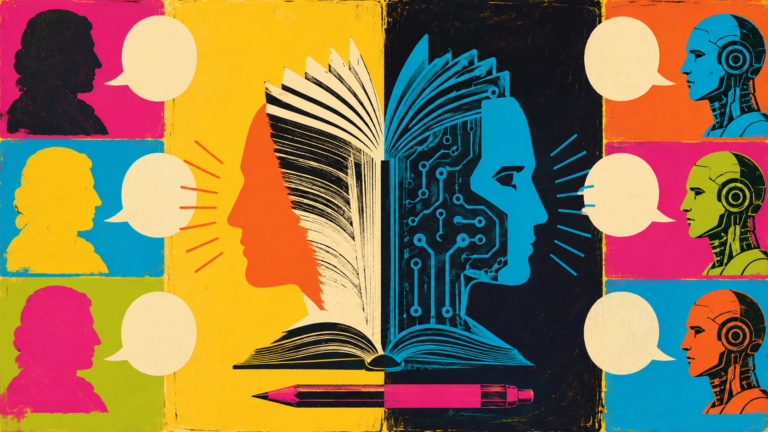
Now, that conversation has taken a shift recently, because so much of it has become AI-focused. If you look at what is produced online and what people are talking about online, a lot of it is now AI-generated.
And with AI, we have something amazing. We have a tool that can teach us and let us dive deep into whatever interests us. We can each have a personal coach who guides us through our obsessions and our questions, one who is extraordinarily cheap, always available, and personalized. That is wonderful.
But we are also producing an enormous amount with it, and a gap has opened between producing content and authoring it. An author is someone who is present in the text. Authorship means believing what you write. For an author to believe in what he writes, he needs to be able to understand and to defend his work. Authorship is a form of agency even when assistance is available.
Professor Virgil Storr raised this question at a Rising Tide Foundation event: If organizations like FEE, Mercatus, and others in our ecosystem value agency and authorship in our students, how should we think about learning from now on?
I asked myself, “What would Adler say about this?” I believe Adler would see this as a moment when we need liberal education even more than ever.
Adler was responding to the problems of his own time. Education had become an expression of industrial society: highly specialized, narrow, tied to professional vocations, and very passive.
His response was that liberal education should be universal. Bring the Great Books to everyone. Bring people into the Great Conversation, and give them access to the body of knowledge that lets them take part in it. And make reasoning active.
That is what How to Read a Book does. It teaches you to read actively, to ask questions of a text and then to answer them with the material in front of you. Socratic discussion makes that reasoning richer. And learning should not stop with the classroom years; it should last a lifetime.
Adler’s pedagogical method, the Paideia approach, is usually described as a tripod: didactic instruction, intellectual coaching, and Socratic questioning. If we take Adler seriously, we can update his question.
He asked: What kind of education does a person need in order to be an active and free agent in a modern liberal democracy? Today, we might ask: What kind of learning does a person need in order to remain the author of his life and work, a co-author of the world we are building, and someone who keeps his judgment in a world of abundant intelligence?
Much of what Adler thought about liberal education still holds.
First, we still need instruction.
We still need to gather knowledge. We need to know things rather than relying entirely on frictionless retrieval. Without acquired knowledge, we will not know when whatever we are retrieving is wrong. We will not know when it is shallow.
If judgment is scarce, we need to make sure that we are exercising judgment over ideas that we ourselves possess. Our own organic hard drive needs frameworks and mental models with which to assess and evaluate whatever the machine is outputting to us. We cannot delegate knowing.
Second, coaching.
Coaching is having an extraordinary moment. We can now bring it to a level Adler could only have dreamed of. Coaching has become abundant. It has become personalized. It has become extraordinarily cheap. And I think this is a tremendous addition to liberal education. It is also something our organizations should be focusing on: making high-quality coaching abundant.
Third, Socratic discussion.
This is the Baumol part of the system, the part whose relative cost rises as everything around it gets cheaper, because humans should argue with humans. All the themes of the Syntopicon: love, justice, beauty, responsibility, liberty, government, peace, commerce… All of those Great Conversations should ultimately be held between human beings. AI is a tool. AI can engage in sophistry for you. AI can play devil’s advocate. AI can guide you and challenge you. But the final test, both for yourself and in relation to others, is the actual Socratic conversation.
So, instruction, coaching, and Socratic discussion. Instruction was already abundant before AI. Coaching has become dramatically more abundant because of AI. Socratic discussion is harder to scale. Seminars become relatively more expensive as everything else grows cheaper and more productive. But the effort a seminar demands is part of what a seminar produces. That is central to it.
I think there is now a fourth pillar—a more generative part of education itself.
Education can become more agentic. Understanding can be translated directly into making things. Writing a thesis, starting a company, developing a business plan, building a piece of software: these used to come slowly and late in life. Now they can happen much sooner. Adler’s classroom also becomes a studio.
This is not simply AI changing liberal education. It is liberal education changing because it can become more agentic and more generative. That is why we use the name generative liberal education.
There are also features of this new environment that change all four pillars. One is that we still want friction in the classroom.
When calculators appeared, that did not mean that we no longer needed to learn mathematics, or that mathematics should only be learned with a calculator. The calculation itself was never the whole point of learning mathematics. For the same reason, LLMs should not eliminate writing, reading, memorization, or argumentation. We need periods of unassisted cognition.
And that brings me back to what the future educational system should be trying to achieve. How do we make sure people remain authors? Authors of their choices, their ideas, their companies, their relationships, their writing, their discoveries and inventions.
I’ve called this elsewhere the positive-sum classroom. The goal is not to preserve every task humans used to perform before AI, nor is it to delegate every task AI can now perform. It is to use the machine in ways that increase what the human can understand, judge, and create.
We need “cognitive gyms.” Think about why we need gyms. We became so abundant in calories and physical conveniences that we now go into a room and repeatedly move a piece of metal up and down. Viewed narrowly, it looks completely pointless. But that’s how we keep our muscles strong.
We need to do something similar with writing, reading, memorization, argumentation, and pen and paper. As we expand the space of possibilities with AI, we should not erase or outsource the capacities that make us independent thinkers. Judgment remains with us. Cognitive independence remains with us.
What we owe our students now is the formation that lets them enter the Great Conversations as authors, and add new sentences to it that are true to themselves.