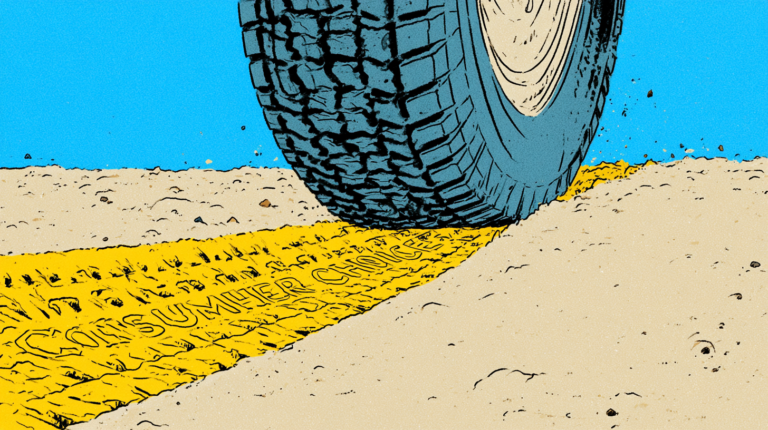

If efficient tires save Californians money, why mandate them?
On August 17, the California Energy Commission (CEC) approved the nation’s first energy-efficiency standards for replacement tires. Beginning in 2029, replacement tires sold for passenger vehicles and light-duty trucks in California will have to meet minimum standards for “rolling resistance”—the force that resists a tire as it rolls along the road.
Lower rolling resistance can improve fuel economy in gasoline-powered vehicles and extend the range of electric vehicles. Those sound like good things. And, according to the California Energy Commission, they come at relatively little cost.
The CEC estimates that under the first phase of the regulation, a set of four tires will cost consumers about $6 more while saving the average driver approximately $85 in fuel costs over the life of the tires. Under the stricter second phase, beginning in 2033, the additional cost is estimated at $26 per set, while fuel savings are projected to be approximately $179.
Assuming those estimates are accurate, most people would probably say, “Sounds like a pretty good deal.” But that raises an obvious economic question: If these tires are such a good deal for consumers, why does the government need to force people to buy them?
Good economics requires looking beyond the most obvious effects of a policy and considering its effects on all groups, not merely the group policymakers intend to benefit. Engineers and regulators can measure rolling resistance. What they cannot objectively measure is how much an individual consumer values lower rolling resistance relative to all the other characteristics he or she might want in a tire.
Different drivers will weigh those other characteristics differently. Some care about price, practicality, ride comfort, or brand reputation. Someone who puts 5,000 miles on his or her luxury car may place less value on the fuel efficiency of these new tires than someone who puts 50,000 miles on his or her minivan. Thus, the government cannot determine that low-rolling-resistance tires are the best choice for every consumer.
F.A. Hayek explained this problem beautifully in his famous 1945 essay, “The Use of Knowledge in Society.”
The commissioners and staff at the CEC may possess excellent scientific information about tire performance. But they do not possess what Hayek called knowledge of “the particular circumstances of time and place.”
They do not know my budget, how many miles I drive, how long I plan to keep my car, what weather conditions I encounter, what other bills I need to pay this month, or how much I value fuel economy relative to traction, comfort, durability, and other characteristics. Multiply that problem by millions of California drivers, and the knowledge problem becomes obvious.
This is precisely why decentralized markets are superior to top-down regulation. Markets allow millions of individuals, each possessing knowledge of his or her own circumstances and preferences, to make different choices. There is a simple alternative to a government mandate: provide consumers with information. If lower-rolling-resistance tires really offer the savings the CEC projects, tire retailers have a compelling sales pitch:
“This set of tires costs $26 more today, but we estimate that it will save you $179 in fuel over the life of the tires.”
That is useful information that will allow consumers to evaluate the trade-offs and decide for themselves. That is very different from having the government make the decision for them. Markets do more than provide information. They respond to consumer demand. If motorists value the fuel savings enough to pay for more efficient tires, their purchases create profit opportunities for manufacturers to produce more of them. No mandate is necessary.
One of the first lessons economics students learn is that people respond to incentives. Another is that good intentions do not guarantee good results. The CEC expects the regulation to produce substantial benefits. But regulations also change incentives in ways policymakers may not anticipate.
Consider a lower-income driver whose tires need replacing. An additional $26 may seem insignificant to an affluent household, but to someone struggling to pay rent, groceries, gasoline, insurance, and utility bills, every additional expense matters. The long-term savings may sound appealing to some consumers, but the buyer should be free to choose cheaper tires now and get the more fuel-efficient ones when he can afford them. Without this choice, some drivers might have to continue driving on worn tires, creating a safety trade-off that is easy to overlook when the focus is primarily on fuel savings. Sound economic analysis requires us to consider not merely the immediate and visible benefits of a policy, but also its less obvious costs and unintended consequences.
Interestingly, the CEC’s Replacement Tire Efficiency Program exempts various specialty tires from its minimum performance standards, including competition tires, certain winter tires, off-road tires, motorcycle tires, temporary spare tires, and several other categories. Why? Because different tires serve different purposes. That is perfectly sensible. But once we acknowledge that tire buyers face trade-offs among different characteristics, we have already conceded much of Hayek’s point.
The CEC argues that its standards can be achieved without sacrificing safety, tire life, or other important tire characteristics. Suppose that is entirely correct. It still does not resolve the fundamental economic question. Demonstrating that a product has desirable characteristics is not the same thing as demonstrating that the government should prohibit consumers from purchasing alternatives.
Supporters of low-rolling-resistance tires also argue that the standards will produce environmental benefits. According to the CEC, the standards are expected eventually to reduce gasoline consumption by approximately 141 million gallons annually and carbon dioxide emissions by roughly 2 million metric tons per year. Those benefits should similarly not simply be ignored, but the existence of an externality or so-called “market failure” does not automatically establish that a particular government intervention will improve matters. Economic analysis must compare real-world institutions, not an imperfect market with an imaginary perfect government. Government actors are human beings, too. They face information problems, imperfect incentives, political pressures, administrative costs, and the possibility of unintended consequences.
Competition allows us to discover information that cannot simply be known in advance by a central authority. An unhampered market allows tire manufacturers to experiment with different combinations of price, efficiency, traction, durability, safety, comfort, and performance. Consumers then reveal what they value through their decisions to buy—or to abstain from buying—those products. Those decisions transmit information throughout the market. Profits encourage manufacturers to produce more of what consumers value. Losses tell them to change course.
Perhaps the CEC is correct: California consumers overwhelmingly prefer lower-rolling-resistance tires once they understand the potential fuel savings. If so, there is an easier way to find out. If the CEC’s numbers are right, tire manufacturers and retailers have every incentive to advertise those savings, and consumers have every incentive to take advantage of them. California is already notorious for its taxes and regulations. It does not need another mandate to protect consumers from choices Sacramento believes they should not be allowed to make. When it comes to California’s tire market, perhaps the state should adopt a simpler rule: Don’t tread on consumer choice.