
Big investors aren’t the reason for high housing costs. The government is.
The 21st Century ROAD to Housing Act became law last month the way bad ideas often do: quietly, and with a name that sounds like the opposite of what it does. At best, it is largely innocuous, and at worst, it will make America’s frustrating housing market even worse.
One provision stands out as particularly damaging: Section 1001, haughtily titled “Homes Are for People, Not Corporations.” Big companies, the argument goes, are buying up houses, and that’s why rent and home prices are so high. The section recycles President Trump’s executive order from earlier this year banning institutional investors from owning single-family homes, a tactic Democratic Senators Bernie Sanders and Elizabeth Warren have called for even earlier. While the ROAD Act’s exceptions and definitions of “institutional investor” and “single-family home” allow for some workarounds, its nice-sounding solution actually exacerbates America’s dysfunctional housing market.
The ban on institutional investors is as misguided as it is bipartisan. Such investors own a tiny percentage of the total single-family home inventory. Even in the metro areas where they are most concentrated, their share of total ownership doesn’t even crack the double digits. To blame them for high housing costs is, to put it kindly, a stretch.
But even if big companies owned a large portion of single-family homes, they still wouldn’t be the culprit behind the high cost of housing because homes are for people and corporations. Institutional investors don’t buy homes to have them sit empty. They buy them so they can rent them out—that’s the point of the whole enterprise—resulting in no net loss of housing. One might as well try to ban grocery stores because “food is for people, not corporations.” As I’ve previously argued, institutional investors are middlemen and, like all middlemen, they improve efficiency and drive prices down, not up. Two recent studies confirm exactly that.
Examining the Atlanta metro area, where institutional investors have the biggest presence, economists Felipe Barbieri and Gregory Dobbels found that these investors bring rents down by 2.3%. It’s not a huge amount, but it’s directionally opposite to what critics claim.
Why does this happen? The authors note that because many of these rental homes are similar to each other and located close together, large investors rent homes more efficiently than small-time landlords. Maintenance costs are much lower when repairs involve comparable equipment in the same area.
At the same time, the market for single-family home rentals is still competitive. Even a sizable presence of Wall Street investors must compete with one another, as well as mid-sized investors and mom-and-pop landlords, not to mention duplexes, townhomes, and apartments. All that competition means that much of the savings gets passed on to renters.
But that’s not the only reason big investors bring rental prices down. A study by economist Joshua Coven, which found a similar decrease in rent, pointed out another explanation that’s both often ignored and painfully obvious: investment boosts construction.
When investors start buying single-family homes, these homes get a tiny bit more expensive. (Coven makes it clear that this is nowhere near enough to explain rising housing prices.) Developers respond to these higher prices and build more homes, resulting in a much smaller increase in prices than there would be otherwise. And the supply effect is huge: for every four homes institutional investors buy, builders add another house.
It’s worth noting that Coven’s study also covers the Atlanta metro area, which has one of the nation’s least restrictive zoning laws, and is thus most responsive to changes in housing demand. Even a small increase in price generates a lot of construction. It’s why despite Atlanta’s surge in population, and with incomes similar to those of the average American, housing costs are about half those of the rest of the country.
Atlanta allows markets to work. The resulting affordability is a big reason people want to move there, and the resulting growth is why the area has enjoyed so much Wall Street investment.
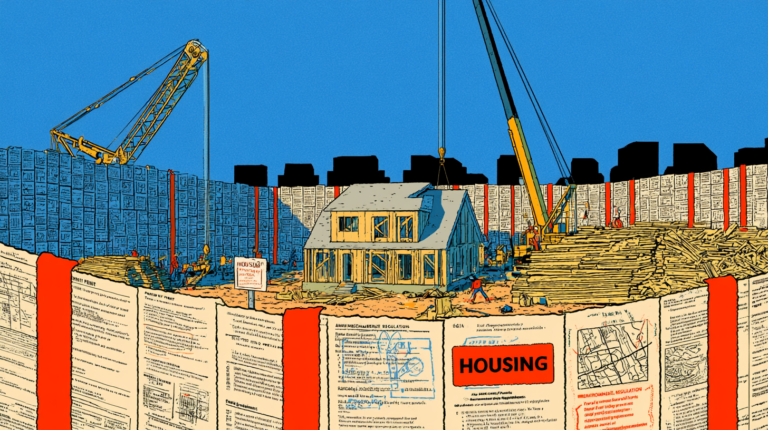
High housing prices stem from government barriers to construction, not from investors buying homes. Zoning laws, environmental restrictions, parking requirements, historic preservation barriers, and NIMBY petitioners all make it so difficult to build that even big increases in prices fail to spur much construction. The end result is a doubling of housing costs.
That’s why there are virtually no institutional investors in the expensive metro areas of San Francisco, New York, and Los Angeles. People are fleeing the high housing prices of these regulation-choked cities. Investors, always a forward-looking bunch, see those dwindling populations and steer clear.
Los Angeles’s sluggish recovery after the Eaton Fire last year illustrates how burdensome these barriers can be: 18 months after the disaster, just 1% of the 13,000 homes destroyed have been rebuilt. Delay is unavoidable to a certain extent—the fire left some soil toxic—but time-consuming and expensive regulations needlessly keep thousands of lots vacant and their owners without a home. The “accelerated” approval process the city created to encourage recovery only applies to homeowners who want to rebuild exactly what was there. Any new build that alters the footprint, size, or use must endure fees and approval delays. These problems get many times worse if the owner dares to add more units to the lot, which is exactly the kind of denser construction that the undersupplied city needs most.
The City of Angels could’ve treated the disaster as an opportunity to reinvent its housing policy and cut out the myriad regulations that block construction. Deregulation would’ve attracted much-needed investment and sparked a boom that would’ve transformed its devastated neighborhoods into affordable housing examples for the rest of the country. It could’ve allowed markets to work. But the city instead chose the familiar snail’s pace of overregulation, and thousands remain displaced a year and a half after they lost their homes.
Government, not investors, is the root problem of housing prices. Rather than take on barriers to construction, politicians find it easier to blame Wall Street. America is short millions of housing units, and scapegoating won’t build a single one. We need more housing investment, not less.