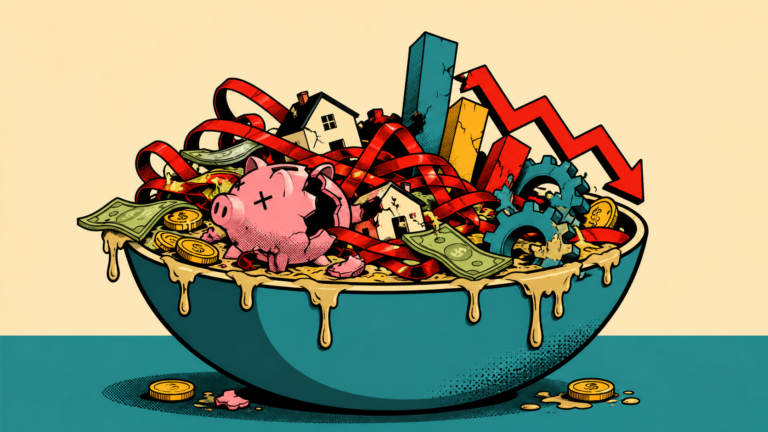

In the AI age, it becomes very easy to work by glancing. You prompt for something, a piece of code, a report, an image, and then you glance at the output rather than understand it, and the glance is enough to send you prompting again, often without truly knowing what is right or wrong in what you just saw. Glancing burns tokens without ever producing the answer you were looking for. Glancing leads to AI slop.
In economic policy, the same glancing produces “slopnomics”: policies that look like they make economic sense at a glance, because the glance only reaches the shallow zero-sum layer of the mind, when what they need is the deeper positive-sum training. Many of us have inevitably trained ourselves to detect AI slop from a mile away. We also need to train ourselves to detect slopnomics.
Now, slopnomics is not new. The whole point of Economics in One Lesson was to be its antidote. Hazlitt asks readers to keep tracing the consequences of an economic action across time and social space. Go back further, and you find Bastiat, in the 1840s, building humorous thought experiments that pushed proposed policies to their logical extreme so that readers could see, through exaggeration, what those policies would actually do. By taking a magnifying glass, Hazlitt and Bastiat were exposing the political flaws hiding in normal scale. They’ve been asking us to stop glancing.
Noah Smith recently pulled a Bastiat. The case in point is a recent New York proposal requiring a 10% discount for self-checkout compared to human cashiers.
You can feel the anti-economic thinking here: “Stores profit more from self-checkout, and this is why they favor machines over human cashiers. So let’s punish them by capping what they can charge in the machine lane!”
Noah’s move was to imagine an extreme version of the policy so that readers would understand “that the bill would actually make grocery stores fire human cashiers in favor of more self-checkout.” Instead of 10%, he asked us to imagine a 90% mandated discount.
At a 90% discount, no one would ever queue for a human cashier again. Everyone in the store would line up for a machine, and the staffed lanes would sit empty. The store would then have every incentive to expand checkout capacity by removing the remaining cashiers and installing more machines. If it refused, a competitor would open an all-machine store next door and take its customers. This is a pro-unemployment policy.
The 90% version also raises the obvious question: How could a store possibly afford that discount? The same way it affords a 10% one. By raising the price on the tag until the discounted price lines up with what the store needs to cover its costs. Grocery margins are razor-thin, barely moving above 2%. The way stores afford any discount—senior, student, veteran, coupon, or otherwise—is by setting list prices so that the average price actually paid still clears that hypercompetitive margin. What seems to be a gift from the store is just a redistribution among shoppers.
Notice that in this self-checkout case, you barely need the long-run analysis. Even the immediate consequences fail. But the exaggeration is what makes them visible, because the 10% version was calibrated, like all good slop, to survive one’s glance.
But how does slopnomics survive? Will it survive? Well, the rise of the Democratic Socialists, promoting rent freezes from New York outward, is a good measure of how much dry foliage is lying around for the slopnomics fire to catch. Part of this is psychology. Zero-sum thinking comes naturally to a tribal brain and has to be trained out. Part of it is ideological. Zero-sum thinking gets actively promoted by politicians and intellectuals, and then hardens into anti-economic thinking in the public.
Anti-economic thinking takes many forms, from socialism to central planning to protectionism to inflationism, but it usually comes down to a few basic fallacies that deny the premises of economics. Its most recent shape is affordability socialism: the attempt to fight a bottleneck economy that makes housing, energy, and other essentials expensive by creating… new bottlenecks. From price caps on rent to price mandates at checkout, affordability socialism will be the great slopnomics factory of the near future, because it takes a real grievance and routes it through the zero-sum default rather than through the question of why supply is constrained.
So, are you trained to detect slopnomics? When you saw the news about the 10% self-checkout discount, did your brain trace the consequences? (Beyond the reflex that it is coercive interference in a private business.) We will have to train young people to do this, to neutralize anti-economic thinking with real economic thinking.
The good news is that slop detection is a trainable skill. Exposure plus attention has helped us detect AI slop. So it is on us to train our eyes and our brains to detect slopnomics, the way many of us can now spot AI slop writing or images from a mile away.
Part of the answer is to teach more Bastiat, Hazlitt, and writers like Noah Smith to younger audiences.
Another is to use AI tools to pull a Bastiat, that is, to model the consequences of bad policy (and it is fitting that it comes from the same technology that gave us slop). Our hackathon this past June did exactly that. The winning team of college students built a small but sophisticated simulation in which AI agents act as economic agents, trading, producing, and exchanging with some degree of autonomy. You can then press buttons to activate policies from a menu, slopnomics included. You can click to impose a price control and watch the consequences propagate: incomes fall, measured satisfaction drops, and the agents drift into a black market to complete the trades the policy tried to prevent.
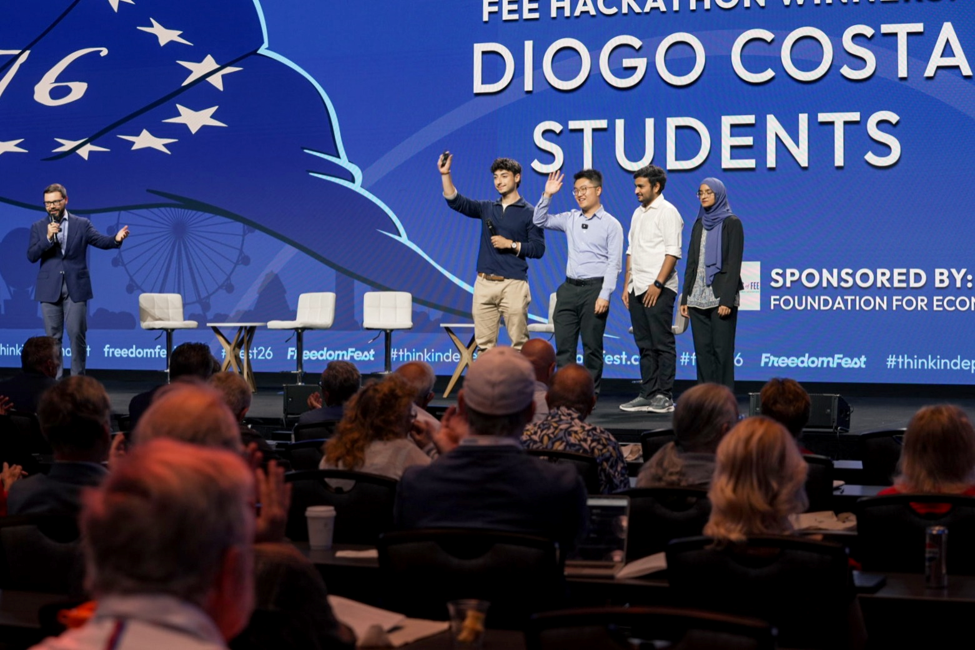
One student on the winning team told us afterward that the simulation had convinced him of the harms of affordability policies he had previously supported, some of which he had never really thought through. He simply ran the simulated policy, looked past the initial glance, and saw the consequences unfold.
That is the work. Bastiat wrote parables, Hazlitt wrote the lesson, a new generation is building simulations. The medium changes, but the assignment is the same one it has been for two centuries: look beyond the glance, and make the unseen seen.