
Europe’s timber powerhouse under threat.
Poland is one of the most dynamic and promising economies in the European Union. With GDP growth of 3.6% in 2025 and forecasts pointing to 3.7% in 2026, the country continues to establish itself as one of the continent’s engines of growth.
However, there is a European regulation threatening one of the sectors that contributes most to this success: the timber and furniture industry.
The Polish timber and furniture sector is made up of around 32,000 companies employing approximately 196,000 workers, the vast majority of them SMEs. Polish manufacturers account for roughly 19% of the European Union’s furniture exports, frequently ranking as either the largest or second-largest exporter in Europe. This sector is primarily based on small and medium-sized family-run rural businesses, unlike in other countries where production is more concentrated in large corporations.
The EU Deforestation Regulation (EUDR) will penalize these companies with bureaucratic requirements that are impossible to comply with at low cost. Although the EUDR affects several Member States with strong forestry traditions, such as Austria, Sweden, Finland, Romania, and the Baltic countries, Poland is among the most heavily impacted because of the enormous weight of its sector and its dependence on rural family-run SMEs.
This regulation is part of the European Green Deal, the broad package of policies intended to make Europe the world’s first “Net Zero” continent by 2050. In the name of this utopian ambition, measures are being imposed that reveal a disconnect from, and even disregard for, economic reality.
The EUDR was created to ensure that products placed on the European Union market, or exported from the EU, do not contribute to deforestation or forest degradation, either in Europe or elsewhere in the world. To achieve this, companies are required to prove that the product did not originate from land deforested or degraded after December 31, 2020, that it was produced in accordance with the legislation of the country of origin, and that it complies with a due diligence declaration. Companies must provide precise geolocation data, through GPS coordinates, for each plot of origin, carry out a full risk assessment, and submit an official declaration through the EU system.
The implementation of this regulation has already been postponed twice, creating persistent uncertainty, a factor that is itself problematic for producers. Initially scheduled to enter into force at the end of 2024, it was postponed to December 2025 and, more recently, to December 30, 2026, for medium and large companies, and June 30, 2027, for micro and small enterprises.
Although the European Commission has proposed simplifications and extended deadlines for micro and small businesses, a complete exemption of SMEs from the scope of the EUDR has never been considered, as highlighted by Polish MEP Marcin Sypniewski (ESN) in a written parliamentary question to the European Parliament. He pointed out that it is impossible for small and medium-sized enterprises to remain unaffected by the regulation, since they often operate as subcontractors for larger companies that require the maintenance of full documentation.
Large corporations are better equipped to absorb the high costs imposed by these requirements.
Polish SMEs, however, are unable to bear these costs, and it is foreseeable that many will have to reduce activity, lay off workers, or even shut down entirely, leading to greater market concentration in the hands of large corporations. With less competition and less diversity among producers, prices are likely to rise for consumers.
This regulation, blind to differences between national realities, ignores the fact that Poland does not represent a sustainability risk and is, in fact, one of the most sustainably forested regions in Europe. Around 29.6% of the country’s territory is covered by forests managed to exemplary standards and supported by high reforestation rates. Since the end of the Second World War, forest coverage in the country has increased by nearly 10%. (Germany, by contrast, has lost 12% of its coverage just since 2000.)
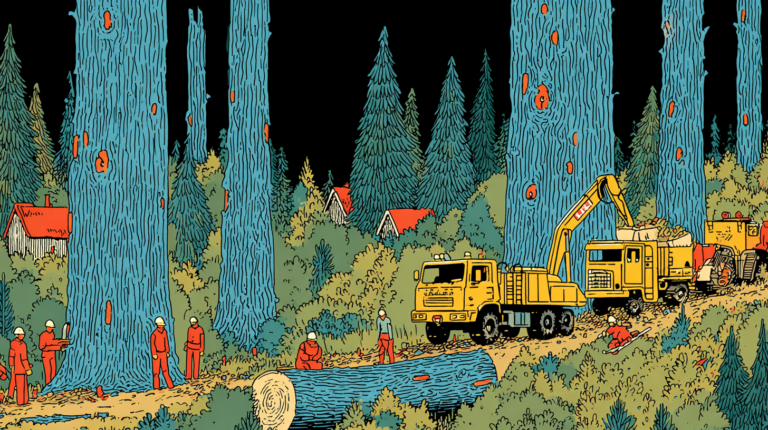
Approximately 500 million trees are planted in Poland every year, and forest regeneration is mandatory after any logging activity. Timber harvesting represents only 60% of the natural annual growth of forests, meaning the risk of net deforestation is virtually nonexistent.
Economies that depend on their natural resources have direct incentives to manage them sustainably, because their own economic prosperity depends on it. Poland understands that destroying its forests would mean destroying a significant part of its industry, employment, and exports, which is why it has maintained effective forest management practices that preserve timber stocks.
Countries should be responsible for managing their own resources, since their prosperity ultimately depends on whether those resources are managed well or poorly.