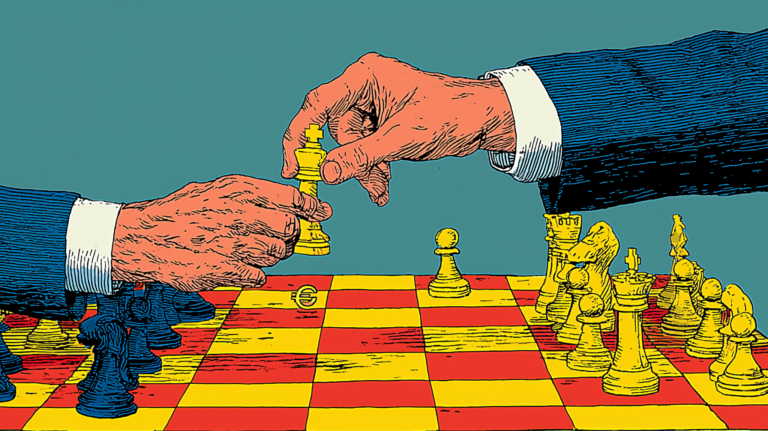

Spain is desperate to win the next presidency of the European Central Bank.
Luis de Guindos escaped Spanish politics just in time. In March 2018, he stepped down as Economy Minister, having served under prime minister Mariano Rajoy since 2011; three months later, Rajoy was ousted in a no-confidence vote, his Popular Party engulfed in a huge corruption scandal. De Guindos, now 66, has spent the last eight years as Vice President of the European Central Bank (ECB), the institution responsible for maintaining price stability throughout the bloc. He hands over to Croatia’s Boris Vujĉić at the end of this month, leaving Spain without representation on the ECB’s six-member board for the first time in several years, a situation that Madrid is determined to rectify.
Under the Socialist leadership of Pedro Sánchez, Spain has emerged as one of the strongest voices in the EU. Sánchez’s opposition to Israel, Donald Trump, and the Iran War have made him a darling of the international left, a position he consolidated in April by hosting a summit of leftist leaders in Barcelona. (Sánchez is much more popular abroad than he is at home, where his government is drowning in corruption allegations—much like Rajoy’s was in 2018, when Sánchez forced him out.)
Economically, too, Spain is a frontrunner. Its economy has consistently outperformed EU averages over the last few years, and in 2024 was named the best in the world by The Economist. Spain’s tourism industry is a global superpower, generating 13% of the country’s GDP, and its banks and energy companies, especially those in the renewable sector, are amongst the biggest on the planet. Madrid is looking to match this economic and diplomatic clout with a formal EU appointment, preferably in the bloc’s most powerful financial institution.
Although Spain held the rotating presidency of the Council of the European Union for the fifth time in 2023, it now strives for something more than a symbolic position. Amazingly, this EU institution exists alongside both the European Council and the Council of Europe. Its presidential country is tasked with chairing a thousand meetings in six months, proving beyond question that the EU could cut back on both councils and meetings. Spain last performed this tedious administrative role under the slogan “Europe, closer together”; but because neutrality is required of the presiding nation, there was hardly any scope to influence policy.
Spaniards currently occupy two big roles within the EU. Nadia Calviño, Economy Minister under Sánchez between 2018 and 2023, has been president of the European Investment Bank since January 2024; and Teresa Ribera, formerly Spain’s Minister for Ecological Transition (also under Sánchez), was appointed the EU Commission’s Vice President and Commissioner for Climate and Competition at the end of that year. Yet neither of these positions provides Spain with the opportunity to shape eurozone policy for the best part of a decade (ECB terms last for eight years). To do this, Madrid must secure one of three ECB positions that comes up for renewal before the end of next year—including the presidency, which since 2019 has been occupied by France’s Christine Lagarde.
De Guindos, who will move to a less pressurized role as Professor of European Political Economy at the University of Comillas, is “convinced” that Spain will secure new representation at the ECB. According to a poll conducted by the Financial Times, former Bank of Spain governor Pablo Hernández de Cos, who sat on the ECB’s governing council between 2018 and 2024, is the frontrunner in a “tight” race for the presidency. Joachim Nagel, president of the Bundesbank, is second, followed by Klaas Knott, former governor of the Bank of the Netherlands, and current Bank of France governor Francois Villeroy de Galhau. Spain’s Socialist economy minister Carlos Cuerpo has already said he will not be contesting an ECB seat, without explaining why.
Appointment to the ECB presidency does not just depend on professional qualifications, although the final candidate must face questioning by the Committee on Economic and Monetary Affairs. It is also an intensely political matter, requiring the support of 16 of the 21 countries in the Eurogroup. This leaves plenty of room for ideology, personal grievances, and partisanship to influence the selection procedure—and Spain has scores to settle.
During the Socialist leadership of José Luis Rodríguez Zapatero from 2004 to 2011, Spain had hardly any EU influence. One commentator partly attributed this period of silence to the prime minister’s provincial perspective: “[Zapatero] seldom travelled before rising to high office and is not competent in any foreign language.”
Things didn’t get much better under Zapatero’s Conservative successor. Like his predecessor, Rajoy was uneasy on the international stage and focused almost entirely on domestic politics. In 2012, Spain failed to secure a seat on the ECB board, in a battle triggered by the expiration of José Manuel González Páramo’s term. When Yves Mersch was nominated by Luxembourg as a replacement in January, the European Council tried to fast-track his appointment, claiming that the ECB couldn’t have a senior post vacant in the middle of a debt crisis. But the EU Parliament objected, on the grounds that more women were needed in the top jobs. Spain followed, claiming that there had been insufficient discussion of Mersch’s suitability (and obviously because it wanted another Spaniard to replace him). Mersch was eventually appointed in November, after the longest battle over an EU post in the bloc’s history.
Three years later, Madrid tried again. De Guindos, who in 2015 was halfway through his stint as Economy Minister, ran for the presidency of the Eurogroup, the monthly meeting of the (now 21) finance ministers whose countries use the euro. He was eventually defeated by his Dutch counterpart Jeroen Dijsselbloem, whose bailout negotiations with Greece won the admiration of his peers. Spain competed for the post again in 2020 with Calviño, a former EU executive supported by France, Germany, and Italy. Initially a favorite, she was beaten by Ireland’s Paschal Donohoe, who had the backing of several smaller nations as well as the European People’s Party, the biggest group in the EU parliament. Cuerpo, Spain’s current economy minister, tried briefly last year, but withdrew due to lack of support in a predominantly center-right Eurogroup (he was also beaten by Donohoe, who was elected to a third term but resigned shortly afterwards to take a senior role at the World Bank).
These defeats have made Madrid even more hungry for representation within the EU’s financial leadership. No longer a silent European partner as it was under Zapatero and Rajoy, Spain seeks a weighty role that corresponds to its present-day prominence. Winning the ECB presidency would not only achieve that goal; it would also make up for all those times a Spaniard lost the race.