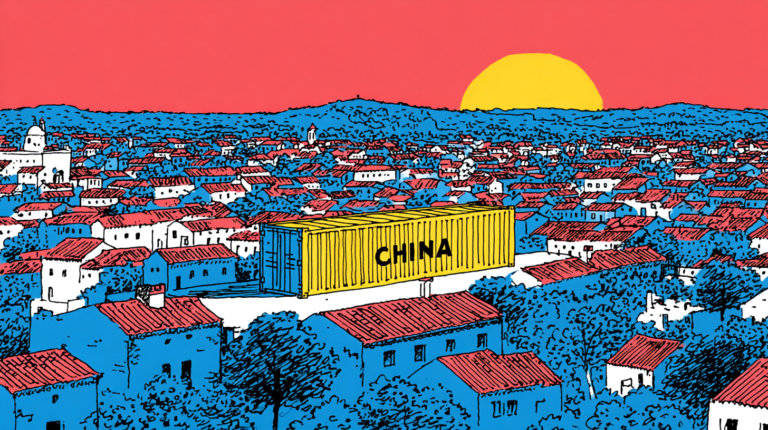

Spain is the latest nation to court China’s markets.
Despite US Treasury Secretary Scott Bessent’s warning that anyone seeking stronger trade ties with Beijing would be “cutting their own throat,” Donald Trump’s weaponized tariffs are causing many countries to seek closer relations with China. There has been a barrage of diplomacy in the first few months of 2026, especially from European leaders concerned about the effects of Chinese competitiveness on domestic industries. French president Emmanuel Macron, who visited Xi Jinping last December, said that European trade and industry faced a “life-or-death moment,” and that its future depended on more balanced trade relations with the world’s largest manufacturing country.
The latest European leader to visit Beijing, between April 11 and 15, was Spain’s Socialist prime minister Pedro Sánchez. The Spanish premier’s meeting with Xi Jinping was the fourth in as many years—and trade was top of the agenda. In 2025, exports from Madrid to Beijing exceeded imports by €40 billion, a deficit described by Sánchez as “unsustainable.” His visit was part of a broader strategy to reduce the EU’s €360 billion trade deficit with China. Although the two leaders apparently agreed on measures to improve Madrid’s imbalanced relationship with Beijing, no concrete details have been released.
Aware of Sánchez’s hostility to Trump, Xi also used their meeting to make several indirect hits against the US president. Praising the Spanish premier for his “moral rectitude” (even though two former members of his inner circle are currently on trial for corruption), Xi said that tighter trade ties between Europe and China would “benefit their [respective] societies and also contribute to the stability, peace, and prosperity of the world in this delicate international climate.” Any country aligning itself with Beijing, he claimed, would find itself “on the right side of history.”
Spain already has a strong foundation on which to develop stronger ties with China, its biggest trading partner outside Europe and the world’s third-largest consumer of Spanish olive oil, behind the US and EU. Sánchez’s last visit to Beijing was in June 2025, as the two nations celebrated the 20th anniversary of their strategic comprehensive partnership. Agreements reached then included the export of Spanish cherries to China for the first time and an expansion of the Chinese market for Spanish pork products, which already accounts for 20% of Spain’s pork exports. Renewables is proving to be another lucrative sector for Madrid. The Chinese battery manufacturer CATL has partnered with multinational automobile company Stellantis to construct a €4.1 billion ($4.3 billion) lithium iron phosphate battery plant in Zaragoza in Northern Spain, due to open by the end of this year. More investments on this scale will be needed if Madrid is to close its €40 billion trade gap with Beijing.
The leaders of Ireland, Canada, Finland, and the UK have also visited Beijing this year, seeking stronger economic relations amidst a world order that China’s leader claims is “crumbling.” Wary of causing diplomatic rifts while they try to attract Chinese business, none have challenged China on human rights issues. Perhaps they also remember a 2021 speech in which Xi stated that any country attempting to “bully, oppress, or subjugate” China would have its head “bashed bloody against the great wall of steel.”
In early January, Micheál Martin became the first Irish premier to visit Beijing in almost 15 years. After a series of what he called “positive engagements” with Xi and his premier Li Qiang, Martin secured the reopening of the Chinese market to Irish beef, after a suspension in September 2024 due to an isolated case of BSE. Ireland’s prime minister also pressed for greater cooperation in renewables and research, in order to reduce a trade deficit of €376 million.
Next up for Xi was Mark Carney, the first Canadian premier to land in Beijing since 2017. Ignoring a request from Human Rights Watch to focus on humanitarian issues, Carney also homed in on trade. Operating in what he calls a “new world order,” he wants Canada to double its non-US exports over the next decade (currently, 70% of Canadian exports go to the US). A draft deal between Carney and Xi would permit 49,000 Chinese electric vehicles into Canada and reduce tariffs on Canadian canola, lobsters, and peas. Trump’s reaction to the agreement has been characteristically schizophrenic: though describing it as a “good thing,” he has also threatened Canada with 100% tariffs if it follows through.
Visiting China towards the end of January, Finland’s prime minister Petteri Orpo was told that his country could “swim freely” in China’s “vast” markets. His state visit was followed a few days later by that of the UK’s prime minister Keir Starmer, the first by a British premier since 2018. It yielded concrete results, despite Trump’s warning that it was “very dangerous” for Britain to do business with Beijing: a four-year investment by AstraZeneca in China worth $15 billion, a 50% reduction in Chinese tariffs on Scotch whisky, and visa-free travel for British citizens in China up to 30 days.
Human rights organizations will no doubt be angry that none of these leaders tried to leverage political change in China as part of their trade negotiations. But there is an argument that open trade itself has significantly contributed to the liberalization of Chinese society, beginning with the open-door policy initiated by Deng Xiaoping in 1978. On this analysis, the gradual opening up and privatization of the economy has resulted in greater personal freedom, especially in China’s rural areas, where the return of household responsibility (baochan daohu) has released millions from servitude to the state. Private companies now account for around 60% of China’s GDP and 90% of new jobs. Even in a state as repressive as Communist China, it seems, open trade can chip away at governmental control.
The EU leadership itself still has a fraught relationship with Beijing, after hiking tariffs on Chinese electric vehicles in late 2024 (a move that Spain opposed). But this might change now that several member states are pursuing unilateral trade agreements with China, driven east by increased US protectionism. They have realized that the best way to reduce their trade deficit with Beijing is not to impose punitive sanctions, but go on the hard sell—increase the exports rather than limit the imports.