


Ambition cannot replace realism.
In 2020, the European Union launched its Green Deal. Six years later, investments in hydrogen-based projects have collapsed, and electricity prices are twice as high as in the US and China. Europe is losing its competitive edge. In our research for the Institute of Economic Affairs, we identify eight reasons why the EU Green Deal is not working. In doing so, we draw policy lessons for the United Kingdom.
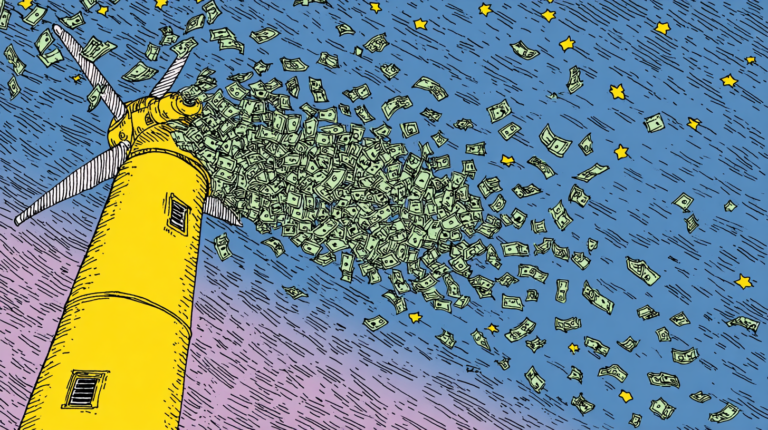
In December 2019, the European Commission presented the Green Deal as a historic project. Europe would become the world’s first climate-neutral continent while strengthening its industrial base. Six years later, the picture is considerably bleaker. Electricity prices for industrial customers are about twice as high as in the US and China, several large-scale hydrogen projects have been postponed or cancelled, and the EU’s global competitiveness continues to weaken.
This development is not surprising. The green deal marks a clear break with traditional environmental policy, which has historically been based on emissions pricing, technology neutrality and incremental improvements. Instead, the EU has embraced a mission-oriented industrial policy in which the policy identifies winning technologies, sets detailed sectoral targets and channels large resources to selected projects and companies.
In a new collective volume—“The Green Entrepreneurial State? Exploring the Pitfalls of Green Deals”—we, together with 17 other researchers, analyse the green agenda from both a theoretical and empirical perspective. The conclusion is clear: green industrial policy suffers from structural problems; therefore, it rarely works as intended in practice.
First, the policy attempts to solve complex, systemic challenges with tools that require overview, control and predictability. But climate and energy systems are characterised by uncertainty, rapid technological development and global dependencies that cannot be controlled from above through roadmaps drawn by politicians. Germany’s Energiewende is a cautionary example: A politically motivated nuclear phase-out has contributed to high electricity prices, continued fossil fuel dependence and weakened industrial competitiveness.
Second, the green agenda ignores the fact that politicians and authorities are not neutral social planners but are influenced by self-interest, emotional narratives and special interests. The result is rent seeking, clientelism and support for projects that are politically attractive rather than socio-economically valuable. Europe’s investments in hydrogen, steel and battery production are stark illustrations of this problem.
Third, competition is distorted. When certain technologies—such as hydrogen, wind power or specific industrial projects—receive extensive support, the market’s decentralised selection process is undermined. Technologies that are not socio-economically viable are kept alive, while alternative solutions are squeezed out. This is exacerbated by the fact that system costs, grid expansion and storage requirements are often ignored in decisions.
Fourth, government risk-sharing increases moral hazard. When taxpayers bear a large part of the downside, the incentives to take excessive risks become stronger. Experience from several green mega-projects shows that technological optimism is often combined with a lack of cost control.
Finally, behavioural economic mechanisms play a central role. Climate policy has typically been couched in alarmist terms where threats are exaggerated and opportunity costs downplayed. In such a “loss framing,” even very risky and expensive projects become politically rational, despite the uncertainty of their benefits.
This does not mean that climate policy should be abandoned. On the contrary, history shows that well-designed environmental policy can be effective. The EU’s carbon dioxide emissions have fallen sharply since 1990, while the economy has grown and the emissions of several hazardous air pollutants have been almost eliminated. These successes have been achieved mainly through pricing, technology neutrality and gradual improvements—not through large-scale industrial policy.
Against this background, the EU’s climate strategy should be revised. Instead of detailed regulation and technology selection, the policy should be based on two principles: a uniform and comprehensive emissions trading system and strict technology neutrality. A well-functioning price on emissions gives companies incentives to find the most cost-efficient solutions themselves. Targeted subsidies and sectoral targets should be phased out, and complementary support—where justified—should be time-limited, competitive and carefully evaluated.
The EU’s Green Deal was launched with great ambition. But ambition cannot replace realism. Without a reorientation, Europe risks continuing to combine high climate policy costs with weak climate benefits—thus losing both industrial competitiveness and public support for climate policy.