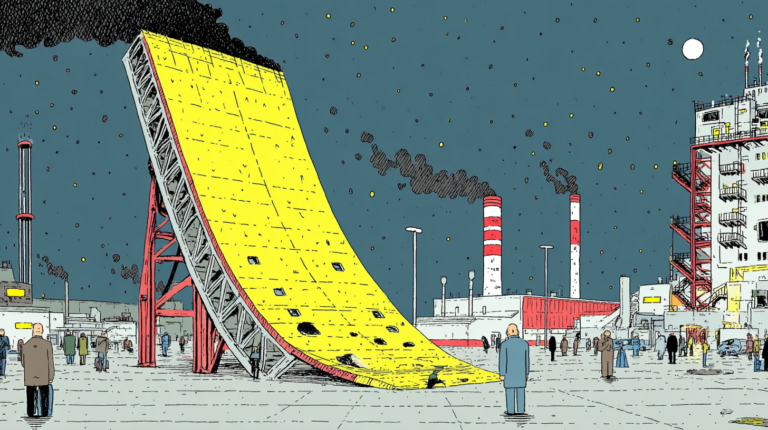

In the final analysis, the sector will either be competitive or it won’t.
The Government’s approach to the UK’s steel industry has always looked like a cross between inveterate, unshakeable optimism and the panicked thrashings of a drowning man clutching for a flotation aid.
An extremely charitable observer would argue that the Government had always had a very clear aim: to preserve Britain’s steel industry in order to safeguard employment in the sector and to provide resilience in manufacturing a product vital for growth and security.
A more cynical mind might counter that someone who makes a wish as a penny is flipped down a well has a very clear aim. Without a practical, sustainable and realistic plan to achieve that aim, such airy, wouldn’t-it-be-nice ambitions are politically worthless at best.
This week the Business and Trade Secretary, Peter Kyle, unveiled Labour’s latest gambit. From July, import quotas for tariff-free steel will be reduced by 60%, and imports above those levels will be subject to a 50% tariff. In other words, when facing a crisis, the Government’s response is protectionism.
It is not alone in this. The exclusionary regime brings the UK broadly into line with the United States, the EU and Canada. That does not necessarily mean it is the right approach, but we should not underestimate the challenge facing the Government. It had already agreed to provide £500 million towards the expected total cost of £1.25 billion of Tata Steel building electric arc furnaces at its steelworks in Port Talbot.
At the same time, under the Steel Industry (Special Measures) Act 2025, last April ministers took control of Jingye-owned British Steel and its steel plant at Scunthorpe to save it from imminent closure. That has come at an enormous cost: as of the end of January, the Government had spent £359 million in nine months on “working capital, covering items such as raw materials and salaries”—in other words, simply keeping the facility open. It is not difficult to see that figure rapidly reaching half a billion pounds.
Here is the fundamental problem. The Government is guided by a declaration of what it wants to be the case. As Kyle put it: “We are closing the decades-long chapter of destructive deindustrialisation and committing instead to strengthening and sustaining Britain as a steelmaking nation.”
That does not mean it is an achievable end. Fundamentally, as the United States Supreme Court has recently indicated to President Trump, tariffs are a form of taxation and sooner or later the financial burden will fall on the domestic consumer. Tariffs artificially insulate industry from the reality of market forces, which can drive up costs, discourage efficiency and act as a deadweight on innovation and progress. If the government is hobbling your competitors with financial levies, why try harder?
It is clear that the UK’s steel industry cannot compete on the global stage without state assistance—or, to use a less niminy-piminy phrase, taxpayer-funded subsidies. That means every taxpayer is being charged to keep the industry alive. Under those circumstances, it is necessary to ask why UK steel is uncompetitive, and whether it is right to keep the sector afloat artificially.
Business energy costs in Britain are among the highest in the world, and, especially with blast furnaces, steelmaking has a ravening hunger for energy. Tariffs do nothing to address that, but instead attempt to balance an existing disadvantage for the UK sector with a newly introduced artificial one for its competitors abroad. But this only levels prices upwards: it does nothing to make British steel more affordable or more efficiently produced, merely penalising the lower costs borne by foreign manufacturers (and, in some cases, offsetting the subsidies they are granted by their own governments).
The traditional counterargument is that steel has a particular strategic value and necessity in “defending critical industries and national security,” as Gareth Stace, Director General of trade body UK Steel, phrased it. This presupposes that the UK could in extremis find itself unable to import steel of the required kind, both for infrastructure projects and for defence programmes. It is an argument that has potency but is not a slam-dunk, and its acceptance begs another question: if we must retain a sovereign steel industry free from outside intervention, is there therefore no ceiling on what we must be prepared to pay for it?
This is not so much a strategy as a sticking plaster. Rather than address the reasons underlying UK steel’s relative inability to compete with international producers, the Government is heaping heavier costs on their overseas rivals in the hope it will lead to some kind of equilibrium. But in the final analysis, the sector will either be competitive or it won’t. If it is unable to compete on the world stage, for whatever reason, then we cannot adopt a goal—allowing it to survive financially—without some notion of the limits of that.
When means follow declaratory policy, it can become very expensive very quickly. After all, the declaration need not compromise: it sets a non-negotiable destination and demands that a route be found. But the Government is lurching from one holding position to another.
Every day, solely to make sure British Steel’s Scunthorpe plant does not close, we are spending more than £1.2 million. That is expensive stasis. But it is no more simplistic or extemporising than the rest of the Government’s steel strategy. This crisis will not pass simply by asking consumers to pay more, at however many removes it may be. Yet that appears to be the extent of Whitehall’s thinking. It is not enough.