
Smaller, more flexible learning environments are well-positioned to test new approaches, and can adjust as needed.
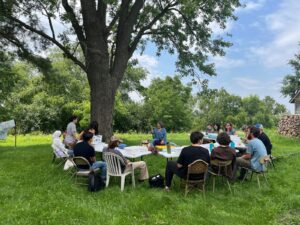
Perhaps you are a parent who wants your children to enjoy screen-free schooling, holding textbooks and pencils instead of Chromebooks, while connecting deeply with the physical world. In that case, an outdoor school network like Carolina Kids Co-Op, which I wrote about in my previous article, might be the best fit.
Alternatively, you might be a parent who recognizes the rapid advancement of artificial intelligence (AI) tools and platforms and wants your children to both master and benefit from these innovations. If so, fast-growing school networks such as Alpha School will likely appeal to you.
Or maybe you are somewhere in between, valuing a blend of high-tech and low-tech learning experiences in your children’s classrooms. “We’re unplugged and plugged in,” said Shiren Rattigan, founder of Colossal Academy in Fort Lauderdale, Florida, and its virtual counterpart, Colossal Online.
“You have to unplug. You’ve got to take a notebook out, to pick up a pencil again,” said Rattigan, adding that it’s crucial to leverage AI to enhance learning. “This is a technology that I believe is here to actually help humanity. Specifically in education, it’s allowing us to differentiate learning and really meet the learner based on their interest and skill level.”
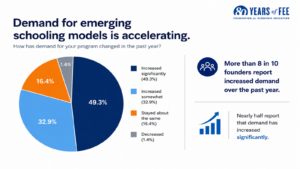
Rattigan, a former public school teacher who launched her middle school microschool in 2021, is among a growing group of educator-entrepreneurs creating a varied mix of schools across the U.S. The diversity of these schooling models, along with their increased financial accessibility due to the widespread expansion of school-choice policies, means that more families are able to select schools aligned with their distinct preferences and needs—including their views on AI in the classroom.
For those who want an AI and analog balance, creative schooling options like Colossal Academy provide a blueprint.
Rattigan is using AI tools such as ChatGPT to create individualized lesson plans and assist students with extra help on tricky topics, while also introducing her students to the latest AI technologies. She has partnered with another South Florida education entrepreneur, Angel Sobrino, who leads weekly lessons for Colossal students on AI tools and their cultural and ethical implications.
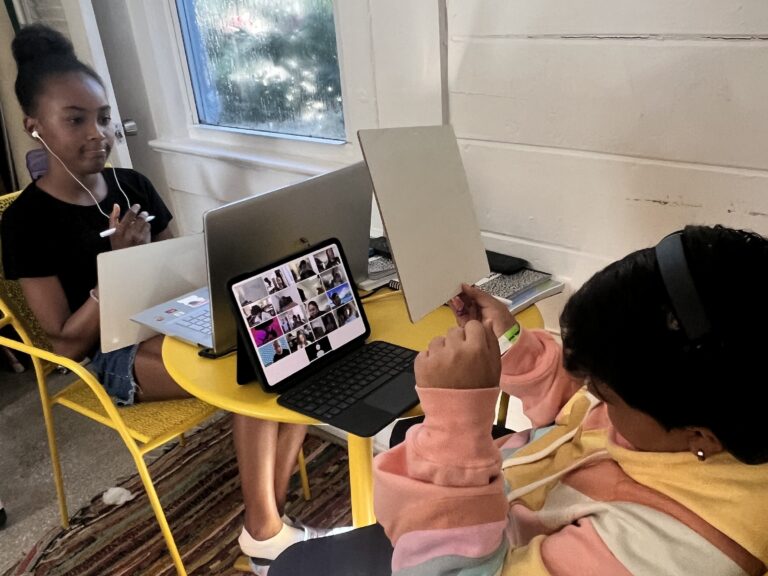
Sobrino is the founder of the homeschooling platform, The Hive Interactive, and its AI Tools Club, which offers live Zoom classes exploring cutting-edge AI technologies. A group of 15 Colossal Academy students meets weekly with Sobrino to learn about AI tools such as MidJourney, Canva Magic, ChatGPT and NotebookLM, while engaging in Socratic discussions about the use of AI. “What makes an idea truly original in the age of AI?” and “What is the most exciting and scariest thing about AI?” are examples of recent conversation prompts. Colossal students regularly present to their classmates on how they are using the AI tools they learn about in Sobrino’s class. For instance, one student recently created music using Suno, a generative AI music platform, and eagerly showed his classmates how to use the program.
Like Rattigan, Sobrino is a techno-optimist who believes that AI can enhance learning and improve a student’s overall educational experience. “AI isn’t replacing learning,” said Sobrino. “It’s replacing the friction that used to block learning.”
Colossal Academy is just one example of how today’s emerging schools are being intentional about integrating artificial intelligence and equipping students and teachers to use it effectively. At Acton Academy Red Rock in Las Vegas, Nevada, founder Amy Novak takes a slightly different approach.
“We actively use it as a tool, but learners have to be licensed prior to using it,” said Novak, explaining that this process of acquiring an “AI Driver’s License” takes about two weeks and mostly involves grappling with moral issues around AI use. Upon licensing, students can also receive an industry micro-credential from ProfAI. She adapted this licensing idea from Tobin Slaven, who leads Acton Academy Fort Lauderdale and is bullish on the potential for AI to transform K-12 education for the better by making it more learner-driven. Novak’s and Slaven’s schools are part of the popular Acton Academy network, which includes approximately 300 independently-owned and operated schools worldwide that empower learners to take charge of their education.
One reason today’s emerging schools are able to navigate artificial intelligence in creative ways is their agility. Unburdened by the bureaucratic constraints and curriculum pressures that many educators in traditional schools encounter, new school founders are able to respond quickly to the needs and interests of their students and families and pivot as needed. If a new AI tool seems promising, they can adopt it quickly without waiting for permission. Similarly, if it’s not adding value, they can drop it.
As AI tools evolve at a rapid pace, smaller, more flexible learning environments are well-positioned to test new approaches, develop school-based expectations for responsible use, and adjust as needed.
As educators and policymakers across the U.S. grapple with questions around AI use in schools, the bigger story is that parents are increasingly able to choose a school that reflects their personal views on AI in the classroom. In a more decentralized, entrepreneur-driven education landscape, families can select screen-free schools, tech-enabled programs, or thoughtful blends of both. What is right for one student or school may not be right for another, which is why boosting the supply of assorted schooling models and methods matters—particularly in the age of AI.