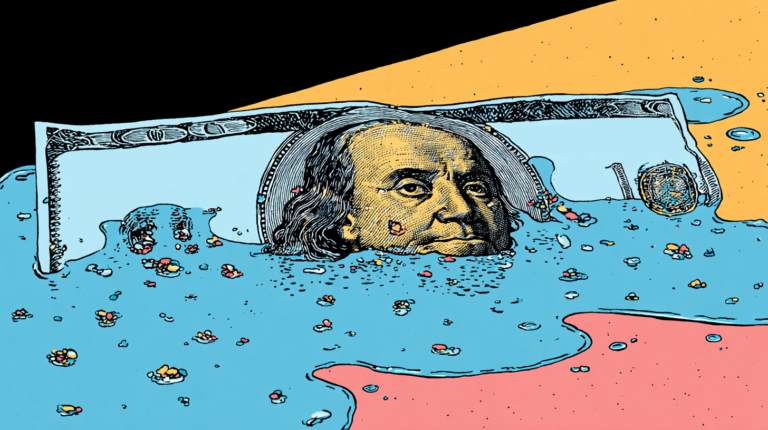

Can the dollar remain the world’s reserve currency?
On February 6, 2026, the Dow Jones hit a record level of 50,000. It was now 5 times its level in 1999 when it hit 10,000 for the first time. But how real has the increase been? In 1999, $10,000 would have bought you 40 ounces (oz.) of gold. In 2026, $50,000 buys you only 10oz. of gold.
The fact is that in 27 years, the dollar has lost 75% of its value.
The dollar has been the world’s reserve currency since the Bretton Woods agreement in 1944. It was backed by gold at $35 per oz. until President Nixon effectively ended the Bretton Woods system in 1971. Since then, the world has relied on fiat currencies, and had to trust the governments that control them. The dollar has remained the major currency for international trade; central banks have typically held most of their reserves in US Treasury bonds.
But it is under threat. As their US Treasury bonds mature, many central banks are not rolling them over; instead, they are replacing them with gold. The World Gold Council reports net purchases by central banks of over 4,000 metric tons for the 2022–25 period.
To put this in context, most of the gold ever mined is still in existence—estimated to be 216,000 metric tons. Central Banks currently hold at least 16.5%—36,000 metric tons.
In 1997, the Reserve Bank of Australia (RBA) sold two-thirds of its gold holdings (167 metric tons) for about AUD 2.4 billion—less than AUD 450 per oz. At the current price of over AUD 7,000 per oz. that represents a real-term loss of AUD 35 billion.
Key to understanding this is that the RBA sees its primary responsibilities as maintaining full employment and the stability of the currency. The use of monetary policy to maintain full employment is a throwback to Keynesian economics—the concept that unused labor should be soaked up by government projects funded by increasing the money supply.
Suffice to say, for the moment, that government projects do not have the entrepreneurial discipline to make the best use of scarce resources, have no measure of economic success, and are usually delivered late and over budget.
To meet its objective of maintaining the stability of its currency, the RBA aims to keep inflation in the range of 2% to 3%. If they were to achieve this objective, then the value of the currency would halve in each generation. If the RBA is successful in its policy, at an average of 2.5% inflation, one AUD will be worth about 50 cents in 28 years’ time.
That is not what I would call a stable currency. I would rather have one that was worth 100 cents in 28 years’ time. I would rather be able to write contracts without having to consider the currency risks. I would rather be able to save without having to consider how much I would lose from inflation. In practice, of course, central banks do not meet even their own arbitrary targets. Consequently, the value of the currency halves in fewer years. As we have noted, the dollar has lost 75% of its value in the last 27 years.
So, we have three reasons to be concerned about the RBA. Its judgement in managing our reserves was poor, and, unlike other central banks, it is not taking action to correct its mistakes. Its use of monetary policy to manage full employment is based on discredited economic theory. Its inflation objective is counter to its brief to maintain a stable currency.
It seems fair to ask, “Is it fit for purpose?”
Concern about the desirability of central banks is international. My colleagues at the Mises Institute in the USA have recently produced a documentary on the US Federal Reserve called Playing with Fire: Money, Banking, and the Federal Reserve.
Under a gold standard, money is supported by tangible assets. Fiat currencies are not backed by tangible wealth—only by a promise to pay out of future tax revenues. The temptation to print more is too much for any democratic government. Consequently, inflation becomes a permanent debilitating feature of the economy.
A devaluing currency favors some citizens and disadvantages others. It favors borrowers over lenders. It favors those who have assets—property, shares, gold, works of art—but it disadvantages those whose livelihood depends on their wage or pension.
Thus the inequity and the inequality. If government uses monetary policy to fund welfare spending, they create inflation which devalues the currency and makes those on welfare poorer.
Moreover, a devaluing currency discourages saving, meaning that there will be less capital formation and fewer opportunities for improvements in productivity. The nation will be poorer.
There are also negative social effects. Civilization flourishes when citizens take a long-term view of life—when they focus on future satisfaction rather than instant gratification. Economists refer to this as having a “low time preference.” When most citizens have a low time preference, we are able to create pleasant, free, and affluent societies.
Economically, when we forego consumption and save for the future, we accumulate capital that entrepreneurs can use to fund projects that make work more productive. Individually, we build a financial buffer that will enable us to cope with hard times. We become more independent.
Socially, being a good citizen becomes important. We look after relationships and value our reputation. We care for our children, pass on our values to them, and ensure that they have a good education and become good citizens.
Every few months, we sweat on the decision of the RBA board to reset the cash rate which is the basis for all interest rates in our economy. Is it ideal that a few experts make such a decision? Hayek in his essay “The Use of Knowledge in Society” argued that such expert groups cannot have all the knowledge necessary to make sound decisions. Specifically, they cannot have all the local and transient knowledge, and therefore such decisions are better left to the market. Then nuances understood by millions of people acting in their own best interests can be brought into play.
Instead of the RBA playing an authoritarian role, interest rates could be set by thousands of individual borrowers and lenders to suit each specific case. But to do this efficiently, they would need sound money—a currency which did not lose its value due to arbitrary, unfunded fiscal decisions.
A major flaw in modern democracies is that, in order to retain political power, parties must provide benefits to select groups of voters—not only pensions for the elderly and the unemployed, but also grants for the arts and sporting facilities, and subsidies for favored supporters. There are limits to how much of this can be provided by taxation without causing voter disaffection. So they resort to deficit spending. They borrow money by issuing government bonds. That is, they print money. They cause the inflation that their central bank then struggles to contain.
But a currency that governments cannot deflate puts limits on government spending. Many alternatives are being discussed. Most of them include some role for gold. The BRICS nations—Brazil, Russia, India, China, and South Africa—are considering a new currency comprising a mix of their fiat currencies and gold. A return to a gold standard is also a possibility.
Frequently, we are led to believe that the use of gold as currency is some quaint, old-fashioned idea. Not so. John D. Mueller in 2010’s Redeeming Economics wrote:
The essential requirement for restoring a stable international monetary system is that major countries agree to replace all official foreign-exchange reserves with an independent monetary asset that is not ultimately some particular nation’s liability. Many standards are possible in theory, but monetary authorities still hold nearly 900 million ounces of gold, and the simplest, most effective, most tested solution is a modernized gold standard without foreign exchange reserves.
John Mueller may be right. But you would also have to fight a powerful lobby from the institutions who currently profit from foreign exchange transactions.
Judy Shelton in her recent book Good as Gold suggests creating Treasury Trust Bonds which would give the holder, at maturity, either a guaranteed number of US dollars or a guaranteed amount of gold. These bonds would act as a control on government spending by signaling, via their market price, the extent of government-created inflation.
Personally, I would favor taking control of currency away from governments. Abolish legal tender. Allow citizens to trade in the currency of their choice. Let them choose the most stable.