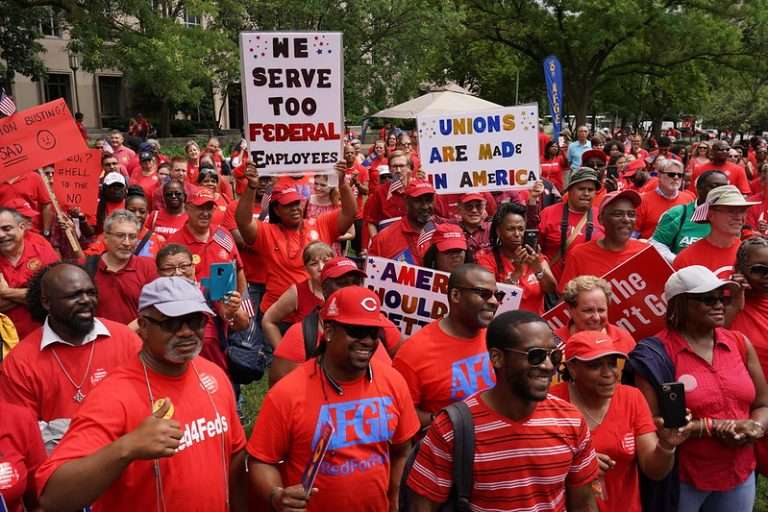

Most Trump voters probably weren’t expecting a staunch pro-union voice to be his Labor Secretary nominee.
In his 2020 presidential campaign, Joe Biden promised to unify Americans. However, any such unity with regard to labor policy quickly gave way to his self-characterization as “A union man. Period.”
Biden’s support for unions rather than all workers showed up most clearly in his support for the Protecting the Right to Organize (PRO) Act, which would help unions at the expense of the vast majority of American workers.
The PRO Act passed the Democrat-controlled House, but not the Republican-controlled Senate. Carl Horowitz said it would “dismantle virtually every existing safeguard against union monopoly in the private-sector workplace,” and Eric Boehm called it a “grab bag of policies that labor unions have been pushing Congress to pass for years,” to expand union special privileges at the expense of others.
Many thought that with Donald Trump’s election, the PRO Act would be revealed for the con job it is and disappear. But that is not so clear now. Trump announced Republican Rep. Lori Chavez-DeRemer of Oregon (who just lost her House seat in the 2024 election) as his Labor Secretary nominee. And she was not only one of a few Republicans to vote for the PRO Act; she was a co-sponsor, and is already supported by the Teamsters, who are “ready to work with [her] every step of the way to expand good union jobs,” and the NEA, for her positions “in stark contrast to Donald Trump’s anti-worker, anti-union record.”
Since unions are always promoting themselves under the banner of their freedom of association, that may be the place to start in evaluating the PRO Act, and the restrictions it would build upon, which few people understand.
Unions already deprive many Americans of their freedom of association. As the Supreme Court found in its Janus decision, unions impose a “significant impingement on associational freedoms that would not be tolerated in other contexts.”
Union “rights” already take away workers’ freedom to associate with a different union, to choose alternative forms of group representation such as voluntary unions, or to represent themselves in negotiations with employers. They remove workers’ freedom to associate with non-union employers or to resolve workplace issues directly with employers by forcing such arrangements exclusively through unions.
They erase employers’ freedom to not associate with unions or to solely employ workers who have no union involvement. They undermine consumers’ freedom to associate with lower-cost, non-union producers. They force taxpayers to pay more for government services as a result of government employee unions and Project Labor Agreements that require union terms and greater costs. In each of these ways, freedom of association is applied only as a special privilege for unions, denied to non-members.
In fact, unions violate the most basic freedom of association of many current union members. Many have never been given the right to vote on unionization, and those who might push for a new election are kneecapped by rigged rules.
Once a majority of the workers for an employer at a particular time vote to certify a particular union, it becomes the monopoly negotiator for all workers. No further elections need ever be held. So workers added after a union is certified need never be given a vote on the union, and those who voted for it need never be given a chance to reconsider. For example, no one who started work in GM’s Michigan plants since 1937 has voted to certify their union, and virtually no one who started work in government within the last half-century has either.
The PRO Act would exacerbate all those denials of workers’ freedom of association. It would repeal right-to-work laws—one of unions’ common targets—which a majority of states have to protect workers from being forced to join a union and pay union dues involuntarily (though there are some nuances regarding right-to-work and freedom of association, as discussed here and here). It would require employers to provide private employee information (including cell phone numbers, email addresses, and work schedules) to union organizers, violating the associational rights of those who don’t want to join or be approached by unions. It would allow unions to initiate snap elections in non-union workplaces more rapidly, limiting opponents’ ability to present opposing positions. And it would codify “card check” elections, eliminating the protections against union coercion provided by a secret ballot.
It would allow the NLRB to invalidate a vote against unionization for virtually anything it chooses to call “employer interference.” It would require contractors and franchisees to bargain with unions regardless of whether they have control over wages, benefits, etc., outlaw employment arbitration clauses, authorize “secondary boycotts” by unions against companies maintaining a business relationship with a target company, and more.
Far from benefiting all workers, advancing unity, unions actually create disunity not only by constricting workplace competition, but by denying many others their freedom of association. Further, those denied that fundamental right include many union members, whose interests unions are supposed to represent.
The PRO Act would add a cornucopia of new ways for unions to further advance their own interests at everyone else’s expense. That might make sense for Union Man Biden, but it does not make sense for all Americans or for Donald Trump. That makes his Labor Secretary pick a serious cause for concern, because you would be very hard-pressed to find anyone who was part of the Trump “landslide” who expected him to push for the same labor policy as under his predecessor.
Additional Reading:
Unions Are Clearly in the Wrong about Freedom of Association by Gary M. Galles
The Fundamental Problem with Unions According to Leonard Read by Gary M. Galles
The Three Faces of Unionism by Hans F. Sennholz