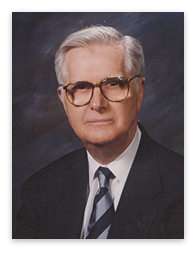
Dr. Peterson is the Burrows T. Lundy Professor of Philosophy of Business at Campbell College In Buies Creek, North Carolina.
Item: In 1977 Congress voted to increase Social Security payroll taxes. In 1978 this very same Congress seeks to roll back at least part of the increase.
Item: The Interstate Commerce Commission had on its books about 400,000 tariff schedules and 40 trillion rates telling the transportation industry what it might charge customers.
Item: A listing of all the new U.S. rules and regulations set in 1976 over business required 57,027 pages of fine print in the Federal Register.
Item: From 1955 to 1965 the money supply had grown at an annual rate of 2½ per cent. Since 1965 the money growth rate has averaged almost six per cent. The cost of living in each period, as measured by the Consumer Price Index, roughly rose apace.
Item: Government has long been usurping funds needed for private investment. Such investment in the U.S. in recent years, as a percentage of GNP, was the lowest of all industrialized nations, including the United Kingdom. At the same time approximately 70 per cent of the long-term capital funds available in private money markets was being borrowed by the Federal government and 80 per cent by government at all levels.
And so on ad infinitum.
This situation of government gone haywire devastatingly detailed in William E. Simon’s remarkable new book, A Time for Truth (Reader’s Digest Press [McGrawHill Book Company, 122]
Avenue of the Americas, New York, N.Y. 10036] $12.50)—brings to mind the observation of Thomas Paine that “government, even in its best state, is but a necessary evil; in its worst state, an intolerable one.”
A time for truth? Indeed, and a time to act. Former Treasury Secretary Simon, now president of the John M. Olin Foundation, chairman of the National Energy Foundation, vice chairman of Investing America National Council, and a trustee of Lafayette College and Georgetown University, tells why he came to write of America’s descent into what Mises called “planned chaos”:
It is my intention in this book to communicate the wider perspective that I acquired so traumatically in Washington . . . the reason for discussing economic issues is not to inspire a national passion for bookkeeping, but to inspire a national awareness of the connection between economic and political freedom. The connection is real and unbreakable. To lose one is to lose the other. In America we are losing both in the wake of the expanding state.
The dual question posed by Mr. Simon is: How did we get into this mess, and how do we get out?
He’s in a good position to answer the question. William Simon saw government at the highest policymaking level from the inside. He served as Secretary of the Treasury from 1974 to 1977. He also served as Deputy Secretary of the Treasury, 197374, and as chairman of the Economic Policy Board, the Federal Energy Office and the East West Foreign Trade Board.
So, how does government act? Well, from this “Inside Washington” view of things, consider how government responded to the energy crisis, in particular to the Arab oil embargo in the wake of the Yom Kippur War in October of 1973. Suddenly America was cut off from Arabian oil. The crisis was real.
Typically, the government didn’t act as much as it reacted. Congress demanded action. A centralized oil allocation process was quickly put together (Mr. Simon terms it a “disaster”). Oil price controls, already in place under President Nixon’s “New Economic Policy” of generalized wage price controls, were tightened (thereby compounding the crisis).
As head of a newly created Energy Policy Office, President Nixon appointed Colorado Governor John Love. But Governor Love on a weekend early in the crisis decided to go quail hunting with Interior Secretary Rogers Morton. Washington flipped. How could an energy czar attend to his pleasure when America was in dire straits of fast running out of oil? President Nixon dropped Governor Love like a hot potato and named William Simon as the new energy czar.
Mr. Simon’s free enterprise proclivities were manifest all right, but like King Canute he was unable to stop the interventionist tide. For example, in the face of media and political pressure for rationing, the President ordered rationing stamps printed and held in reserve. “Maybe that will shut them up,” he told his energy czar.
But it didn’t shut them up. Pressure increased for formal rationing, which the price controlled oil starved oil companies and gas stations practically resorted to anyway, pretty much without any specific government directive (though some states such as Oregon directed that motorists with even numbered plates shop for gas on certain days of the week, and motorists with odd numbered plates shop on other days).
Gas lines lengthened into two, three, four-hour waits. The centralized allocation system “kept falling apart.” Parts of New Jersey suddenly went dry, for example, while other parts had plenty of gas. Palm Beach ran out of gas, while stations ten miles away were well supplied. Tempers frayed across the nation, while domestic supplies and exploration lagged (and lag still) in the face of price lids and environmentalist harassment, which continue to this hour.
In a domestic interlude, Mr. Simon tells how his wife Carol reacted to public criticism during the Arab embargo. She did not want to be recognized. She stopped using charge plates that carried the name William E. Simon. She skulked around in a shawl and dark glasses. One night when Mr. Simon came home late, Carol Simon, normally a loving and cheerful woman, sprang at him and shouted: “Do you know how long I waited in the line? You have to do something!” Energy czar Simon groaned, “Et tu, Brute?”
Mr. Simon admits that he was “a rotten bureaucrat,” that he played the philosophically preposterous role of “William E. Simon, Invisible Hand,” that Congress displayed “extraordinary irresponsibility” in serving as supposedly selfless all wise economic planners.
He holds that today there is precious little public awareness of our flight toward destruction, toward what Mr. Simon calls “the New Despotism.”
Is there a way out?
Yes. A widespread reaffirmation of freedom and free enterprise is the Simon way, i.e., a return to the religion of human liberty, a broad based adherence to a set of guiding principles. Mr. Simon lays down those principles, one after the other:
• The overriding principle to be revived in American political life is that which sets individual liberty as the highest political value.
• There must be a conscious philosophical prejudice against any intervention by the state into our lives, for by definition such intervention abridges liberty.
• The principle of “no taxation without representation” must again become a rallying cry of Americans. Only Congress represents American voters, and the process of transferring regulatory powers—which are a hidden power to tax—to unelected, uncontrollable, and unfireable bureaucrats must stop.
• A critical principle which must be communicated forcefully to the American public is the inexorable interdependence of economic wealth and political liberty.
• Bureaucracies themselves should be assumed to be noxious, authoritarian parasites on society, with a tendency to augment their own size and power and to cultivate a parasitical clientele in all classes of society.
• Productivity and the growth of productivity must be the first economic consideration at all times, not the last. That is the source of technological innovation, jobs, and wealth.
• This means that profits needed for investment must be respected as a great social blessing, not as a social evil, and that envy of the “rich” cannot be allowed to destroy a powerful economic system.
• The concept that “wealth is theft” must be repudiated.
• Conversely, the concept that the absence of money implies some sort of virtue should be repudiated.
• Similarly, the view that government is virtuous and producers are evil is a piece of folly, and a nation which allows itself to be tacitly guided by these illusions must lose both its liberty and its wealth.
• The “ethics” of egalitarianism must be repudiated. Achievers must not be penalized or parasites rewarded if we aspire to a healthy, productive, and ethical society.
• The American citizen must be made aware that today a relatively small group of people is proclaiming its purposes to be the will of the People. That elitist approach to government must be repudiated.
With a preface by Milton Friedman and a foreword by F. A. Hayek—both Nobel Laureates—this book is a roadmap charting a route away from tax and tax, spend and spend, cradle to the grave insecurity. William E. Simon points the way to a critically needed American Renaissance.