
Tom Stoppard, RIP.
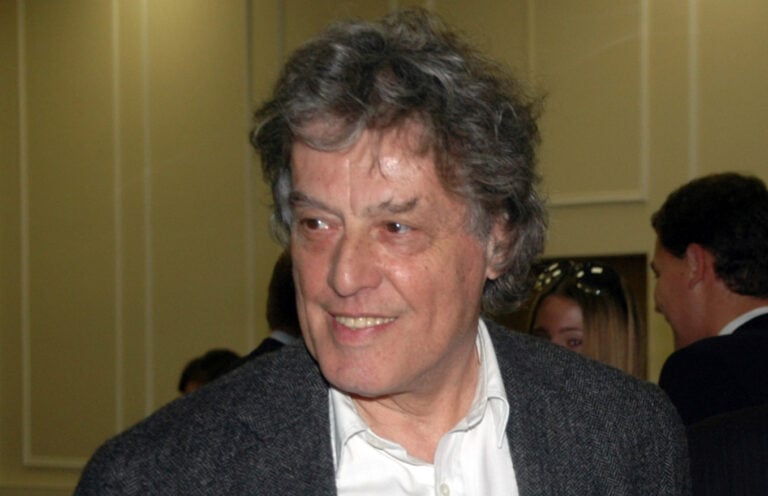
Tom Stoppard died on Saturday, November 29th, at 88. Some would call him a scholar’s playwright, due to his allusions and philosophical meditations. When my friend Pedro Sette-Câmara introduced me to his work, I was pursuing graduate studies in New York. The Coast of Utopia was premiering at Lincoln Center, and I couldn’t find an affordable ticket to see it. Instead, I read his trilogy in book format.
Partially because of my studies in political philosophy at the time, I started to see in his work the themes related to human freedom and human knowledge, as well as the forces that threaten them.
The Coast of Utopia is, in many ways, a dramatic rendering of Isaiah Berlin’s Russian Thinkers, a collection of essays on Alexander Herzen, Mikhail Bakunin, Vissarion Belinsky, and Ivan Turgenev that constitutes a meditation on the birth of the Russian intelligentsia. I was reading Berlin at the time I read Stoppard, and I found in his writing Berlin’s intellectual history made flesh. Later I saw that Stoppard acknowledged his debt explicitly: “Isaiah Berlin is an author without whom I could not have written these plays.”
What Stoppard found in Isaiah Berlin was a framework for understanding freedom that cut against the grain of revolutionary idealism. Berlin drew a famous distinction between negative and positive liberty: freedom from interference versus freedom to achieve some higher self or collective goal. In The Coast of Utopia, Bakunin dreams of a freedom that will arrive after the revolution, when the old order has been swept away and humanity can finally become what it was always meant to be. Herzen, by contrast, insists on freedom as it can be lived now, in the present, by actual people with their actual desires and limitations.
Stoppard saw that the concept of positive liberty, however noble in aspiration, can be twisted into its opposite. If true freedom means realizing your “higher” self, then those who claim to know what your higher self requires can justify coercing you in the name of liberation. The revolutionary who forces you to be free speaks as if he is liberating while conscripting you into someone else’s vision of the good. Berlin saw this logic at work in Soviet communism, in fascism, in every system that sacrificed present human beings for the sake of an imagined future perfection.
As Stoppard later put it, “positive freedom in the USSR meant empty shops, rubbish goods and rubbish lives for millions, but that was not the point for me, that was not the dystopia. The horror was the loss of personal responsibility, of personal space in the head, the loss of autonomy, of the freedom to move freely, and the ultimate Orwellian nightmare which is not to know what you have lost.”
Herzen’s From the Other Shore, written after the crushing of the 1848 revolutions, gave Berlin and Stoppard the language to articulate this critique. “If progress is the goal,” Herzen asked, “for whom are we working? Do you truly wish to condemn the human beings alive today to the sad role of caryatids supporting a floor for others some day to dance on?” The one thing we can be sure of is the reality of the sacrifice, the dying and the dead.
“Life’s bounty is in its flow,” wrote Stoppard through Herzen’s mouth. “Later is too late. Where is the song when it’s been sung? The dance when it’s been danced?”
Stoppard asks these questions in one of his most beautiful passages in Coast of Utopia. Herzen watches his son Kolya die and reflects on what it means to love something that will not last: “Because children grow up, we think a child’s purpose is to grow up. But a child’s purpose is to be a child. Nature doesn’t disdain what only lives for a day. It pours the whole of itself into each moment. We don’t value the lily less for not being made of flint and built to last.”
The utilitarian case for liberty—that it produces better outcomes, more prosperity, greater innovation—is true but incomplete. Freedom is valuable in itself, as an expression of human dignity, as the necessary condition for a present and meaningful life. “It’s only we humans who want to own the future, too.”
Stoppard presented an existential view of freedom. Freedom is not merely an instrumental means to something else. It is a constitutive part of what it means to be a human mind that thinks and acts in the world. This is why free people do not have to be politically motivated to threaten a totalitarian system. They just need to act and think as free people.
Stoppard returned again and again to artists, intellectuals, and dissidents as his protagonists. In Rock ’n’ Roll, set across the decades of Czechoslovak communism, the character of Jan insists that listening to the band the Plastic People of the Universe is not a political act. The authorities had a different understanding. A band playing music they want to play, for an audience that wants to hear it, outside the structures of state approval is intolerable precisely because it is not political. It is simply free. As Stoppard himself explained: “They’re not actually ideological, they just want to play their music and they don’t care about communism or anti-communism—they’re musicians, artists, pagans. The police resent them because they don’t care.”
This indifference is their power and their peril. At some point, the regime wants to make concessions to their performance, but in exchange asks them to cut their long hair. They agree to what sounds like a trivial concession. Then they are asked to soften a lyric, to make one small compromise after another. The cumulative effect is surrender. This is the road to serfdom as lived experience.
The totalitarian worlds that haunted Stoppard were not abstract to him. Born Tomáš Sträussler in Czechoslovakia in 1937, he fled the Nazi invasion as an infant. His father died when the Japanese bombed his ship fleeing Singapore. His mother remarried a British army major, and Tomáš became Tom. He later described himself as a “bounced Czech” who “put on Englishness like a coat.”
His biography gave Stoppard something that theoretical defenders of liberty often lack: the personal knowledge of what it means when freedom fails. Relatives of his had died in concentration camps, and he did not learn their names until he was in his fifties. He visited Prague in 1977 to meet Václav Havel and other dissidents. He wrote about Havel’s trial along with three other Chartists, noting the Kafkaesque absurdity of one of the charges: “damaging the name of the state abroad.” The show trial, he observed, was “not good theatre” because the puppets kept showing their strings.
Stoppard called himself a “timid libertarian.” He distrusted grand ideological pronouncements, having seen where they led in the 20th century. Instead, he explored freedom’s stakes through worlds that are simultaneously fantastic, deeply personal, and tragically incomplete. As he spoke while accepting the PEN/Allen Foundation Literary Service Award: “You kind of stand there in your Western idea of what morality is and what amorality is and suddenly you’re not quite sure. You thought you’d always known what was which and suddenly, you’re not sure. This is the fate of thoughtful people as the century unfolds.”
That uncertainty and epistemic humility is part of a fully human life. Questioning one’s reality was an idea that Stoppard returned to, through the frame of theatrical performance, from his early breakout work, Rosencrantz and Guildenstern are Dead (1966), to The Real Inspector Hound (1968) and The Real Thing (1982). In each play, the characters (and the audience) are challenged on what is real. To live among unanswered questions, rival interpretations, and half-finished conversations is not a regrettable price we pay for better theories. It is the atmosphere in which free and rational animals live and breathe.
In Stoppard’s Arcadia, Thomasina Coverly, a mathematical prodigy of thirteen, weeps for the burning of the Library of Alexandria, and all the knowledge that was lost with it. Her tutor Septimus consoles her: “We shed as we pick up, like travelers who must carry everything in their arms, and what we let fall will be picked up by those behind.”
Septimus’s consolation is also Stoppard’s epistemology. Knowledge is not a treasure locked in a single vault, vulnerable to any barbarian with a torch. It is dispersed across countless minds, rediscovered in countless contexts, carried forward through the unpredictable conversations of free people thinking aloud. The march of open societies is a distribution of intellectual risk, a world where no single fire can consume what humanity knows. As long as we keep thinking and talking, reading and writing, singing and dancing, truth will reveal itself again and again. This is why totalitarianism must control not just the state but the human soul, and why the dissident who simply insists on freely thinking his own thoughts poses such a threat.
Stoppard taught me that, in the political community, freedom and knowledge are not separate domains, nor are they abstract ideals reserved for a utopian future; they are things to be practiced now, amidst the mess and noise of the living. And now the playwright himself has become one of Septimus’s travelers, letting fall what we who follow will pick up.