The curious case of microstates.
On September 29, 2024, I visited a country I didn’t know existed until the moment I crossed its border. That is particularly surprising because Geography was my favorite subject in high school. I thought I knew of every one of the world’s 195 countries, not least because I’ve traveled to half of them.
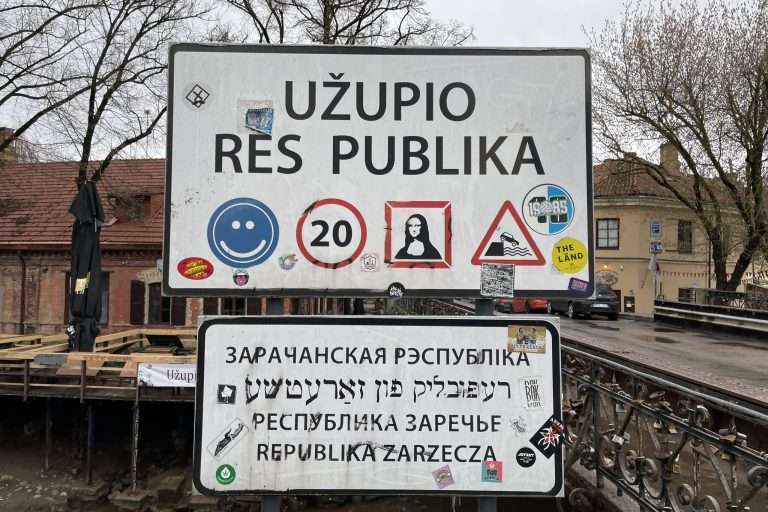
Driving around the capital of Vilnius, Lithuania, in Eastern Europe, I crossed a bridge over the Vilnele River. Mid-way on the span, a very prominent sign announced, “Welcome to the Republic of Užupis!” Another sign nearby declared, “Get your passport stamped here.”
The Republic of Užupis? Is this some sort of prank, I wondered? No, it’s real. It’s a neighborhood in Vilnius that boasts about 7,000 people living on 143 acres. Too small to be a country? Think again. The tiniest country on the planet is Vatican City. It’s only 121 acres, and fewer than 1,000 people live there.
In 1997, Užupis declared its independence. It has its own flag, currency, president and cabinet ministers, and national anthem. For a brief time, it had an army, but its 11 serving members have since retired. Occasionally, Užupis grants honorary citizenship to a famous person, and it sends ambassadors all over the world, even though no government has yet sent one to Užupis. By one count, at least 1,000 of its 7,000 inhabitants are artists or musicians.
The Republic has its own Parliament too, which meets in a tavern and is known locally as the Barliament. No kidding.
I was barely a hundred yards into Užupis when I noticed nearly two dozen large plaques on a wall stretching the better part of a whole block. Each plaque contained, in a different language, the entire Constitution of the Republic of Užupis.
Any illusions that Užupis might be a real country evaporated when I read its Constitution. It lays out no institutional framework for government, qualifications for office, or other essentials of a legitimate governing document. It’s just a list of 41 statements, some of which make sense while others are silly at best.
Number 29 is OK, I guess. It simply says, “No one can share what they do not possess.” Sounds like private property to me. Number 36 declares, “Everyone has the right to be individual.” Hard to argue with that.
But others come across as positively loony, betraying the tongue-in-cheek intentions of the artists who wrote the document. Consider these:
- Everyone has the right to die, but it is not an obligation.
- Everyone has the right to love.
- Everyone has the right not to be loved, but not necessarily.
- A dog has the right to be a dog.
- Everyone has the right to celebrate or not celebrate their birthday.
Užupis is, at worst, a humorous tourist trap. At best, it’s a charming enclave in Vilnius, with a mostly unserious Constitution. Its cafés beckon and its artsy, feel-good environment is appealing. I recommend you visit if you have a chance.
Other “micro-nations”—whether widely and officially recognized or not—are more common than most people realize. They also tend to be among the freest enclaves in the world. The better-known ones that I myself have written about include Andorra, Liechtenstein, San Marino, and Bottleneck.
For half a century, the Principality of Hutt River within the state of Western Australia fancied itself an independent nation. A farmer named Leonard Casley (“Prince Leonard” to the rest of the world) seceded from Australia in 1970 and ran the 29-acre place until his passing in 2019. He even declared war on Australia. He issued stamps, passports, royal titles, and currency, though no government ever recognized any of them.
Ron Manners of nearby Perth, Australia (and founder of the Mannkal Economic Education Foundation) shared his insights to Prince Leonard’s claims with me in a recent email:
The Government of the day reminded him that they had a “wheat quota” per farm. Like most government laws, they were designed to “keep the price of wool up” but threatened to bankrupt Leonard as they said “he only had ONE quota, even if he bought another farm.
Faced with buying a farm on which he could grow nothing, he did a remarkable thing…
He read the Australian Constitution to see if the legitimate role of Government included “bankrupting a citizen.”
When he found to the contrary, he promptly wrote to the Queen and signed off as “Prince Leonard of the Hutt River Province via Australia.”
Of course, she responded to that address, indirectly acknowledging the existence of the Hutt River Province, and launched a new career for himself as Prince Leonard.”
[Ron wrote about his experience with Prince Leonard and the creation of the microstate for the Mannwest site.]
Alas, the principality did not survive. Graeme Casley (Leonard’s son), had inherited the “throne,” but CNN reported in 2020, sadly, that “the economic impact of the Covid-19 pandemic, coupled with a giant tax bill, have forced the principality to announce it will finally surrender to Australia.”
A microstate still going strong, however, is Seborga, a 3,500-acre principality with a website and a long history, allegedly. Declaring their independence from Italy in 1963, its founders claimed that their nation has roots going back to the year 954. Nestled along the border with France, the historical region of Seborga was swept under the rug almost as an oversight when the Congress of Vienna rewrote European boundaries in 1815. From its modern founding in 1963 until 2009, its head of state, Georgio I, assumed the positively Trumpian title of “His Tremendousness.” It pegs its currency, the luigino, to the US dollar; six luiginos officially equal one dollar, though they circulate only amongst the 300 residents of Seborga. You can read more about this quirky corner of Europe in this article from the Huffington Post.
Perhaps the silliest microstate started as an abandoned military defense platform in the North Sea (close to Britain) before being declared the “Principality of Sealand.” In 1967, a pirate radio broadcaster named Paddy Roy Bates occupied the platform (roughly the size of two tennis courts), declared independence, and created Sealand’s constitution as well as currency, stamps, and national anthem. There was even a court case to establish whether it was in British territorial waters. In August 2024, CBS News reported the full-time population of Sealand to be exactly one. But they will sell you a title—would you like to become a Count or Countess for £200?
The most recent of the world’s micro-nations is Liberland. Formed by a group of self-described “classical liberals” in 2015 from a floodplain on the Croatian side of the Danube River, Liberland very actively promotes its independence around the world. Two years ago, I proudly accepted the offer of honorary citizenship by Liberland’s president Vit Jedlička. With any luck, and if neither Croatia nor neighboring Serbia arrests me, I hope to visit one of these days. In the meantime, check out the website, Liberland.org. Go Liberland!
Micro-nations are fascinating, regardless of what other governments may think of them. Maybe I will declare myself to be one and call it the Republic of Reed. But of course, I would probably be invaded rather quickly.
Only big and “legitimate” nations do invasions, incidentally, which is in its own way a compliment to the micro-nations of the world.
Additional Reading:
Arty, Hipster, and a Country Within a Country: Welcome to the Republic of Užupis by Richard Franks
Užupis: A Tiny Republic of Free Spirits by Erin Rhone
The Republic of Užupis, Vilnius: A Post-Soviet Art Enclave by Sinéad Browne