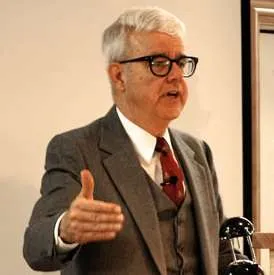
Gary North is a member of the Economists’ National Committee on Monetary Policy.
The flight of Apollo XI was probably the most stupendous technological achievement of the decade. (Unquestionably, it was the most stupendous bureaucratic achievement of the decade: scheduled for 1969, it actually took place in 1969!) Editorials in every paper in America, I suppose, have lauded the flight as the monument to the capacities of mankind to conquer nature and order our affairs, the assumption being that the ability to fly a rocket implies the ability to organize a society, in theory if not in practice. The flight has brought to the forefront that old cliché, “Man’s scientific wisdom has outrun his moral wisdom”; we can go to the moon, yet somehow we have failed to solve the problem of mass poverty in the United States.
The gap between moral wisdom and scientific knowledge has been a problem since the scientific revolution of the sixteenth century. Immanuel Kant, writing in the late 1700′s, struggled mightily with this very question: How can man bridge the intellectual chasm between scientific knowledge (the realm of law and necessity) and moral knowledge (the realm of freedom and choice) without sacrificing the integrity of one or the other? Hegel, Marx, and the modern moral philosophers have all lived in the shadow of this dilemma, and the crisis of modern culture reflects man’s failure to resolve it. The responses to this dilemma, as a rule, take one or the other of two forms, symbolized by Arthur Koestler as the Commissar on the one hand, and the Yogi on the other.
The Commissar is enraptured with science and technology; he is confident that scientific planning in proper hands can so alter man’s environment as to bring about a new earth and a new mankind. The Yogi takes the opposite tack of disengagement from “the world,” laying stress on each man cultivating his own garden. Find inner peace, he urges, and the external world will take care of itself. His assumption is that science and technology are neutral, that developing from their inner imperatives they will eventually find their own benevolent level.
But this assumption is invalid because the planners won’t let it happen this way. Once accept scientific planning as a legitimate and even necessary function in a society and any form of “spirituality” which assumes the impotence of moral concepts in the social and economic affairs of men is helpless before the planning elite. If a change in the hearts of men only has impact on their internal lives, then the external realm of science is left free to do its “neutral” best. Unfortunately, the planners can never be neutral; hence, their application of technology to the affairs of men cannot be neutral. Planning involves the allocation of scarce resources, and some programs must be accepted while others are rejected. The planners must use a scale of values—nonempirical, a priori moral values—in the administration and formulation of their plans. Hayek’s arguments along these lines in his Road to Serfdom (1944) have laid the question to rest. Unless one’s moral commitment involves a view of external reality, one will remain helpless to reverse the course of external affairs. For this reason, those who counsel retreat from the world actually cooperate with the drift into totalitarian planning.
From the Moon to the Earth
During the week of the moon shot, I fully expected some local television station to show George Pal’s 1950 classic, Destination Moon. Sure enough, a Los Angeles station presented it one evening. No doubt it was shown in other cities around the country. I missed it this time, but I have seen it often enough to reproduce some of its dialogue verbatim (the dialogue, however, was considerably inferior to Pal’s special effects). Tom Powers played a military man whose rocket programs kept producing failures. He finally is able to convince John Archer, a captain of private industry, to construct the rocket that will get the job done.
The message: only American private enterprises can get us to the moon.
That was great stuff in 1950. Yet the reality is far, far removed in 1969. The moon shot was, by its very nature, a task for the state. Private firms could be contracted, but the NASA officials were behind it, financially and administratively, from start to finish. Tom Wicker, writing in his nationally syndicated column, put the fact in all its clarity: “No one ever made the remotest pretense that men could get to the moon via free enterprise, states’ rights, rugged individualism, or matching grants.”’ The reason: “… this was government-managed enterprise, pointed toward an agreed goal, operating on planned time and cost schedules, with ample administrative authority derived from Federal power and wealth.” An amen is due here. Good show, Mr. Wicker.
Mr. Wicker, unfortunately, made a great leap of faith when he began to compare our heavenly achievement with our supposed capabilities for solving more earthly tasks. He was not alone in this leap. Editorial after editorial echoed it, and I single him out only because he is widely read and generally regarded as one of the superior liberal pundits. He makes the leap seem so plausible: “So the conclusion that enlightened men might draw is that if the same concentration of effort and control could be applied to some useful earthly project, a similar success might be obtained.” He recommends a vast program of publicly-owned housing construction, say, some 26 million new units by 1980.
Flora Lewis’ column was far more optimistic; her horizons for mankind’s planning capabilities are apparently much wider. “If the moon can be grasped, why not the end of hunger, of greed, of warfare, of cruelty?” She admits that there are problems: “They seem provocatively within our new capacities and yet maddeningly distant. We are told it is only lack of will that frustrates these achievements, too.”² Nature is boundless, apparently; only our “lack of will” prevents us from unlocking the secrets of paradise and ending the human condition as we know it. This is the messianism of technological planning. It is basic to the thinking of a large segment of our intellectuals, and the success of the Apollo flights has brought it out into the open.
Mr. Wicker wisely set for our government a limited goal. Miss Lewis does not necessarily limit the task to government planning alone, but it is obvious that she is basing her hopes on a technological feat that was essentially a statist project. At this point, several questions should be raised. First, should the state have used some $25 billions of coerced taxes in order to send two men to the moon’s surface? Would men acting in a voluntary fashion have expended such a sum in this generation? In short, was it worth the forfeiting of $25 billions worth of alternative uses for the money? Second, given Mr. Wicker’s plans, could we not ask the same question? Is the construction of public housing, and the use of scarce resources involved in such construction, on a priority scale that high in the minds of the American public? Would a noninflationary tax cut not be preferable?3 It is typical of socialistic thinkers to point to emergency spending (e.g., a war) or some statist rocket program and recommend a transfer of funds from one branch of the state’s planning bureaucracy to another. I have never heard them recommend a reduction of spending by the state. Spending precedents set in war time, like “temporary” taxes, seem to become permanent. Finally, in Miss Lewis’ example, is the mere application of the techniques of applied science sufficient to end warfare and cruelty? Or could it be, as the Apostle James put it, that our wars come from the hearts of men?4 Conversion, in and of itself, may not redeem technology, but can Miss Lewis be so certain that technology can redeem mankind?
The Limits of Technology
Technology is a tool. Like any tool, it has its limitations. One must be very careful to keep from using an inappropriate tool to complete some task. It makes it imperative that the user specify the exact nature of his task beforehand.
Any standard economics textbook will usually compare economics with engineering. The contrast is not perfect, but it does set before the reader the different ways an economy must plan. The engineer must decide, given a specific goal, how to allocate the available resources to complete it. The economist must look at the available resources, and decide where to allocate them, given a multiplicity of goals. In some cases, it will be difficult to separate the two jobs, but the distinction is useful for purposes of conceptualization.
The Technocrats of the 1930′s urged us to accept the economic guidance of the engineering elite. They would eliminate “waste.” Yet the engineers of the Soviet Union have been forced to construct crude economic accounting techniques in order to deal with such “capitalistic” phenomena as value and the rate of interest. Engineering—meaning specialized, technological competence—cannot deal with such psychological imponderables as consumer preferences. Only the price mechanism of a free market can do this with any degree of accuracy, which is why Ludwig von Mises rejects socialist planning.5 If we confuse engineering with economic calculation, we will destroy the rational allocation of scarce resources by the market. It would involve turning over the task of ordering literally quintillions of economic relationships to a centralized elite with necessarily limited knowledge.° The results can be predicted: irrational decisions, petty bureaucratic coercion, and a loss of political freedom.
Governments can provide certain services that, by their very nature, men do not want to see offered to the highest bidder, as on a free market. Justice is not to be purchased for the profit of the judges involved. Governments are seldom efficient in solving complex, interpersonal problems that require a careful balancing of supplies and demands (for they are plural until registered, specifically, on a market, by a given supplier and a specific purchaser); when personal preferences of many individuals involving varied and even conflicting goals are the issue, governments are not particularly successful agents for getting things settled. The fine shadings are lost in the aggregate decisions.
A Leap of Faith
Therefore, to take a leap of faith from some particular instance of a “successful” government project—success defined as the operationally satisfactory completion of a certain unquestioned goal—to the realm of economic planning involves a faith far greater than anything imagined by the medieval scholastics. Yet Dr. Irving Bengelsdorf, a staff writer with the Los Angeles Times, thinks that “there may be hope” along this line of thinking, in spite of the difficulties inherent in any computerized quantification of qualitative personal preferences. He states the problem well; he cannot show how his answer is linked operationally with the problem he states:
In contrast to the novel and uncluttered venture of getting to the moon, [an] uninhabited, non-social, non-political moon, the problems of society are exceedingly complex to solve because any solution demands that, people have to change their daily ways of life, their interactions with other people. This is difficult to do. For, from birth, people already come overlaid with traditional prejudices, encrusted with hoary cultures, and swaddled in ancient customs. And these are hard to change.
But, there may be hope. Both the Apollo 11 flight and the Manhattan Project of World War II show that once a clear goal has been set, a vast, complex project involving large numbers of people with different training and skills working together can achieve a solution.7
Between the first paragraph and the second lies a social revolution. Also present in the gap is the unstated assumption that we can reduce the complexities of society to “a clear goal,” which is precisely the problem governments have not learned to solve. I am at a loss to see how a wartime bomb project or a trip to the moon indicate anything except the amazing capacity for spending that governments possess.
Spaceship Earth
Barbara Ward, one of the most respected Establishment thinkers in Britain, and former editor of The Economist, has taken Buckminster Fuller’s spaceship analogy and has turned it into an effective neo-Fabian propaganda device:
“The most rational way of considering the whole race today is to see it as the ship’s crew of a single spaceship on which all of us, with a remarkable combination of security and vulnerability, are making our pilgrimage through infinity.” This assumes, of course, a chain of command, a previously agreed upon destination, and some shared faith in the way one goes about getting there. But what are a few assumptions among rational men, especially planners? Now, fellow crewmen, “Think what could happen if somebody were to get mad or drunk in a submarine and run for the controls. If some member of the human race gets dead drunk on board our spaceship, we are all in trouble. This is how we have to think of ourselves. We are a ship’s company on a small ship. Rational behavior is the condition of survival.” Clearly, as she points out, “Rational rules of behavior are what we largely lack.”9 All is not lost, however. Our divisions are based on divisions of power, wealth, and ideology, but these can be overcome through reason. There is a universal means of instant communication—technology —which brings us together.¹º “Quite apart from common tools and methods, we also have mental attitudes that do not vary from culture to culture and are common to a single world civilization.”” What these common bonds are, she fails to mention; nevertheless, “in short, we have become a single human community.“¹²
The problem with all of this “spaceship reasoning” is that it assumes as solved those fundamental problems that need solving in order to make possible the spaceship analogy. The thing which strikes me as ironic is that the language of the spaceship involves a chain of command approach to the solution of human problems. Those humanitarian intellectuals who decry the petty military dictatorships in underdeveloped nations want to impose a massive system of command over the whole earth. That is what the call to world government implies.¹³ The spaceship analogy necessarily views society as a vast army. Yet for some reason, Hayek’s identical conclusion about the implications of socialist planning is invariably rejected as absurd. It is the mentality of the militarist. Miss Ward even is willing to admit that our experiences in wartime helped to create the foundation of modern economic policy:
Thus, not by theory or dogma but largely by war-induced experience, the Western market economies have come to accept the effectiveness and usefulness of a partnership between public and private activity…. but there is now no question of exclusive reliance on any one instrument or any one method. The pragmatic market economies have worked out their own evolving conceptions of public and private responsibility and the result is the dynamic but surprisingly stable mixed economy of the Western world.¹4
The Chaos of Noneconomics
I would have put it a different way. I would have pointed to the signs of our contemporary system’s increasing inefficiency, corruption, and extralegal practices which we more usually associate with those warfare economies from which she says we borrowed our planning techniques. What we have created is a noneconomics, and Miss Ward proclaims the benefits of such a system:
But, on the whole, in economics the Western world can move from position to position with little sense of contradiction and incompatibility. We had no very fixed views before so we do not have to bother too much about what we believe now. It is a considerable source of strength.15
This, then, is “reason, spaceship style.” It is the triumph of intellectual chaos, and it is inevitably recreating the economy in its own image.
Grounding the Ship
Dr. William G. Pollard, a physicist who was a part of the Manhattan Project, has written a little book which tries to undergird the spaceship analogy with a theological framework. His theology is radical, but he is honest in seeing the purpose of the Apollo flights as being ultimately religious. He thinks it marks the end of the era of science-worship. Diminishing marginal returns are about to set in:
Sending men to the moon and bringing them back in 1969 may prove to be from the perspective of the twentieth century the central symbol of the golden age of science in the twenty-first. Like the great pyramids of Egypt or the lofty cathedrals of medieval Europe, this feat will stand out as a peak expression of the spirit of the golden age; the maximum economic investment which a great civilization could make in a feat which served no useful purpose other than making manifest the lofty height to which the spirit of an age could rise. It will not be worth repeating except perhaps by Russia for the purpose of sharing in its glory. Thereafter, even more massive applications of science and technology to basic human needs will have become so urgently necessary that no further diversion of available talent and resources to manned space flights can be permitted.¹6
We can hope that he is correct, but who knows for certain? The government was so successful, as it usually is, in achieving a feat “which served no useful purpose” other than its own glory, that we may have more of the same. But this much should be clear: the analogy of spaceship earth is more than an analogy; it is a call to religious commitment. The call is to faith in centralized planning.
At the beginning of this essay, I pointed to the dual theories of regeneration, symbolized by the Yogi and the Commissar. They feed on each other, take in each other’s intellectual washing, so to speak. If we are to confront the mythology of spaceship earth, it must be in terms of a rival moral philosophy, one which has social and economic implications, as well as technological implications. We must deny the validity of any vision of man as central planner, a little god who would arrange in an omniscient fashion the lives of all men in all the spheres of their existence, as if we were some permanent military crew. We must acknowledge the validity of the late C. S. Lewis’ warning in The Abolition of Man that when we hear men speaking of “man’s taking control of man,” we should understand that it implies certain men taking control of all the others.
When men seek to divinize the state, they succeed merely in creating hell on earth. The Christian church fought this point out with the Roman Emperors, both pagan and Arian. The state may not claim to be God’s exclusive or even chief representative on earth.”’ The theology of spaceship earth would have us return to the religious political theory of the ancient world, all in the name of progressive technology and planning.
The astronauts are back on earth. We must seek to keep them here. It is time to ground our spaceship programs, both interplanetary and domestic. Let the captains go down with their ideological ship. There are better ways of allocating our scarce resources than in constructing spaceship earth.
—FOOTNOTES—
I Tom Wicker, Riverside, Calif. Press, July 22, 1969.
2 Flora Lewis, Los Angeles Times, July 22, 1969,
3 Cf. Gary North, “Urban Renewal and the Doctrine of Sunk Costs,” THE FREEMAN (May, 1969).
4 James 4:1.
5 For a summary of this literature spearheaded by Mises, see my chapter on “Socialist Economic Calculation,” in Marx’s Religion of Revolution (Nutley, New Jersey: Craig Press, 1968).
6 Ibid., p. 193.
7 Irving S. Bengelsdorf, Los Angeles Times, July 24, 1969.
8 Barbara Ward, Spaceship Earth (New York: Columbia University Press, 1966), p. 15.
9 Ibid.
¹º Ibid., p. 4.
¹¹ Ibid.
12 Ibid., p. 14.
13 Ibid., p. 17.
14 Ibid., pp. 9-10.
15 Ibid., p. 10.
16 William G. Pollard, Man on a Spaceship (Claremont, Calif.: Claremont Colleges, 1967), pp. 59-60.
17 R. J. Rushdoony, Foundations of Social Order (Nutley, New Jersey: Craig Press, 1968).
***
Economic Growth
The only positive ways the government can use to attempt to promote economic growth are to tax, inflate, spend, and control—that is, to leave you with less real money to spend, and to restrict the ways you can spend what you have left. Thus, we are clearly not choosing the means and policies that will increase the long-time production of goods and services that we consumers want and are willing to pay for. I am convinced that the only possible way to accomplish that goal is to reject totally the restrictive influence of government controls and ownership and deficit spending, and to return to the free market economy that is the hallmark of a responsible and prosperous people.
DEAN RUSSELL