Jets! Autos and cornflakes! Reapers and homes and dishwashers! Trains and pencils and microscopes and ships! Clothes and computers and flowerpots and radios and watches! The list of these supposed realities, the things we see and touch, is virtually endless —and still growing.
Can it be that these material things are not themselves fundamental but are in the nature of shadows cast by human qualities we cannot see with the eye or touch with the hand?
Dr. Donald Hatch Andrews, the renowned scientist, answers in the affirmative:
I suggest that we postulate that the intangibles of truth and beauty, human freedom, courage, honor, honesty are the core of the truly basic realities; and that the supposed realities which we see and touch and feel are really only shadows cast by these truly basic dynamic forms….¹
Why, one might ask, should anyone devoted to an understanding of economics wish to examine this postulation? Would this not be turning away from day-to-day practicality? Are economists not primarily interested in the removal of poverty, in a proliferation of these things by which we live and prosper? Is not economics the study of the production and distribution of wealth, the efficient and just allocation of scarce resources? Granted the high value of truth and beauty, freedom, courage, honor, honesty, of what relevance are they to material well-being? Do not these intangibles pertain to another realm of life? How can voice delivery at the speed of light, for instance, be but a shadow cast by these spiritual attributes?
The answers to these questions take an unconventional turn if the postulation proves correct. And, further, the study of economic welfare must undergo a drastic shift in emphasis.
But is the postulation valid? I believe it is, that material well-being — the possession of things we see and touch — is no more than a potential dividend of moral rectitude.
To approach the matter from the negative side, is it not a fact that a high standard of living is out of the question when and where moral depravity is the mode? A society of thieves would soon perish of starvation, as would a people bereft of freedom, or unattentive to a search for truth. Were dishonor, ugliness, and lies the general practice, life itself, let alone affluence, would be impossible.
On the basis of these simple observations, are we not warranted in concluding that material wellbeing has to be preceded by certain spiritual attributes and that the things we see and touch are shadows cast by these intangible but real forces?
Admittedly, the study of economics aims at finding out how better to produce and distribute the material things by which we live and prosper. But, assuming the correctness of our postulation, economics of the meaningful brand is a discipline founded upon and secondary to a high moral order. A truly productive, trading society must presuppose men of some rectitude, not rogues.
Political Authoritarianism
We must distinguish, however, between true and false economics, the latter being a roguish sort of business. Merely observe the “economists,” in business as well as in the academies, whose systems involve feathering the nests of some at the expense of others, who would rob countless Peters to fatten selective Pauls, and who pay honor to little more than their own schemes. We witness in these instances the “economists” themselves lacking the moral and spiritual attributes which must be presupposed for fruitful economic activity. This sort of thing — systems aimed at controlling individuals in their economic behavior — should not be referred to as economics but as manifestations of political authoritarianism.
Parenthetically, something is amiss in our vaunted educational institutions: turning out authoritarians and calling them “economists” who, in turn, teach authoritarianism and call it “economics.”2 This parallels in confusion our “educated” people who commend and lend cooperation to gambling (lotteries) as a means of financing the same brand of schooling that “educated” them!3 They would do well to heed Emerson, “… the end preexists in the means.”
So, I claim to be false that brand of “economics” which pertains to the immoral, egotistical, and satanic, namely, how forcibly to control the lives of others.
These Things Shall Be Added
Economics proper is concerned with the behavior of men in voluntary, cooperative, competitive, private activity — with the governmental agency of force limited to keeping the peace.
Within that framework of how men behave when moral and free, we do indeed discover that the tangibles — the things we see and touch—are but shadows cast by the basic realities: truth and beauty, human freedom, courage, honor, and honesty.
The postulate we are trying to examine is simply a scientist’s rendition of “Seek ye first the Kingdom of God and his righteousness, and all these things shall be added unto you.” No mention is made of how “these things” — the tangibles — shall be added. Merely seek what is right and true and they shall be forthcoming without further ado, automatically, so to speak. In short, so goes the promise, “these things” are but shadows cast by finding and observing the verities.
The mystery of such “manna from heaven” largely accounts for the all-too-common rejection of this counsel offered by first a biblical and now a scientific writer. Ever so many persons, particularly the pragmatists emerging from our modern educational institutions, are reluctant to accept anything bearing the stigma of mystery; they accept only that which their little minds can analyze and explain.
Investigation into how a moral people behave when free — the valid brand of economics — overwhelmingly supports the view that “these things” are shadows cast by spiritual attributes.
Here is but one example among many. This is written on a hot, humid day in August, but an air conditioner keeps my workroom at a comfortable temperature. The startling fact is that not a person on the face of the earth knows how to make this new-fangled gadget, nor has any living person had more than an infinitesimal part in its making.4 Yet, air conditioners exist by the millions, cooling homes, offices, laboratories, automobiles, airplanes, you name it! If this is not a phenomenon, pray tell, what is!
How are we to account for this miracle that has happened to us? And why has it not happened to various other persons or groups?
It is evident that there could be no air conditioning in a society of thieves. Or among a people whose promises are naught but babble. Or among those whose search for truth is so remiss and shallow that the value of industry, thrift, initiative, and other virtues stands unrevealed. Or among slaves where freedom does not prevail. Or among a people so lacking in courage that all innermost convictions remain forever hidden. A society of liars would lack air conditioners, planes, autos, food — and could not long survive.
It should be plain that these “miraculous conferments can happen only to a people more graced with rectitude than damned by depravity. Nor is it too difficult to see why.
At the level of economics — secondary to the moral order — exchange is the key to abundance. To appreciate this fact, merely contemplate your plight were you left exclusively to your own resources.
Willing Exchange: Key to Abundance
There are two kinds of exchange: willing and unwilling. Unwilling exchange is of the authoritarian brand: the forcible exchange of one’s income to finance idleness, to put men on the moon, and the like. Unwilling exchange is beyond the pale for no other reason than its coerciveness. Were another reason necessary, its inefficiency could be cited. The Russians, for instance, are the leading practitioners of unwilling exchange.
Willing exchange is the key to abundance at the economic level. In the U.S.A. alone, these exchanges — the tangibles and the intangibles — run into inestimable trillions daily, so numerous and ordinary that we are scarcely conscious of them.
Willing exchanges, essential to the removal of poverty and the source of economic gain, are more prolific among honorable people, those whose word is as good as their bond, than among dishonorable people. We avoid trading with cheats and liars as we avoid the plague. Willing exchanges run to men of veracity; they proliferate where the verities are sought and observed; the better these truths are understood and practiced the more numerous the exchanges and, thus, the more are “these things” added unto us. It is literally true that the supposed realities which we see and touch are but shadows cast by truth and beauty, human freedom, courage, honor, and honesty.
It is implicit in these reflections that the economist who is not first a student of the verities — moral philosophy—must perforce depend on others for an understanding and spread of righteousness, the basic reality to which his discipline is secondary. But far better if both disciplines are mastered by each and every one of us—by you and me.
—FOOTNOTES—
¹ Donald Hatch Andrews, The Symphony of Life (Lee’s Summit, Mo.: Unity Press, 1967), 440 pp.
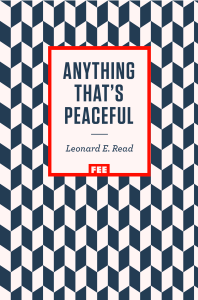
2 For what this writer believes to be amiss in education, see Chapters XV, XVI, and XVII in Anything That’s Peaceful (Irvington-on-Hudson, N. Y.: The Foundation for Economic Education, 1964).
3 Education is the excuse used to justify the New York State lottery. For a critique of gambling as a means of financing governmental activities — education or whatever — see “Kakistocracy,” THE FREEMAN, August, 1963.
4 For more detailed explanations of this irrefutable claim, see “Only God Can Make A Tree — or a Pencil” in Anything That’s Peaceful, and also my recent monograph, “Where Lies This Fault?
5 See “Freedom’s Theory of Value,” THE FREEMAN, October, 1967.
***
Swayed by Passion
When a state has weathered many great perils and subsequently attains to supremacy and uncontested sovereignty, it is evident that under the influence of long established prosperity, life will become more extravagant and the citizens more fierce in their rivalry regarding office and other objects than they ought to be.
As these defects go on increasing, the beginning of the change for the worse will be due to love of office and the disgrace entailed by obscurity, as well as to extravagance and purse-proud display; and for this change the populace will be responsible when on the one hand, they are puffed up by the flattery of others who aspire to office. For now, stirred to fury and swayed by passion in all their counsels, they will no longer consent to obey or even to be the equals of the ruling caste, but will demand the lion’s share for themselves.
When this happens, the state will change its name to the finest sounding of all, freedom and democracy, but will change its nature to the worst thing of all, mob-rule.
The Histories of Polybius, Book VI