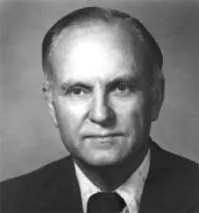
Dr. Sennholz heads the Department of Economics at Grove City College in Pennsylvania.
An important pillar of our republican form of government is the people’s control over government spending. Representative government means budgetary control. The people, through their representatives, consent to certain taxation in order to facilitate public policies. They determine the task of the Administration and its expenditures. No penny must be spent without the consent of Congress.
Senator Monroney of Oklahoma, Chairman of the Joint Committee on Organization of Congress, briefly described this pillar as follows: “The primary function of the Congress is still the exercise of the power of the purse… If we use this power well, we can and will be able to control the size of government, its activities, and the number of people who find their way on or off the payroll. This is the major responsibility given to the Congress by the Constitution. We dare not fail in this assignment.” But how has the Congress actually discharged this duty during the 1960′s?
Since 1960 the Federal government has grown rapidly in size and expense. Administrative Budget expenditures alone have risen from $76.5 billion in 1960 to an estimated $153.9 billion in the fiscal year ending June 30, 1970. (Cf. The Budget of the United States Government for 1970, p. 524.)
But this is not the only Federal budget. The 130 Federal trust funds, among which the Old-Age and Survivors’ Insurance (Social Security) and the Hospital Insurance Trust Fund (Medicare) are the largest, receive taxes and disburse funds without Congressional appropriations. Their expenditures have grown even more significantly than Administrative spending. From 1960 to 1970 they are expected to rise from $21.2 billion to $48.3 billion, or 128 per cent.
And finally, there are some 85 Federal enterprises and government-sponsored enterprises that are scheduled to spend another $31 billion. Altogether, the Federal government plans to spend $232 billion in the coming fiscal year. When compared with 1960, this constitutes an increase of nearly $120 billion.
The Burden Grows
Since 1960 the Federal government has more than doubled its taxing and spending and, at the given rate of growth, must be expected to double again in less than 10 years. The growth rate of Federal Trust Funds, which cover more than two-thirds of the total Federal expenditures on health, education, and welfare, will probably exceed all others. In the 1970 Budget, Trust Fund receipts are estimated at $50.9 billion, or 35 per cent of total administrative receipts of $147.8 billion. Nor does there appear in sight any end to the expansion of the Social Security and Medicare programs.
In terms of total personal income of $800 billion, which is the government’s favorite measure of progress and prosperity, the 1970 Federal tax take of $198.6 billion amounts to approximately one-fourth. But personal income is a gross estimate that includes personal taxes of more than $105 billion. If we deduct this amount and base our calculations on disposable personal income of only $700 billion, the $198.6 billion of Federal spending amounts to 29 per cent. But how is this possible if most people pay Federal income tax rates below 29 per cent? Many individuals, in fact, pay much higher rates. Highly productive businessmen pay various corporation taxes in excess of 50 per cent plus individual income taxes of 50 per cent or more on the remainder, which comes to 75 per cent or more of their earned incomes.
The tax burden of government that is frequently overlooked is hidden in the costs of all goods and services we consume. All goods bear taxes that account for varying shares of the purchase price. This is how every citizen, even the poorest member of society, must bear the growing burden of his government. Taxes are the largest single item in our cost of living; nothing else can compare with the cost of government. For instance, Americans spend less than $100 billion on food per year and more than twice this amount to finance the Federal government.
To Change the Economy
We often forget that taxation aims not only at raising the desired revenue but also at other purposes. Today, taxes are a favorite tool of government policy and control. In the past, regulation through taxation was limited, by and large, to protective tariffs which restricted the supply of goods in order to benefit certain producers. Modern regulatory objectives are much wider and more far-reaching. Some taxes aim at influencing certain consumption. Some are designed to affect certain sectors of production and trade. Others are to change business customs and conduct. Still others aim at controlling or changing our economic system. The revenue accruing to the government treasury may be a desirable but not vital objective of taxation.
Taxation may even aim at changing our economic system. All taxes that attack the substance of private property, destroy individual incentive, and prevent capital formation, are gnawing at the foundation of a free economy. Confiscatory income taxes and business taxes diminish the incentive to work. Many professional people whose services are urgently needed by society are induced to work less and retire earlier than they otherwise would. Young men may be tempted not to enter business and become founders and promoters of successful enterprises, but to seek security and prestige in government offices and appointments.
Confiscatory taxes that aim at the roots of our individual enterprise system, spend and consume what generations have built and accumulated. Heavy death duties and highly progressive business and income taxes tend to consume productive capital. It is true, such taxes do not destroy the real capital—factories and equipment—but they consume the liquid cash the heirs must raise in order to satisfy tax claims. In expectation of his demise, a successful businessman may sell out to his competitors in order to prepare his estate with readily marketable securities, such as U.S. Treasury bonds. The confiscatory death tax thus eliminates many independent enterprises and promotes growth of giant corporations.
To Equalize Incomes
Our present tax structure openly aims at greater equalization of income and wealth through tax rate progression. However, this must not be understood to mean that the system relieves the lowest income brackets from a proportional share of the tax burden. On the contrary, it has been proven by a number of able writers that even the poorest people pay a higher percentage of their income in indirect taxes than does the class with the greatest number of taxpayers.
F. A. Hayek, eminent Austrian economist, found that “it was not the poorest but the most numerous and therefore politically most powerful classes which were left off relatively lightly, while not only those above them but also those below them were burdened more heavily—approximately in proportion to their smaller political strength.”
Taxation is no simple government matter. It presents problems of shifting, diffusion, and incidence, the difficulties of which challenge even the ablest economist. Every tax sets into operation a chain of reactions that affect industrial production, wages, income, employment, standard of living, mode of living, and so on. Most legislators probably are unaware of the numerous economic effects of the taxes imposed.
They may be unaware that the steep graduation of the income tax accomplishes the very opposite of what it was meant to do. It perpetuates economic and social inequalities and thereby creates a rigid class structure that divides society. The expropriation of high incomes effectively prevents formation of capital and wealth that facilitate individual improvement. How can an able newcomer from the wrong side of town rise to economic and social eminence if his “excess income” is expropriated at every turn of success? How can he challenge the business establishment with its hereditary wealth and position if he is prevented from accumulating the necessary capital?
On the other hand, old businesses can relax, turn inefficient and bureaucratic because newcomers with excess profits are prevented by confiscatory taxation from ever challenging the establishment. It is true, the tax progression prevents the rich from growing richer; but it also protects them from the threats of competition by ambitious and able newcomers. Thus the rich stay rich, and the poor stay poor, which gives birth to economic and social classes. Instead of individual effort and productivity, the coincidence of birth and inheritance becomes the main economic determinant for most individuals.
To Fight Inflation
The tax objective that has been very much in the news throughout the 1960′s is the cure of inflation. Taxes are raised or reduced depending on the rate of inflation. Surtaxes are imposed and tax credits for equipment purchases are repealed because inflation is said to require the tax boost.
The rationale of this taxation is based on the popular, although erroneous, notion of inflation. According to this view, rising prices are inflation. Prices are pushed up by profit-seeking businessmen and labor unions seeking unreasonable wage increases. In order to reduce their purchasing power, which is reflected in an ever-rising demand for production equipment by business and for consumers’ goods by labor, the Federal government aims to check this demand through higher taxes.
Unfortunately, such tax levies cannot alleviate inflation, but may actually make matters worse, because they do not attack the root of the inflation problem. The futility of taxation as an inflation remedy becomes apparent as soon as we accurately define inflation. If we bear in mind that inflation actually is the creation of new money by government, we clearly perceive the futility of trying to cure inflation by new tax levies which merely shift more purchasing power from the people to the government. Taxes do not halt the printing presses; only the President and his monetary authorities can halt them.
If the monetary authorities continue to print money or create credit, no tax, no matter how high, can prevent the effects of inflation, such as rising prices and wages. It is true, rising taxes may cause havoc and ruin for taxpayers, but they do not necessarily slow down the government money presses. It is even conceivable that profits and interest might be completely expropriated—which, of course, would precipitate economic stagnation and chaos—and yet inflation could continue to ravage the country. After all, one does not preclude the other. In fact, the policies complement one another as they extract income and wealth from the people.
Taxation and Inflation Twins
Taxation and inflation are twin burdens imposed by government. A given administration may resort to inflation because taxation is unpopular; and the next administration may choose to tax because inflation is unpopular. But both measures further reduce the people’s income and wealth. Inflation reduces the people’s real income through higher prices. Fixed income receivers and owners of money or claims to money have their real purchasing power reduced in proportion as the government gains through money creation and deficit spending. Though the following administration may resort to higher taxation, it does not thereby reduce the money supply created by its predecessor. So, prices stay high even though the money presses may be silent for a while. The new tax levies on business tend to reduce capital investment and economic output. And this lower output in turn raises prices even higher. Both inflation and taxation thus raise prices and reduce disposable real income while boosting government revenue.
It is true, if the surtax revenue were applied toward reduction of the money supply, prices would tend to decline. The inflation would be followed by a deflation with all its disastrous consequences. But the burdensomeness of government would not be reduced by the shift in policy. The people, instead, would face three blows of government finance: inflation, taxation, and deflation. Can a free economy survive such an assault?
Inflation—the creation of new money—can be halted without delay. Its inevitable effects gradually spread throughout the system and run their course. Prices may continue to rise many months after the new money was first created. After all, economic adjustments take time. During this period of readjustment which presents great difficulties to business, a wise administration would reduce its tax burden rather than raise it.
Taxes Should be Neutral
In a free society the cost of government should be small compared with national income. Nevertheless, government must resort to taxation in order to cover its expenditures. But this taxation should not intentionally divert the economy from production chosen and directed by millions of consumers. Taxes should be neutral. A neutral tax would merely take a part of every citizen’s income for public expenditure without aiming at regulating or changing the economic actions of people. In particular, it would not hamper economic freedom and would not promote government enterprises with taxpayers’ money. In fact, government would terminate its ownership or operation of business-type activities for which there is no specific constitutional authorization, returning such properties through competitive bidding to individuals and private business organizations.
Such a withdrawal of the Federal government from activities that by tradition and constitution created. After all, economic ad- were left to the individual would instantly reduce the need for tax revenues. For instance the Federal government owns 32.3 per cent of the total land and water area of the United States. More than 700 Federal departments, agencies, and sub agencies carry on business-type activities, such as loans, grants, research, propaganda, news and advisory services, transportation, communications, construction, management of land and other resources, generation and transmission and distribution of power, and so on. If all this bureaucratic activity were liquidated and the vast assets sold to the people, a great many tax problems would vanish. In the hands of taxpayers this property not only would yield tax revenues instead of consuming them but also would be made productive in the service of human needs and wants.
Such a fiscal reform would revitalize the ideals and principles that made this nation great; it would permit reduction of many taxes and the abolition of those most damaging to the economy.
Welfare Through Tax Reductions
Substantial reduction of estate and income taxation would give new life to private charity and voluntary social action. There can be no doubt that many contemporary evils, such as persistent poverty, chronic unemployment, lack of education and training, slums and crime, have grown to such frightening proportions because confiscatory taxes have crippled private charity and voluntary social action. The Federal government now faces intolerable conditions and loud demands for their solution because it has nearly preempted social welfare through its tax policy. When almost 40 per cent of personal and corporate income is consumed by various levels of government, there is little left for private charity and voluntary social action.
The Federal government alone cannot solve the burning economic and social problems of our time, but it could help to revitalize private effort by removing or liberalizing its limits on the deductibility of charitable contributions. To encourage independent action toward desirable social objectives, the Federal government must, above all, cease to discriminate against the very individuals it aims to benefit. The aged, for instance, whose well-being is a primary concern of contemporary government, now lose their Social Security benefits if they should continue to earn certain wages. Why not halt this discrimination and permit them to work freely for their own support and betterment? If retired workers contribute their efforts and talents to charitable endeavors, why shouldn’t such contributions be treated as “gifts” by the tax code?
Economic development is said to be an important objective of the Federal government. Yet, such development by individuals—whatever is built and created—is immediately subjected to taxation by all levels of government. A wiser tax policy would seek to reward individual effort rather than penalize it. Tax credits might help to spark business development in depressed areas. To provide employment for educationally and culturally handicapped workers, the minimum wage legislation could be revised in ways that would permit employers to hire and train them.
If education is seriously considered a governmental responsibility, why not adopt tax policies that would encourage rather than discourage private efforts to that end?
If slum clearance and urban renewal are desirable, why not encourage private enterprise to help, through tax incentives rather than penalties?
A wise tax policy need not impose ever higher taxes but might, instead, give recognition to individual effort and achievement toward the realization of welfare objectives. Above all, care should be taken not to cause the very evils the intervention is meant to alleviate.
Of course, such tax policy would not be neutral. It would still reflect government planning and directing along welfare state lines. But it might be a hopeful initial step on the road back toward self-reliance and universally lower taxation.
***
Proportional Taxation
Straight proportional taxation is the only practical and definite arithmetic principle of direct taxation that there is between the principles of (a) everybody paying the same amount of tax and (b) income equalization, that is, taxation, coupled with subsidy, which results in everyone having the same income after the tax and subsidy.
BRADFORD B. SMITH, Liberty and Taxes