
Lawfare is costing taxpayers and eroding trust.
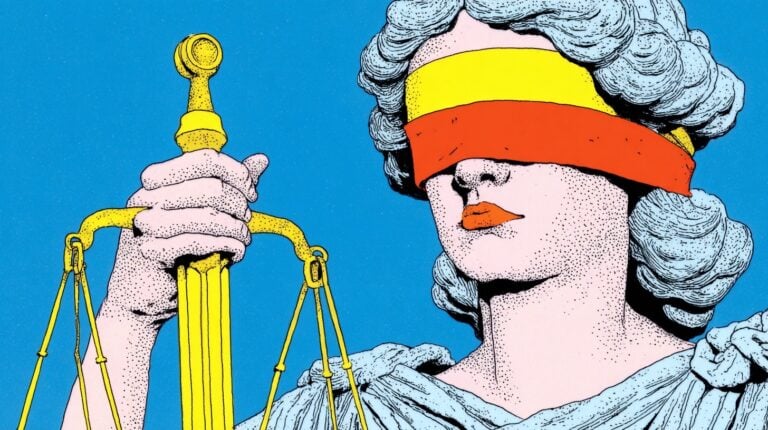
If there is a threat to democracy in Spain, it’s not from the “far right,” that mysterious force to which Socialist prime minister Pedro Sánchez wants to attribute all the country’s problems. Recent developments have highlighted two issues that are causing much more damage to public trust in democratic institutions—namely, the politicization of the judiciary, or “lawfare,” and financial corruption. Lawfare is alleged to be the reason for an unprecedented ruling against Spain’s former attorney general; while a massive fraud case centered on 95-year-old Jordi Pujol, president of Catalonia from 1980 to 2003, has tarnished the reputation of a once-revered politician.
At the end of last month, Spain’s attorney general Álvaro García Ortiz resigned after the Supreme Court found him guilty of leaking details of a tax probe into the romantic partner of Isabel Diaz Ayuso, the Conservative president of Madrid. Ayuso has established herself as Sánchez’s most formidable critic, and claims that the investigation into her boyfriend Alberto González Amador is an attempt to push her out of power. As she said last March: “The most suspicious thing, the most murky thing, is to see all the powers of the state leaking data about an individual… to try to destroy a politician.”
Amador, a businessman, is charged with defrauding the tax office of around €350,000 ($408,000) earned on face mask contracts during the pandemic. Last March, Spanish media reported that his defense team had asked for a plea bargain, before it was officially announced by the Prosecutor’s Office. According to the deal, Amador would admit to tax fraud in order to avoid a trial and potentially prison. The seven-judge panel at the Supreme Court—comprising five judges considered conservative and two “progressive”—identified Ortiz as the leaker, although several journalists testified that he had not been their source. It announced its verdict quickly, even before publishing the legal rationale on which it was based. Leftist Podemos, formerly a member of Sánchez’s coalition, called it a “judicial coup”—proof that the tribunal had “taken another step in its subversive escalation.”
Ayuso’s mortal enemy must empathize with her on some level. Sánchez, who nominated Ortiz for attorney general in 2022, also claims that the judiciary is out to get him. It was confirmed in September that his wife Begoña Gomez will face a jury trial over charges of corruption and influence-peddling, even though the evidence seems thin. The case against Sánchez’s brother David, who is accused of holding a state position created especially for him, will also go to court. Even more damagingly for the Socialist leader, several former members of his government are under investigation for taking kickbacks on face mask contracts during the pandemic; one of them, ex-transport minister José Luis Ábalos, was recently sent into pre-trial custody (the government’s enthusiasm for face masks, the efficacy of which was always questionable, now makes a lot more sense). Sánchez portrays all this as a smear campaign designed to topple his government. If both he and Ayuso are right, though, judicial bias goes both ways. Spain’s top judges might be corrupt, but at least they’re dishing out punishment to both the left and right.
Catalan separatists have also claimed to be victims of a politicized judiciary. For Pujol’s supporters, the fraud allegations against him and his family represent another attempt by the establishment to discredit the secessionist cause—but the years of investigation already carried out, plus Pujol’s own admissions, suggest that there’s real substance to them. Pujol’s plight is similar to that of 87-year-old Juan Carlos, Spain’s former king. Both were key figures in the transition to democracy after the death of dictator Francisco Franco in 1975, Pujol by championing Catalonia’s language and culture after decades of repression, Juan Carlos for guiding the country back to constitutional monarchy. But in their dotage both men have been dogged by allegations of corruption. (Juan Carlos fled Spain in August 2020 amidst suspicion of multimillion-euro fraud, but all the charges were dropped two years later.)
Pujol’s day in court has been coming for a long time. In 2014 (the year Juan Carlos abdicated in favor of his son, Felipe), he publicly apologized for holding an offshore fortune in Andorra—although he claimed it was an inheritance from his father. But in 2021, he was indicted by Spain’s National Court on charges of money laundering, document forgery, and criminal organization. Pujol and his seven children (the eldest of whom, Jordi Pujol Ferrusola, is now 67) are on trial for stashing illegal commissions in offshore accounts, all earned during the patriarch’s two-decade presidency of Catalonia. The verdict is not expected until 2027, by which point the ailing Pujol Senior (who is joining the proceedings via videolink) might not be around to hear it.
The 2019 trial of Catalan secessionists was more obviously politicized. For orchestrating an independence referendum in October 2017, which had been declared illegal in advance by the Constitutional Court, nine leading members of the pro-independence camp were sentenced to between nine and thirteen years in jail. The relevant precedent suggested that they had been tried as symbols, rather than individuals: Artur Mas, who also staged an illegal independence in 2014, was merely banned from public office and fined €36,500. In 2022, a UN committee found that Spain had violated the political rights of four of the jailed secessionists.
Sánchez could afford to be a unionist back in 2019, and hailed the sentences as “the conclusion of an exemplary legal process.” He adopted the same line on Ortiz’s resignation, saying that although he believes the former attorney general is innocent, he “respects [legal] rulings and abides by them.” To this must be added the crucial caveat: unless they interfere with his agenda. In late 2023, Sánchez granted amnesty to all the imprisoned separatists in order to secure their parties’ backing to return as prime minister. His U-turn triggered protests across the country and raised concerns within the EU about damage to the rule of law. Spain, it seems, has a judicialized executive as well as a politicized judiciary.
Spain’s deeply polarized politics has also obstructed the functioning of its legal watchdog. The General Council of the Judiciary (CGPJ), a 20-member body of judges and legal experts, exists partly to maintain a robust distinction between politics and the law. But after Sánchez took power in 2018, parliamentary deadlocks repeatedly prevented new appointments, which must be approved by a three-fifths majority. A long-overdue agreement between the Socialists and Conservatives in June 2024 finally ended this six-year freeze, with each party nominating ten new members.
Clearly, the renewed CGPJ has work to do. The scandals around Sánchez, Ayuso, Ortiz, and Catalan separatists reveal how much the line between Spain’s judiciary and executive has been blurred over recent years. Spain’s political class has contributed substantially to the erosion of that distinction, by using the courts as extensions of congress—and supplying most of the defendants.