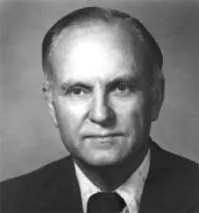
Dr. Sennholz heads the Department of Economics at Grove City College and is a noted writer and lecturer for freedom.
The organization for Economic Cooperation and Development, which endeavors to achieve international coordination of government policies, recently expressed alarm about the ever accelerating rates of inflation. It called the pace of monetary depreciation “unacceptably high” and warned about the inherent dangers of a major business depression as a result of rampant inflation. In fact, many European economists are convinced that “the Western world is at the threshold of a runaway inflation of the Latin-American type.”
During the 1950′s we had grown accustomed to a creeping depreciation of currencies at an average rate of 2 per cent a year. During the 1960′s the rate had climbed to 4 and 5 per cent; last year it reached 6 per cent, which is well beyond the creeping pace. And, if we project the depreciation growth rates of the 1960′s to the 1970′s, we must brace ourselves for inflation of 10 to 20 per cent annually.
We need not here analyze many political and social aspects of this ominous development in the Western world. But we should like to review the history of the greatest inflation of the century, the German hyperinflation of the early 1920′s, and the ideological causes that brought it about. For history is the glass through which we may behold the deeds and errors, the foibles and misfortunes of mankind.
The German inflation, too, began with a creeping rate of one and two per cent. When World War I broke out, the central bank (Reichsbank) immediately suspended redeem ability of its notes in order to prevent a run on its gold reserves. Then it offered assistance to the central government toward financing the war effort. As taxes are always unpopular the government preferred to borrow huge amounts of money to cover its budgetary deficits. And the central bank assisted every issue of new treasury obligations by discounting much of it. Thus, a large percentage of government debt found its way into the vaults of the Reichsbank and an equivalent amount of printing-press money into the peoples’ cash holdings. As in other belligerent countries, the central bank was monetizing the growing government debt.
By the end of the war, the amount of money in circulation had risen fourfold and prices some 140 per cent. Yet, the German mark had suffered no more than the British pound, was somewhat weaker than the American dollar, but stronger than the French franc. Five years later, in December 1923, the Reichsbank had issued 496.5 quintillion marks each of which had fallen to one trillionth of its 1914 gold value.¹
How stupendous! Practically every item of trade was costing trillions of marks. The American dollar was quoted at 4.2 trillion marks, the American penny at 42 billion marks. How could a European nation that prided itself on its high levels of education and scholarly knowledge suffer such a thorough destruction of its money? Who would inflict on a great nation such evil which had ominous economic, social, and political ramifications not only for Germany but for the whole world? Was it the victors of World War I who, in diabolical revenge, devastated the vanquished country through ruinous financial manipulation and plunder?
Every mark was printed by Germans and issued by a central bank that was governed by Germans under a government that was purely German. It was German political parties, such as the Socialists, the Catholic Centre Party, and the Democrats, forming various coalition governments, that were solely responsible for governmental policies. Of course, admission of responsibility for any calamity cannot be expected from any political party.
The reasoning that led these parties to inflate the national currency at such astronomical rates is not only interesting for economic historians, but also exposes the rationale of monetary destruction. The doctrines and theories that led to the German monetary destruction have been applied with similar consequences in many other countries, and underlie the rampant inflation throughout the Western world today.
Four erroneous doctrines or theories guided the German monetary authorities in those baleful years.
No Inflation in Germany
The most amazing economic sophism advanced by eminent financiers, politicians, and economists endeavored to show that there was neither monetary nor credit inflation in Germany. These experts readily admitted that the nominal amount of paper money issued was indeed enormous. But the real value of total currency in circulation, that is, the total value in terms of gold or goods prices, they argued, was much lower than before the war and low relative to that of other industrial countries.
The Minister of Finance, celebrated economist Helfferich, repeatedly assured his nation that there was no inflation in Germany since the total value of currency in circulation, when measured in gold, wan covered by the gold reserves in the Reichsbank at a much higher ratio than before the war.2
The President of the Reichsbank Havenstein categorically denied that the Central Bank had inflated the German currency. He was convinced that it followed a restrictive policy since its portfolio was worth, in gold marks, less than half its 1913 holdings.
Professor Julius Wolf wrote in the summer of 1922: “In proportion to the need, less money circulates in Germany now than before the war. This statement may cause surprise, but it is correct. The circulation is now 15 to 20 times that of pre-war days, whilst prices have risen 40 to 50 times.” Similarly, Professor Elster reassured his people: “However enormous may be the apparent rise in the circulation in 1922, actually the figures show a decline.”3 The Statistical Bureau of the German Government even calculated the real values of the per capita circulation in various countries. It, too, concluded that there was a shortage of currency in Germany, but a great deal of inflation abroad.
Of course, this fantastic conclusion drawn by monetary authorities and experts bore ominous consequences for millions of people. Through devious sophisms, it simply denied individual responsibility for the disaster and thus of certain industries (e.g., coal, electrical, and potash industries) were introduced, but failed to become law. The eight-hour day was enacted, and labor unions were given many legal immunities and privileges. In fact, a system of labor councils was set up which authorized the workers in each enterprise to elect representatives who shared in the management of the company!
While government expenditures rose by leaps and bounds, the revenue suffered a gradual decline; in October 1923, only 0.8 per cent of government expenses were covered by tax revenues. For the period from 1914 to 1923 scarcely 15 per cent of the expenses were covered by means of taxes. In the final phase of the inflation the German government experienced a complete atrophy of the fiscal system.
The depreciation of the currency brought about the destruction of taxable wealth in the form of mortgages and bonds, annuities and pensions, which in turn reduced government revenue. It is true, some speculators reaped spectacular profits from the depreciation, but they easily evaded the tax collector. Moreover, the fiscal policies of the Socialist government were openly hostile toward capital and frequently endeavored to impose confiscatory capital levies upon all wealth. Secretary of the Treasury Erzberger even vowed that “in the future Germany, the rich should be no more.” Consequently a massive “flight of capital” from Germany developed as all classes of savers invested their money in foreign bank accounts, currencies, bills, securities, and the like. Much taxable wealth was removed from the grip of tax collectors.
Furthermore, the rapid depreciation of currency greatly reduced all tax liabilities during the time interval between the taxable transaction and the date of tax payment. The taxpayer usually paid a sum the real value of which was greatly reduced by inflation. Nevertheless, government expenditure accelerated, while revenue in terms of real value continued to decline. The growing deficits then were met with even larger quantities of printing press money, which in turn generated ever larger deficits. The German monetary authorities were trapped in a vicious circle from which they had neither the political courage nor the financial know-how to extricate themselves.
The leading monetary authority, Dr. Helfferich, even warned his people against the dire consequences of monetary stabilization. “To follow the good counsel of stopping the printing of notes would mean refusing to economic life the circulating medium necessary for transactions, payments of salaries and wages, and so on; it would mean that in a very short time the entire public, and above all the Reich, could no longer pay merchants, employees, or workers. In a few weeks, besides the printing of notes, factories, mines, railways and post office, national and local government, in short, all national and economic life would be stopped.”5
The Balance of Payments and the Treaty of Versailles
Throughout the period of the inflation the most popular explanation of the monetary depreciation laid the blame on an unfavorable balance of payments, which in turn was blamed on the payment of reparations and other burdens imposed by the Treaty of Versailles. To most German writers and politicians, the government deficits and the paper inflation were not the cause, but the consequences, of the external depreciation of the mark.
The wide popularity of this explanation, which charged the victorious allies with full responsibility for the German disaster, bore ominous implications for the future. Its simplicity appealed to the masses of economically ignorant people whose chauvinism and nationalism always make the idea of foreign intrigue and conspiracy so palatable. The intellectual and political leaders who actively propagated the doctrine were sowing the seeds for the whirlwind they ultimately reaped a decade later.
During those baleful years, Germany procured gratuitously from abroad large quantities of raw materials and foodstuffs. According to various authoritative estimates, foreign individuals and banks bought at least 60 billion paper marks which the Reichsbank had floated abroad at an average price of 1/4 gold mark for a paper mark. The depreciation of the mark to one trillionth of its earlier value repudiated these foreign claims to German goods. Thus, foreigners suffered losses of some 15 billion gold marks, or some $3.5 billion U.S. dollars, which was eight times more than Germany had paid in foreign exchange on account of reparations.
Even if it had been true that excessive burdens were thrust on Germany by the Allies, there was no need for any monetary depreciation. The two phenomena are entirely independent. If excessive burdens are thrust upon a government, whether they be foreign or domestic, government must raise taxes, or borrow some funds, or curtail other expenditures. Excessive reparation payments may be of the mark and who are acquiring vested interests in a continual depreciation…. The enormous speculation on the rise of the American dollar is an open secret. People who, having regard to their age, their inexperience, and their lack of responsibility, do not deserve support, have nevertheless secured the help of financiers, who are thinking exclusively of their own immediate interests…. Those who have studied seriously the conditions of the money market state that the movement against the German mark remained on the whole independent of foreign markets for more than six months. It is the German bears, helped by the inaction of the Reichsbank, who have forced the collapse in the exchange.”
In its broadest sense, speculation is every economic action that makes provision for an uncertain future. The student who studies aeronautical engineering speculates on the future demand for his services. The businessman who enlarges his inventory speculates on a profitable market in the future. The housewife who hoards sugar speculates on the availability of sugar in the future. The buyer or seller of goods or securities hopes to make a profit from future changes in prices. All such actions reflect a natural motivation of free men to improve their material well-being or, at least, to avert losses.
When speculators observe or anticipate more inflation and monetary depreciation, they naturally endeavor to sell the depreciating currency and buy goods or foreign exchange that do not depreciate. They are preserving their working capital. Thus, they are promoting not only their own interests but also those of society which benefits from the preservation of productive capital. The government that is actively destroying the currency is injuring the national interest; successful speculators are safeguarding it. Surely, the speculators who sold German marks and bought U.S. dollars proved to be right in the end.
The Current Dilemma in the Light of the German Experience
The world-wide inflation that is engulfing the free world now springs from similar doctrines and theories. It is true, there is no Treaty of Versailles and no reparation payments that can be blamed for the inflation. But in many countries of Central and Western Europe the responsibility for monetary depreciation is squarely laid on American balance of payments deficits that are flooding those countries with U. S. dollars. While European monetary authorities are actively inflating and depreciating their own currencies—although at a slower rate than their American counterparts—they are pointing at the U.S. balance of payments as the ultimate cause of their currency depreciation. As in the German hyperinflation foreign intrigue and artifice are said to be at work again.
And again the speculators are charged for a share of the blame. American investors who buy foreign securities or make direct foreign investments are said to be largely responsible for the outflow of U.S. funds and loss of gold, which is creating an unfavorable balance of payments and weakening the U.S. dollar. Moreover, Americans who prefer foreign products over home-made products, or choose to travel abroad rather than stay at home are decried as selfish and unpatriotic. Numerous regulations imposed by the very monetary authorities who perpetrate the inflation aim to prevent speculation in order to save the dollar.
The specious argument that denies the presence of any inflation in terms of purchasing power or gold value may be expected to emerge in later phases of the inflation when monetary authorities will desperately seek any argument that promises to hold them blameless.
The most popular contemporary doctrine that advocates inflation and credit expansion pleads its case in terms of economic boom and full employment. Our economic order which is laboring under heavy government intervention and restriction is a stop-and-go system with alternating booms and busts. The booms are generated by heavy budgetary deficits and monetization of government debt. The busts inevitably follow the booms as soon as stabilization is attempted or the rate of inflation is temporarily slowed in order to prevent a hyperinflation. Under the sway of the “new economics” of Lord Keynes and his American disciples, our monetary authorities inflate and depreciate to finance the boom, and then “reinflate” when the economy falters, to prevent massive unemployment. Inflation is the modern panacea for political, social, and economic evils most of which were created by the inflation itself. In truth, it is a savory poison that slowly kills not only the patients who take it but also the doctors who prescribe it.
—FOOTNOTES—
1 According to the British and German systems of numeration, the billion is a million of millions, a trillion a million of billions, and each higher denomination (e.g. quadrillion, quintillion, sextillion, etc.) is a million times the one preceding. In the American system, the billion is a thousand millions, and each higher denomination is a thousand times the preceding. It must also be noted that a billion in the U.S. system is called milliard in the British and German systems. In German and British texts the sentence would thus read: “Five years later in December 1923 the Reichsbank had issued 496.5 trillion marks each of which had fallen to one billionth of its 1914 gold value.”
2 Das Geld, 1923, p. 646.
3 Von der Mark zur Reichsmark, 1928, p. 167.
4 Cf. my essay on “The Value of Money” in the FREEMAN, Nov. 1969.
5 Das Geld, p. 650.