Leaders of the Mtindo Development Initiative understand that without liberty, there is no hope.
One of the wisest men of the last half-century, the late Ghanaian economist and American University professor George B.N. Ayittey expressed the problem of Africa in a profoundly succinct fashion.
“Africa is poor,” he wrote, “because she is not free.” The world’s second largest and second most populous continent, he noted, “has more dictators per capita than any other.”
Ayittey, who died in 2022, loved telling stories of Africa’s rich, pre-colonial history of private entrepreneurship. And he deplored the tendency in more recent, post-colonial times to replace it with the dead, corrupt hand of the State. He looked forward to the day when this sad reality would be rejected:
The richest persons in Africa are heads of state, governors and ministers. So every “educated” African who wants to be rich—and there is nothing wrong with wanting to be rich—heads straight into government or politics.
Government and the political process can, at best, provide an environment in which people, safe from vandals, can solve poverty by creating wealth. Beyond that “nightwatchman” function, the State is simply coercive and redistributive. It steals and punishes wealth, and it bestows power on the crooks who impoverish whole nations. For Africa or any continent to flourish, people must embrace decentralization, private property, free markets, and the “animal spirits” that prompt risk-taking entrepreneurship.
There is hope for Africa. The specter of communism has receded. Haltingly, some places are employing privatization. Free market think tanks are doing great work in a growing number of its 54 countries. But for policies to change dramatically, ideas must change dramatically. When Africans decide that government is the problem, not the solution—when Ayittey’s dream of freedom takes hold—life and growth will take off like a rocket.
For that reason, we welcome a new organization to the fight. It is called the Mtindo Development Initiative, or the Mtindo Network. One of its team leaders is Ulyana Kubini, a Ukrainian who knows that without liberty, there is no hope.
I recently interviewed Ulyana. My questions and her responses are recorded below. I hope that readers will take an active interest in her and Mtindo’s mission.
_____
REED: Tell us about yourselves, especially what first stimulated you to work for the advancement of liberty.
KUBINI: In 2017, at a student conference in Makerere University in Kampala, Uganda, Denis Bua was introduced to a group of liberal thinkers from different learning institutions who believed in ideas like free-market systems, rule of law, individualism, and limited government. These were a group of young people who referred to themselves as “the Cheetah Generation” from Students for Liberty. Through mentorship and risk, Denis eventually created enough of a student base and gathered enough knowledge to start his own venture: the Mtindo Network.
I was introduced to the ideas of liberty at a very young age. Having grown up in Ukraine and seeing the poverty our socialist government’s policies produced before the 2013–14 Maidan uprising, the rebel in me knew one thing: things cannot continue the way they are if we wish to be a prosperous country. But I had no exposure to the ideas of liberty and free enterprise until I came to America.
Once in America, the contrast between my homeland and the US was night and day, economically speaking. I began researching economics, and came across the works of Friedman, Hayek, and Mises. Seeing how these ideas were incorporated in US history, I believed I finally found the ideas that have and would bring prosperity to millions. Through researching student groups that had similar values, I came across Mtindo. Being thoroughly impressed by their work already, I reached out to Denis and Giden Onduri, another Ugandan free-market leader, and the rest is history.
REED: What is the purpose or mission of Mtindo? When was it started?
KUBINI: For over six years, Mtindo’s mission has been to empower individuals through providing essential knowledge and skills related to economics, business, and personal development. By focusing on education, Mtindo empowers people to develop private property solutions that address long-term community needs and environmental challenges. We believe that with the right tools and understanding, individuals can drive positive, lasting change, fostering self-sufficiency and resilience. This mission emphasizes sustainable development, encouraging initiatives that not only solve immediate issues but also promote ongoing benefits for future generations. By empowering the next generation with the ideas of liberty and free enterprise, we hope to build a skilled and prosperous Africa.
REED: What are some examples of your programs and success?
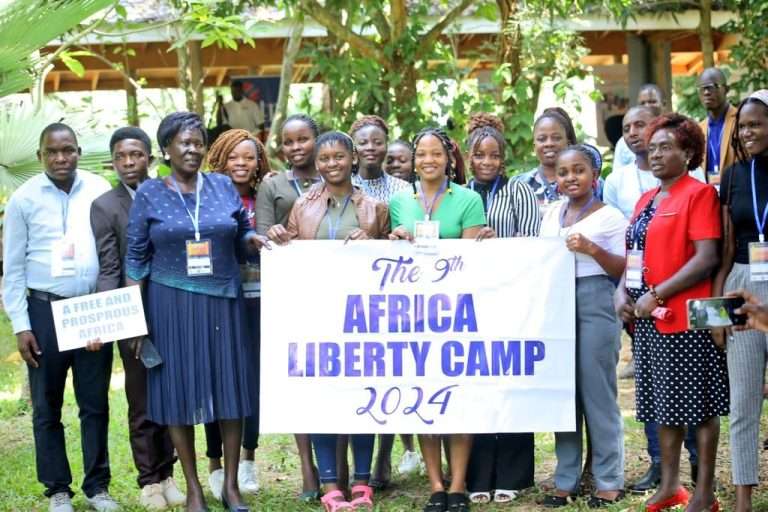
KUBINI: Just recently, over 100 students from across Kenya, the Democratic Republic of Congo, and Uganda participated in the annual African Liberty Camp. There, we hosted pro-liberty speakers and professors, as well as distributed copies of books about freedom. After talks by Li Schoolland and Christopher Lingle on human innovation and how to imagine the economy, dozens of students came up to talk to them more in-depth. Some of these conversations were so engaging that the students even continued the topics over dinner, hours after the talks. The fact that so many young individuals were willing to travel in some cases over 1,000 miles to be immersed in the future of African economics makes us genuinely excited for the future.
We were also able to demonstrate the power of private charity through numerous recent projects, including EducateHer. With this project, Mtindo reached over 265 women and girls across Uganda, distributing healthcare products and working with them to train, educate, and sponsor girls and women to receive education and skills in their desired fields. We believe that the best way to protect women’s rights and further public health is through private initiatives such as this one, especially when corrupt government officials repeatedly diminish women’s access to education.
REED: Why have you chosen to focus on Africa? Which countries are you most involved in, and why?
KUBINI: The Mtindo Network Development Initiative decided to focus on Africa due to the continent’s significant potential for development and the pressing need for sustainable solutions to address social, economic, and environmental challenges.
Africa’s diverse and growing population presents both opportunities and challenges, making it a critical region for change through education as well as skill-building for women and youth.
The organization is most involved in countries such as Uganda, Kenya, Tanzania, South Sudan, Burundi, and Malawi. We chose these nations due to the presence of reliable partner organizations that have easily worked with the Mtindo Network Development Initiative in our cross-border book distribution projects. By focusing on these key countries, Mtindo aims to create scalable and replicable models for sustainable development across the continent.
REED: What barriers does the cause of liberty face in Africa?
KUBINI: Many African countries struggle with political instability and widespread corruption, which undermine democratic processes and hinder the development of transparent, accountable governance and entrepreneurs. These issues can suppress civil liberties, restrict political freedoms, and create environments where the rule of law is weak.
Limited access to education and information restricts individuals’ ability to understand and assert their rights. Without a strong foundation of civic education, populations may not be fully aware of their rights or the mechanisms available to defend them, making it difficult to advocate for greater liberty.
REED: Which liberty-related books, articles, or other media elicit the greatest positive response among Africans?
KUBINI: We have worked with a variety of pro-liberty authors across the globe in distributing their works to our students with overwhelmingly positive responses. One such work is The Divine Economy Model, a popular economics book with a rich enlightenment of economics with an aim to promote economic understanding, justice, and free markets. The book was written by Bruce Koerber, an Auburn-educated economist and author from the United States.
We have also distributed An Introduction to Entrepreneurship by Eamonn Butler, a powerful read that details entrepreneurs’ pivotal role in boosting economic progress, productivity, and prosperity by driving economic growth and creating new opportunities. Many of the ideas presented in this text resonate with students who yearn to start their own businesses, but never got any guidance on how in the government schools. In fact, some government and school officials across the country actively dissuade people from pursuing entrepreneurship. We seek to combat this narrative. Given the interest students have in Dr. Butler’s work, we see more and more students embracing entrepreneurship as a potential career.
We really appreciate FEE and have been using a lot of its free website resources whenever we can, such as for the African Liberty Camp.
REED: How can interested readers learn more about, and follow, your work?
KUBINI: I invite them to visit our website: https://mtindonetwork.org/. They can financially support Mtindo, help spread the word about our activities, and even volunteer if they live in a country where we are presently active.
REED: My work since the 1990s has taken me to quite a few countries in Africa. I know that what Mtindo is doing, along with the projects of African free-market think tanks, has the potential to transform the continent. Ulyana, I wish you and your colleagues all the best!