
Europe is re-embracing nuclear power, but Spain refuses to follow.
On April 28 last year, a massive blackout plunged Spain and Portugal into darkness for over twelve hours. Flights were canceled, thousands of people were stranded on trains, and there were at least eight related deaths. The Spanish right seized on this freak event to attack what it called the Socialist-led government’s “climate fanaticism”—but although renewable energy was generating about 70% of Spain’s power at the time, an in-depth investigation has found that it wasn’t the cause.
Spain’s Socialist prime minister Pedro Sánchez, it seems, was right in saying, “Those who link this incident to the lack of nuclear energy are either lying or revealing their ignorance,” although he can’t have had sufficient evidence for this when he said it. The Spanish premier, however, may still have to rethink his position on nuclear power, as the rest of Europe shifts its energy policy in reaction to a fraught global situation. Sánchez’s crowd-pleasing €5 billion emergency package, designed to reduce the economic impact on Spaniards of events in the Middle East, is a short-term fix for what could be a long-term problem.
The final report on Spain and Portugal’s 2025 blackout was released on March 20 by the European Network of Transmission System Operators for Electricity (ENTSO-E). Its panel of 49 experts concluded that 17 “interacting factors” caused the power outage, including “oscillations, gaps in voltage and power control [and] rapid output reproductions and generation disconnections.” They illustrate this “perfect storm” of inter-connected events with a diagram that resembles the family tree of an ancient dynasty.
According to ENTSO-E, no single cause can be blamed for last April’s blackout. Rooftop solar panels were found to have tripped early, and some might have to be re-fitted—but that’s hardly enough to justify the Spanish right’s claim that an overreliance on green energy was the main culprit. Most of ENTSO-E’s recommendations to ensure that a blackout doesn’t happen again are aimed at the entities responsible for voltage control (although the overall picture is of a badly-managed system with insufficient regulation). It might seem that Sánchez, who has promised to phase out the country’s seven nuclear reactors by 2035, can breathe a sigh of relief: his beloved renewables have been vindicated.
Not quite. The closure of the Strait of Hormuz, a consequence of the Iran War, has once again highlighted Europe’s dependence on energy imports, prompting a dramatic policy reversal. Speaking at the Nuclear Energy Summit in Paris on March 10, EU Commission president Ursula von der Leyen said that reducing the EU’s reliance on a “reliable, affordable source of low-emissions powers” has proved a “strategic mistake.”
Von der Leyen announced that the EU, which imports almost 60% of its energy, will be investing €330 million in fusion technology, with a focus on Small Modular Reactors (SMRs). In this way, Europe hopes to reduce its dependence on oil and natural gas, which respectively account for 67% and 24% of its energy imports. The need is urgent: one recent report by Deloitte calculated that, had Spain’s nuclear fleet not been operating during the energy crisis triggered by Russia’s invasion of Ukraine, it would have faced extra costs of €5 billion, equivalent to 0.4% of its GDP.
Von der Leyen’s renewed endorsement of nuclear power would have been unthinkable 15 years ago. The Fukushima disaster of March 2011—when a tsunami and earthquake severely damaged a nuclear plant on the northeast coast of Japan, releasing radioactive contaminants—caused an EU-wide shift towards renewables (even though only one fatality in Fukushima was linked to radiation exposure). Germany’s then-Chancellor Angela Merkel—in whose cabinet von der Leyen was serving as Minister for Labor and Social Affairs—led the way, announcing an 11-year phaseout of nuclear power. In April 2023, its last three reactors were decommissioned, but current German Chancellor Friedrich Merz considers this to have been a “serious strategic mistake.”
Geopolitical crises are forcing many other EU countries to reconsider their energy mixes. In 2023, Sweden changed its 2040 goal from “100% renewable” to “100% fossil-free,” freeing itself up to invest in new nuclear technologies. Belgium, which had planned to abandon nuclear power by 2025, pushed this back by a decade after Russia’s invasion of Ukraine; then, last May, a large parliamentary majority passed a bill repealing the phaseout completely. Italy is also considering a return to atomic power, after shutting its last reactor in 1987, while Poland is building its first nuclear plant with EU funds. Even Denmark, a country that generates 80% of its electricity with renewable energy, is reconsidering a 40-year ban on nuclear power, in favor of investing in SMR technology.
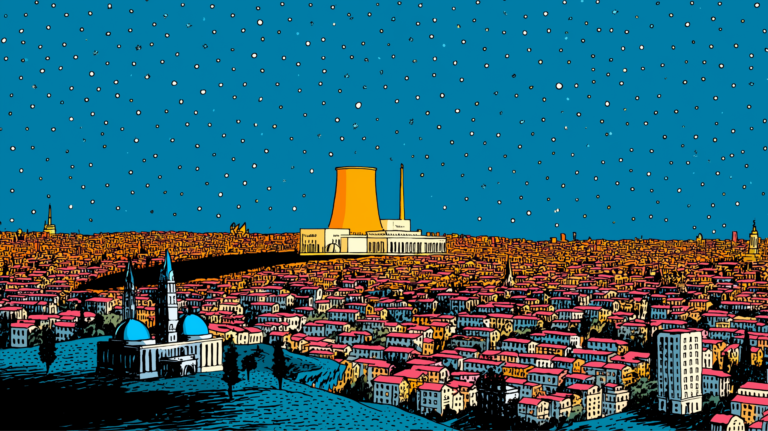
Spain is under increasing pressure to follow their example—and time is running out. Between 2027 and 2028, Sánchez plans to shut down the two reactors at the country’s oldest and largest nuclear plant, situated near the western town of Almaraz, which provide about 7% of the country’s electricity. (Almaraz uses the Tagus River, which flows into Portugal, for cooling, and has long been a point of contention between Lisbon and Madrid.) This will be the first stage of Spain’s plan to abandon nuclear power by 2035, agreed on in 2019 by Sánchez’s government, the major electricity providers, and Enresa, a public company that manages radioactive waste.
But according to a manifesto signed last February (less than two months before the blackout) by 32 leading representatives of Spain’s nuclear industry, that agreement “was made under an industrial, geopolitical, social and economic context that is vastly different from today’s reality.” Their argument is that an expected surge in electricity demand over the next decade, combined with an overreliance on imported gas and oil, makes this timeline unrealistic. Premature dismantling of Spain’s nuclear infrastructure, they warned, would cause “irreparable” social and economic damage.
Shortly before the manifesto was released, the Conservative People’s Party (PP) presented a proposal to parliament calling for the reversal of Spain’s nuclear phaseout. It was approved by 171 votes to 164, but Sánchez took no notice. Last June, he said that he wouldn’t “deviate a single millimeter from the planned energy roadmap,” and that “Spain’s energy future will be green or there will be no future.” Presumably, in ten years’ time, when most other European nations have been reduced to radioactive wastelands, Spain will be living happily off wind and sun.
Green energy might not have caused the Iberian blackout, but that doesn’t mean that Madrid can ignore the nuclear renaissance occurring throughout Europe. Almost a year on, Sánchez clings to his immovable faith in renewables, managing energy policy with what PP leader Alberto Núñez Feijóo has called “enormous ideological bias.” Meanwhile, all eyes are on Almaraz: Will it receive a stay of execution, or become the first casualty of Sánchez’s obsession with green energy?