
Switzerland’s case for decentralization.
Switzerland is the freest country in the world, according to the Human Freedom Index. Small in territory but giant in institutional autonomy, it has built a decentralized, monetarily stable, and deeply participatory democracy, all outside the European Union.
While Member States have no alternative to the uniform directives designed in Brussels, Switzerland negotiates sectoral agreements according to its national interest and the democratic consent of its citizens. The new “Bilaterals III” package, whose entry into force depends on approval by the Swiss Parliament and possibly a referendum, is a reminder that there is an alternative to the European integrationist “one size fits all” model.
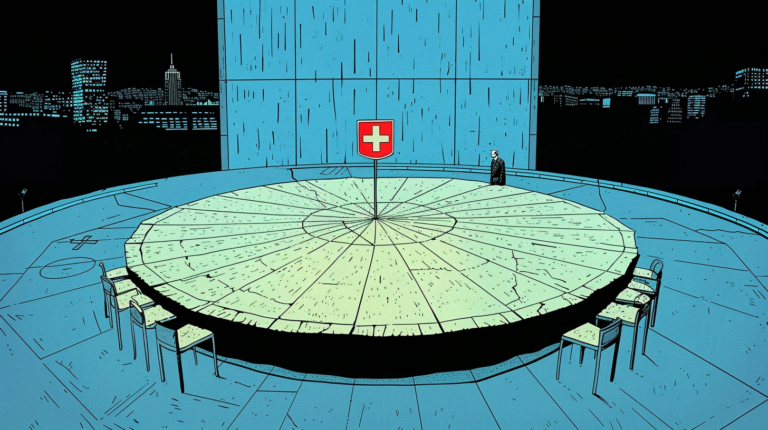
Switzerland’s institutional architecture limits central power. Executive authority is not concentrated in a single figure, but exercised collegially by a seven-member Federal Council. The President of the Confederation, elected for only one year, performs essentially representative functions. The system was designed to prevent the personalization of power and to avoid prolonged concentrations of authority.
The cantons, federal states with almost total fiscal and administrative autonomy, compete with one another in taxation, regulation, and public policy. This institutional competition creates permanent incentives for efficiency and imposes discipline on political power: poor decisions may lead to the flight of capital and residents to more attractive jurisdictions.
Switzerland’s system is rooted in a deeply entrenched culture of direct democracy. Through the optional referendum, 50,000 citizens can require that a law passed by Parliament be submitted to a popular vote. With 100,000 signatures, citizens can propose amendments to the Constitution. Structural issues are regularly decided at the ballot box. Political power therefore remains under constant scrutiny by the population.
It is thus natural that Switzerland’s relationship with the European Union has never taken the form of institutional submission, but rather of contractual and voluntary cooperation.
In 1992, the Swiss rejected accession to the European Economic Area. In 2001, they clearly rejected, with 76.8% of the vote, the opening of negotiations for full accession to the European Union. Switzerland retained the Swiss franc, preserved military neutrality, and rejected the principle of the automatic primacy of European law.
The Swiss rejection followed the increasingly centralizing trend of the European Union over the past three decades: the Single European Act reduced State veto powers; Maastricht launched monetary union and political integration; Amsterdam and Nice expanded competences in justice and governance; and Lisbon consolidated the Union as a political actor with its own legal personality and broadened qualified majority voting. While the EU moved toward automatic harmonization, Switzerland insisted on case-by-case negotiation.
This divergence became evident in 2021, when Brussels sought to force the bilateral agreements into an Institutional Agreement that would have entailed alignment with EU law and strengthened dispute resolution mechanisms. In practical terms, it would have brought Switzerland closer to permanent legal integration. Bern withdrew from the negotiations.
In December 2024, Bilaterals III was concluded, aiming to update and stabilize the relationship in areas such as energy, mobility, research, mutual recognition of standards, and the free movement of persons. The package includes a reinforced safeguard clause allowing temporary restrictions on immigration in the event of excessive pressure, as well as greater involvement of the cantons.
The SVP party, currently the country’s largest political force, gathered signatures for the initiative “No to a 10 Million Switzerland,” to be voted on in June 2026. The proposal seeks to constitutionalize a limit of 10 million permanent residents. If approved, it could require the Government to restrict immigration drastically and, ultimately, to terminate the free movement agreement with the European Union.
By building an architecture based on the primacy of European law, the expansion of qualified majority voting, and the continuous transfer of competences, European integration has been presented as progressive and, in many respects, irreversible. Switzerland demonstrates that such inevitability is a political myth.
The country maintains deep access to the European market, preserves monetary sovereignty, controls its fiscal policy, and upholds mechanisms of direct democracy capable of blocking structural decisions. Prosperity has not collapsed. Stability has not vanished. Cooperation has not ceased.
The Swiss example shows that European centralization is neither inevitable nor indispensable, nor is it the path to prosperity. On the contrary, societies are freer and more prosperous when, through agreement, they establish treaties that place their own best interests as the priority.