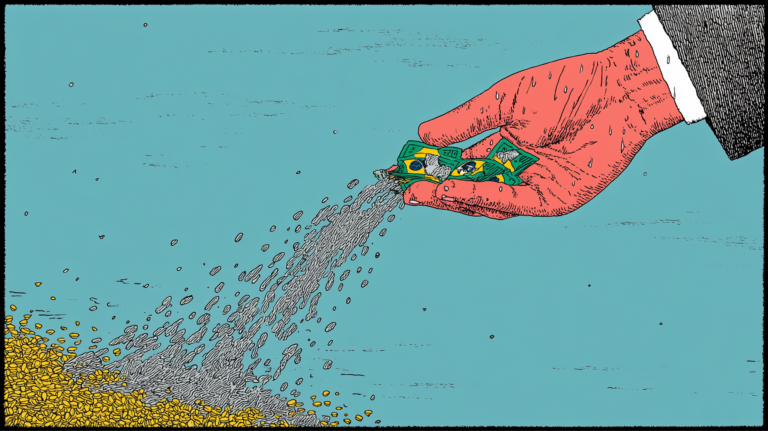

Corruption, taxes, and authoritarian labor shackles.
Brazil finds itself at a historical crossroads that demands a rigorous analysis of its institutional structures. The release of the 2025 Corruption Perceptions Index (CPI), record-breaking data from the Impostômetro, and the persistence of an authoritarian labor framework expose a system of economic asphyxiation and moral erosion. The State, under the pretext of protecting the citizen, in reality hinders their initiative, their property, and their future.
The Transparency International Corruption Perceptions Index, an annual report published by the organization to assess perceived levels of public-sector corruption worldwide, provides important context for evaluating governance and institutional trust in countries such as Brazil. The transparency International report confirms what independent analysts have long pointed out. With 35 points on a scale of 0 to 100, Brazil occupies the 107th position among 182 countries, registering one of the worst marks in its recent historical series. This result is not merely a statistical indicator, but the quantitative expression of an institutional environment in which public power is frequently captured by private interests, eroding social trust. This decline points to deep failures in control mechanisms, associated with the growing politicization of the justice system.
From an economic standpoint, corruption acts as an invisible and arbitrary tax. It raises transaction costs, inhibits long-term investment, and favors the flourishing of so-called crony capitalism. In an environment of high regulatory power, inefficient companies survive at the taxpayer’s expense, while productive entrepreneurs are blocked by bureaucratic barriers. The result is a continuous process of weakening morality and the free market.
According to the Heritage Foundation’s Index of Economic Freedom, as well as the Fraser Institute, there is a strong correlation between economic freedom and low levels of corruption. Countries that limit the scope of government and rigorously protect private property tend to exhibit greater institutional resilience. In Brazil, the opposite phenomenon is observed: the size and complexity of the State together create broad zones of discretion, where bureaucracy becomes a currency of exchange. The politicization of justice, highlighted in the 2025 report, suggests that even institutional checks and balances are fragile.
While the integrity of the Brazilian State is questionable, its capacity to extract resources from society is remarkable. On December 31, 2025, the São Paulo Commercial Association’s Impostômetro registered the record figure of R$3.98 trillion ($772 billion) collected, a nominal growth of 10.56% compared to the previous year. This advance, far exceeding the period’s inflation, reflects a deliberate increase in revenue expansion by the government.
But this increase did not occur by chance. The re-evaluation of fuels, taxation of electronic bets, taxing low-value international packages, incidence on exclusive funds and offshores, plus the end of sectoral tax benefits, have significantly expanded the State’s weight on production and consumption. In February 2026, Brazilians had already paid R$500 billion ($97 billion) in taxes in just the first 40 days of the year.
According to the CPI/IPCA, from the Real Plan launch in 1994 to 2026, the Real accumulated roughly 982.5% inflation, equivalent to prices nearly 10.8 times higher today. In other words, R$100.00 in 1994 now equals R$11.75. Furthermore, according to the Index of Return to Society’s Well-Being (IRBES), Brazil has for 14 consecutive years ranked as the country that charges the most taxes while giving the least return to the population. While the government celebrates “pretty revenue numbers,” the population faces a systematic loss of purchasing power, fueled by a tax system that burdens consumption, disproportionately penalizing the poorest.
Institutional deterioration is also directly reflected in labor remuneration. In 2026, Brazil had one of the lowest minimum wages in the region when converted to dollars. The Brazilian minimum wage, set at R$1,621, equals approximately US$290–300, a value lower than observed in countries like Paraguay (about US$435), Chile (US$560), and Uruguay (US$630). This distortion does not stem from a lack of potential productive capacity, but from structural obstacles, such as high payroll taxation, labor charges that nearly double the cost of formal employment, systemic low productivity, and chronic currency devaluation caused by persistent fiscal imbalances.
The result is a labor market unable to sustain higher real wages, even in a large-scale economy. Evidently, the impoverishment of the Brazilian worker is a direct consequence of low economic freedom and difficulty in doing business.
The critique of Brazil’s tax burden is not based on social insensitivity, but on the realization of its regressivity. The promise of social justice through fiscal expansion ignores the perverse effects of consumption taxation and chronic inflation. As Thomas Sowell observed, the attempt to equalize outcomes through State redistribution frequently reduces individual freedom and strengthens a bureaucracy that consumes resources intended for the most vulnerable.
The asphyxiation of entrepreneurship in Brazil has deep historical roots dating back to the 1940s. The Consolidation of Labor Laws (CLT), promulgated by Getúlio Vargas in 1943, is celebrated by many as a milestone of protection, but a technical analysis reveals its deeply authoritarian ideological matrix. Directly inspired by the 1927 Carta del Lavoro, the foundational document of Benito Mussolini’s corporatist system, the CLT institutionalized State tutelage over the worker.
The fundamental principle of the Carta del Lavoro was that work is a “social duty” and that the State must be the supreme arbiter between capital and labor, suppressing free class conflict in favor of “harmonious collaboration” dictated from top down. Vargas absorbed this logic entirely, creating a structure where the worker is not a free citizen to negotiate contract terms, but a subject protected by an omnipresent State apparatus. The requirement of unique unions, compulsory contributions, and specialized labor justice are direct reflections of this fascist heritage that survived redemocratization.
In practice, this structure imposes high costs on formal hiring. In 2026, the total cost of a worker under the labor legislation regime is expected to approach 190% of the nominal salary. For every real received by the employee, the employer bears nearly double the charges and mandatory provisions. This model discourages formalization, reduces job creation, and penalizes especially those entering the job market, changing fields, and small and medium enterprises.
From the perspective of thinkers like Roger Scruton, replacing individual responsibility with compulsory State security corrodes the bonds of trust that sustain community life. Freer economies, like the United States, allow dynamic contractual adjustments and exhibit more resilient labor markets to economic shocks as a result.
The Brazilian business environment reflects this combination of corruption, high tax burden, and labor rigidity. In the 2025 Index of Economic Freedom, the country ranked 117th, with particularly weak performance in fiscal health and government integrity. Tax bureaucracy requires companies to spend about 1,500 hours annually just to meet fiscal obligations, a significant waste of human and financial capital.
The direct consequence is high business mortality. Less than 40% of Brazilian companies survive after five years of activity. Among the main factors are high credit costs, legal insecurity, and regulatory complexity, which disproportionately affect small entrepreneurs.
International comparisons highlight the contrast. Countries leading economic freedom rankings, like Singapore, Switzerland, Ireland, and New Zealand, show greater institutional stability, lower corruption, and better well-being indicators, including for the poorest. Economic freedom is not a privilege of rich countries, but the proven path to prosperity.
Global data show that freer countries have significantly higher per capita income than repressed ones and that the poorest in those economies enjoy much higher living standards. In contrast, dependence on State transfers tends to perpetuate stagnation and vulnerability.
The institutional degradation evidenced by the aforementioned 2025 CPI has immediate political implications. Social polarization and weakening trust in institutions reflect the perception that the State serves its own protection. The 2025 tax reform, despite simplification rhetoric, reinforces this trend by consolidating one of the world’s highest tax burdens.
Brazil lives at the peak of the conflict between a productive society and an interventionist State. The diagnosis is unquestionable, as corruption, confiscatory taxation, and bureaucratic paralysis form a vicious circle that prevents sustainable growth. Breaking this cycle requires a shock of economic freedom based on reducing the State’s scope, lowering the tax burden, improving the corporatist matrix of labor legislation, and strengthening legal security.