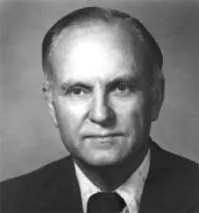
Dr. Sennholz heads the Department of Economics at Grove City College and is a noted writer and lecturer on monetary and economic affairs. This article is reprinted by permission from Private Practice magazine.
Every U.S. President from the time of Franklin D. Roosevelt has been an “inflation fighter.” Some denounced inflation as “public enemy number one,” others even declared war on inflation.
And yet, since the first declaration of war by FDR, the American dollar has lost 80 per cent of its purchasing power and is losing more every day. Inflation is winning all the battles.
For almost 50 years of the anti-inflation war the U.S. government has pointed at several culpable parties. American business, especially big business, has taken the brunt of the blame. One President even used four-letter words to describe the greed of businessmen who raise prices. Some have taken potshots at physicians, attorneys, and other professionals, or pointed at labor unions. All presidents like to flail at speculators who hedge against the U.S. dollar by buying gold and harder currencies. And all have damned foreign governments for ruining the dollar.
Recent proposals in the battle against inflation call for restrictions on the production and consumption of energy and programs to spur U.S. exports, limit imports, sell additional amounts of gold, and encourage West Germany and Japan to buy more from the U.S.
If it were not for the ominous effects of inflation on our lives and our society, the anti-inflation war would be a proper subject for the circus. The clown pompously announces he will demonstrate his skill, but lo and behold, always accomplishes the very opposite. The President formally announces another anti-inflation program, but lo and behold, the inflation gets worse.
The clown’s method of fun is deliberate. He labors to violate a simple natural law. For instance, he seeks to defy the law of gravity by valiantly supporting an object that wants to fall down. He generates laughter, because young children know the futility of his efforts.
For economists familiar with economic laws, the Presidential anti-inflation programs are equally hilarious because they aim to violate inexorable economic laws. Like the Danish King Canute who ordered the rising tide to come no further, the President of the United States is commanding economic laws to yield.
For example, all governmental efforts to restrict imports and promote exports tend to reduce the supply of available goods. Every freshman economist who is familiar with the law of supply and demand, knows that this policy must raise goods prices and thus depreciate the currency.
The administration proposes a Congressional energy package to reduce the importation of foreign oil and gas “in order to bolster the dollar.” But such a reduction will cause energy prices to rise and the U.S. dollar to depreciate. The world seems to know this, as it continues to dump U.S. dollars on the world money markets. Every time the President speaks of energy and his programs, the dollar falls to a new low.
Like the Danish King Canute who ordered the rising tide to come no further, the President of the United States is commanding economic laws to yield.
The U.S. government is selling gold to strengthen the dollar. It offers foreign bankers and governments the opportunity to exchange dollars for gold, which strengthens the international role of gold and weakens that of the dollar. The dollar price of gold may temporarily fall one dollar or two, but the world-wide distribution of gold tends to bolster its importance.
The President lashes out at individuals—especially at foreigners or those Americans who are not expected to vote for his reelection—for causing the inflation through greed. He becomes a judge, and draws applause from those always ready to think evil of their fellowmen. An economist watching this is reminded of the scriptural question, “Why beholdest thou the mote that is in thy brother’s eye but considerest not the beam that is in thy own eye?” He may also remember the circus scene in which a clown turns on the water sprinkler, thoroughly soaking another clown, and then, with great indignation, assails him for being so wet.
Economists frequently wonder about the mentality of politicians. Does the President really believe that God invested him or his administration with special powers? Does popular acclaim and high office mislead him to believe in such powers? Or is he aware of his limitations, but merely acting the role of an omnipotent leader because the people would like him to be omnipotent? Is the economic ignorance really his own or merely a reflection of the ignorance of the electorate? Does a legislator actually believe that he and his colleagues, in Congress assembled and by majority vote, can negate economic law? For that matter, did King Canute’s entourage, which shouted the King’s order in unison, really believe that the rising tide would come no further?
Does a legislator actually believe that he and his colleagues, in Congress assembled and by majority vote, can negate economic law?
Ours is an age of inflation because most people believe in the desirability of more money and credit, which is the very essence of inflation. Motivated by this belief, they bestowed the monopolistic right to issue money on their government and urged it to be free and easy with the issue. Governments greatly enjoy the use of this power because it affords an important source of revenue. Weak administrations, especially, readily yield to the temptation and create massive quantities of money in order to finance their spending programs. Billion dollar expenditures may generate millions of votes.
Issuing new money inescapably produces undesirable effects. Prices rise as recipients of the new money buy more goods and services. Each unit of money depreciates as more units are emitted. People on fixed incomes and savers see their purchasing power reduced, so they complain about the inflation. The government that is busily emitting massive quantities of new money rushes to the rescue: “By order of the President, the Congress, the courts and the police, all prices stop!” The order is given to millions of individuals exchanging goods and services in countless voluntary transactions.
As long as the order agrees with the value judgments of the trading parties, they will continue to exchange as before. But if the order should differ from their judgments, they will react. The seller who is ordered to exchange at a stop price that is lower than his own value judgment, ceases to exchange. In his judgment he would suffer a loss which he can avoid through inaction. The physician whose fee is officially fixed below the rate that causes him to render his service, will reduce his efforts. Thus, shortages inevitably result wherever government fixes prices below those people would set in free exchanges.
At first, the U.S. government resorts to inflation in order to cover its deficits. When rising prices subsequently hurt millions of people and cause them to voice their frustrations, the very administration that indulges in the spending spree is quick to point its finger of blame at some innocent bystander. It may impose wage and price controls, which control people and cause their productive efforts to decline. Lower output in turn causes the value of goods and services to rise and that of money to fall.
The U.S. government alone is conducting the inflation and making it worse with “anti-inflation programs.” An administration that really disapproved of inflation would just stop inflating the currency.