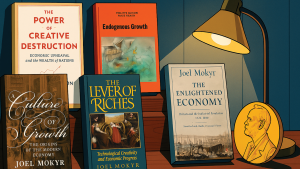
Diving into the research that won this year’s Nobel Prize in Economics.
Daron Acemoglu, Simon Johnson, and James A. Robinson (known collectively as “AJR”) received the 2024 Nobel Prize in Economics for their research on how “institutions shape and affect prosperity.” As Alex Tabarrok highlighted in his review of their work, one interesting aspect is that AJR’s ideas are accessible to a wide audience. Their best-known books, such as Why Nations Fail and The Narrow Corridor, are available in bookstores, reflecting an interest in understanding the relationship between institutions and economic development.
That institutions matter is not new in Economics. In Chapter VII of Book IV of The Wealth of Nations (Of Colonies), Adam Smith explained that the superiority of the English colonies over the Spanish and Portuguese was related to their institutions:
In the plenty of good land, the English colonies of North America, though no doubt very abundantly provided, are however inferior to those of the Spaniards and Portuguese, and not superior to some of those possessed by the French before the late war. But the political institutions of the English colonies have been more favorable to the improvement and cultivation of this land than those of any of the other three nations.
Institutions, as Douglas North pointed out in his work, represent the rules of the game that govern behavior in a society. They are the laws, norms, traditions, and customs that shape behavior and encourage productive or unproductive activities. To understand an economic system, it is essential to analyze its institutions. Peter Boettke points out that “The study of the market order is fundamentally about exchange behavior and the institutions within which exchanges take place”.
AJR’s work is relevant because they found novel ways to identify causal links between the behavior of institutions and their economic effects. As Hayek recalled in The Constitution of Liberty, “If old truths are to retain their hold on men’s minds, they must be restated in the language and concepts of successive generations.” While AJR’s work has been criticized (as Brian Albrecht points out at the end of this text), their approach remains valuable for understanding how institutions that promote economic freedom are essential to prosperity.
Two works by AJR are worth mentioning: The Colonial Origins of Comparative Development and Reversal of Fortune.
In The Colonial Origins of Comparative Development (2001), AJR used mortality rates in European colonial settlements as an instrument to measure the impact of institutions on economic development, and employed an index of protection against the risk of expropriation as a proxy measure of institutions that uphold property rights. They found that in settlements with higher mortality rates (tropical regions), European settlers tended to implement extractive institutions, while in settlements with lower mortality rates (temperate regions), better institutions were fostered. Thus, settlement costs influenced the type of long-term institutions that were established.
In Reversal of Fortune (2002), AJR showed that the richest European colonies in 1500 are now poorer, while those that were poorer then are now richer:
The Mughals in India and the Aztecs and Incas in the Americas were among the richest civilizations in 1500, while the civilizations in North America, New Zealand, and Australia were less developed. Today the United States, Canada, New Zealand, and Australia are an order of magnitude richer than the countries now occupying the territories of the Mughal, Aztec, and Inca Empires.
What happened was that Europeans tended to establish extractive institutions in regions that were initially prosperous and densely populated. But over time there was a reversal in relative income levels as inclusive institutions drove growth in initially poorer settler colonies.
Both studies suggest that economic growth depends on the adoption of institutions that protect private property rights and establish counterweights to government power. Property rights are crucial because, when well defined and protected, they incentivize the efficient use of scarce resources. As economist Armen Alchian said, even if a resource is owned by an individual, its value depends on public appreciation. It is consumers, through their decisions in the marketplace, who determine the most efficient uses of resources. In this way, societies with institutions that protect private property rights are more “inclusive” – as AJR would say – because they involve everyone in making decisions about resources.
Words of Caution
AJR’s work, however, is not without its critics. Economist Deirdre McCloskey, for instance, did not hold back in calling the prize a “Statist Nobel.” She criticized Acemoglu’s support for attempts to censor Elon Musk in Brazil and she argued that AJR’s work idealizes the state and contributes to its expansion.
Ryan Young of the Competitive Enterprise Institute also pointed out two key problems with the laureates’ views: their take on the impact of technological development and Acemoglu’s interpretation of Hayek’s critique of centralized planning.
In their latest book, Power and Progress, Acemoglu and Johnson argue that technological advances tend to favor privileged elites at the expense of ordinary people and advocate for redistribution to level income disparities.
Moreover, Acemoglu appears to fundamentally misunderstand the knowledge problem highlighted by Hayek in his 1945 paper, as noted in this thread on X:
Acemoglu suggests that advancements in artificial intelligence might enhance the feasibility of central planning. However, as I argued here, Hayek’s critique was never about computational capacity. For Hayek, the problem of socialism was not technological but economic. He showed that only a market system, rooted in individual freedom, can effectively harness information that emerges organically. Acemoglu seems to overlook the fact that socialism’s fundamental issue is not the processing of data but the inability to generate the data needed for efficient resource allocation. Hayek showed that without the decentralized decision-making inherent in markets, the relevant data simply do not come into existence.
Listening to these critiques of AJR’s work is crucial to avoid the unearned authority that often accompanies Nobel laureates. Hayek himself warned that the Nobel Prize in Economics can bestow a level of influence that no single individual should wield. Nonetheless, AJR’s academic contributions do contain lessons that resonate with liberal values such as respect for property rights and open markets.
Conclusion
All in all, AJR’s academic work highlights the importance of property rights, especially at a time when they are under threat (in Mexico, for example, a judiciary reform threatens checks and balances to the executive branch). Countries that adopted institutions that upheld property rights achieved sustained economic growth. In contrast, those that rewarded government alliances with interest groups promoted waste and poverty. If we are interested in paving a better future, we need to seek those institutions that are more favorable to open markets and the flourishing of individual rights.
Additional Reading:
Why the Late Robert Lucas Deserved His Nobel Prize by Peter Jacobsen
Remembering Hayek’s Remarkable Nobel Lecture by Lawrence W. Reed
Abolish the Economics Nobel Prize by Peter Jacobsen
A Nobel for a Student of Civilization by Peter Jacobsen