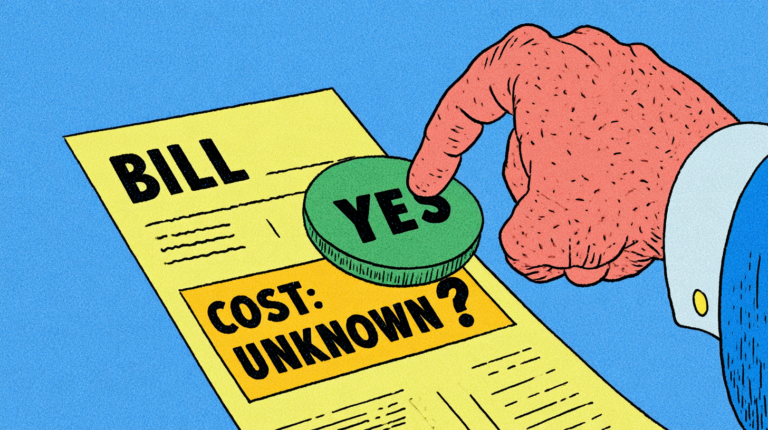

Of the more than 10,000 bills filed in the 104th Illinois General Assembly, almost 6,900 could have unknown costs for taxpayers.
Out of nearly 6,900 bills in Illinois that proposed changes to laws, programs, projects and personnel, lawmakers provided the estimated cost to taxpayers of a mere 32—fewer than half of 1%.
Only those 32 bills in the 104th General Assembly came with “fiscal notes,” which estimate the financial effects of proposed legislation, giving lawmakers and taxpayers information about its potential cost.
While such estimates are required in many other states, Illinois law allows a bill’s sponsor to determine whether it needs a fiscal note. If the sponsor decides it does not, a lawmaker who disagrees must gain the support of a majority of members to require a fiscal note.
Of all 10,023 bills filed in the two years, 6,856 were “substantive,” meaning they proposed changes in how Illinois operates.
In the 104th General Assembly, lawmakers passed and sent 856 bills to Gov. J.B. Pritzker for consideration. Just five of them included a fiscal note.
Most states require fiscal notes on all or substantially all bills. In a 2015 study, the Center on Budget and Policy Priorities measured state compliance with five best practices:
- Requiring fiscal notes on all proposals.
- Having fiscal notes prepared by a nonpartisan entity.
- Projecting the long-term impact of the proposal.
- Revising estimates with changes to the proposal.
- Posting the fiscal notes online.
Illinois complies with only one: Its fiscal notes are posted online.
Without fiscal notes, lawmakers vote on bills without the cost estimates needed for well-informed decisions.
Fiscal transparency in the bill-making process is a way to keep lawmakers accountable and give more information about the financial consequences of legislation before it becomes law.
This article was originally published by the Illinois Policy Institute.