
Although algorithms can process data faster than any human planner, they still depend on the existence of meaningful economic information.
In the early 1970s, Chile attempted an ambitious experiment in economic planning.
The country’s socialist government invited British cybernetician Stafford Beer to help design a computerized system capable of coordinating the entire national economy. The project was called Cybersyn.
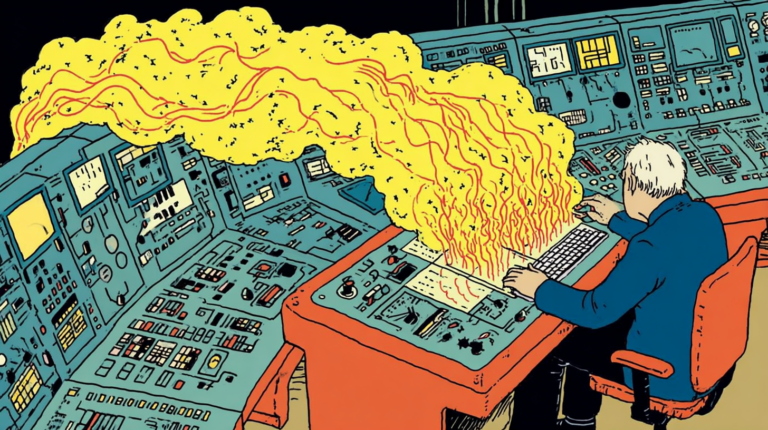
Factories across Chile would send production data to a central network. Government planners would monitor the economy from an operations room equipped with screens and dashboards. With enough information and computing power, planners hoped they could rationally direct economic activity.
The project reflected a long-standing dream among advocates of socialism: that a sufficiently advanced system could plan economic life more efficiently than markets.
But Cybersyn never solved the problems it was meant to address.
During the early 1970s, the Chilean government imposed price controls on thousands of goods while expanding state control over industry. Shortages multiplied, black markets expanded, and economic coordination deteriorated. Political instability soon followed, culminating in the military coup of 1973.
At first glance, the lesson seemed clear: central planning could not replicate the complex coordination performed by markets.
And yet the idea never completely disappeared.
The New Case for AI Planning
Recent advances in artificial intelligence have revived an old argument. If earlier socialist planners failed because they lacked sufficient computing power, perhaps modern algorithms could finally solve the problem.
Some contemporary writers have openly suggested this possibility. In 2019, Jacobin magazine published an article titled “Yes, a Planned Economy Can Actually Work,” arguing that large datasets and powerful algorithms might overcome the classic socialist calculation problem.
Some economists have even entertained the idea. Before receiving the Nobel Prize, Daron Acemoglu remarked that advances in artificial intelligence could make central planning more plausible, suggesting that corruption might be the main obstacle rather than feasibility itself.
At first glance, the argument sounds persuasive. Artificial intelligence can process enormous quantities of information at incredible speed. Modern computing power dwarfs anything available to earlier generations of planners.
To answer that question, we need to revisit one of the most important debates in 20th-century economics.
In 1920, Austrian economist Ludwig von Mises published a groundbreaking article titled “Economic Calculation in the Socialist Commonwealth.”
Unlike many critics of socialism, Mises did not focus on corruption or bad incentives. He granted a generous assumption: suppose the planners are intelligent, benevolent, and genuinely committed to the public good.
Even under these ideal conditions, he argued, socialism could not function. The reason lies in the role of private property and markets in generating economic prices.
In a socialist system where the state owns the means of production, markets for capital goods disappear. Without such markets, prices for machinery, raw materials, and other productive inputs cannot emerge. And without prices, rational economic calculation becomes impossible.
Prices are signals generated through voluntary exchange that reflect the relative scarcity of resources and the competing demands placed upon them.
Consider a simple decision: choosing whether to build a floor using wood, ceramic, or marble. Prices immediately provide information about which materials are scarce and which are abundant. If ceramic becomes more expensive because it is urgently needed elsewhere, the higher price encourages substitution toward wood. If timber becomes scarce, the price of wood rises, and the decision adjusts again.
You do not need to know every detail about why supplies changed. The price communicates the relevant information. And without such signals, economic decisions become guesswork.
A generation later, Friedrich Hayek deepened this critique in his famous 1945 essay, “The Use of Knowledge in Society.”
Hayek argued that the economic problem facing society is a problem of knowledge, not of computation. The information required to coordinate an economy does not exist in one central location. Instead, it is dispersed across millions of individuals.
Much of this knowledge is highly localized. It concerns specific circumstances of time and place: changing consumer preferences, temporary opportunities, technical know-how, or practical experience.
Much of it is also tacit. People often know how to do things without being able to articulate that knowledge fully. Markets provide a mechanism for continuously generating and transmitting this dispersed information through prices. But central planning does not.
Some defenders of technological planning assume that Hayek’s argument was simply about the limited computing power available in the mid-20th century. But Hayek’s argument concerned institutions rather than computing power.
The relevant information does not exist in a form that can simply be collected and processed. Much of it only emerges through decentralized decision-making under the institutions of private property and voluntary exchange.
Artificial intelligence can analyze existing data. But it cannot substitute for the decentralized processes that generate the data in the first place.
The economy is not a machine that can be controlled from a dashboard; rather, it is a dynamic process shaped by millions of decentralized decisions.
Artificial intelligence does not overcome the socialist calculation problem. Algorithms can process data faster than any human planner, but they still depend on the existence of meaningful economic information.
For more than a century, each new technological breakthrough—computers, big data, and now artificial intelligence—has been proclaimed as the tool that will finally allow governments to plan complex economies.
Yes: artificial intelligence can process data. But only markets can discover it.
Learn more about this debate here:
Download the Think Like an Economist: Classroom Edition activity to explore this article through discussion, analysis, and reflection. Access this and past classroom-ready lessons in the FEE Learning Center by creating a free account.