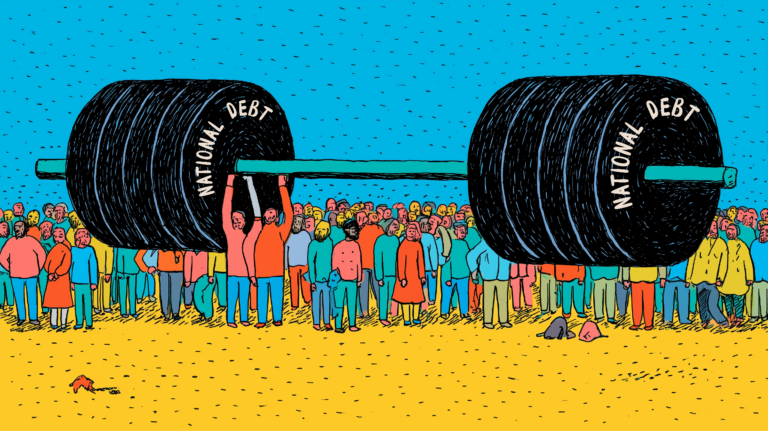

Waiting for a growth miracle while borrowing £500 million a day isn’t a strategy.
Britain’s national debt is now rising by more than £500 million a day. Every single day. It’s the kind of figure that should prompt a national emergency, but instead it’s been met with the kind of collective shrug that suggests we’ve all decided it’s someone else’s problem. Future Chancellor, future Parliament, future generation. Someone will sort it eventually, surely?
Half a billion pounds doesn’t really sound like a real number to most people though. It’s too big, too abstract. So let’s translate it into something that matters.
That daily borrowing represents the entire lifetime tax contributions of almost 400 British households. Not their annual tax bill, their total bill across a lifetime. Picture 400 ordinary families with mortgages, kids in school, worries about their bills, and imagine every penny they’ll ever contribute to the state being consumed in a single day, just to service the consequences of spending decisions made by politicians who never learned to live within their means.
Tomorrow, we’ll borrow another 400 families’ worth. Then another the day after. And so on, indefinitely, while we pretend this is somehow sustainable.
The result? Our national debt is now around 95% of GDP, on track to hit over £2.9 trillion in the next few months. The immediate consequence is an interest bill exceeding £100 billion annually. Debt interest now consumes 10% of all tax revenue, and based on long-term projections from the Office for Budget Responsibility, could rise to over 30% in 50 years unless something changes. We’re not investing in the future. We’re paying rent on the past, and the landlord is getting increasingly impatient.
Then there’s the sovereignty question. Former Bank of England Governor Mark Carney once observed that Britain depends on “the kindness of strangers” to fund itself. Foreign investors now hold a third of UK government debt, and it’s not actually kindness that persuades them to fund us but the cold, hard returns they expect to make. When they get nervous about those returns, we discover just how much of our fate sits in other people’s hands. And they’re getting nervous rather more frequently these days.
The global bond market is now about 35 times the size of our entire economy, compared to four or five times in the 1970s. We’re a smaller fish in a much bigger pond, and when that pond gets choppy, we feel it first and worst.
So what’s the solution? The TaxPayers’ Alliance recently modelled what debt reduction would actually require, and the maths is brutal. To get debt down to 60% of GDP (the Maastricht Treaty benchmark for sustainable national debt) we’d need budget surpluses of at least 2% of GDP annually for 25 years. And there are good reasons to aim for that target beyond just the treaty: the European Central Bank finds that debt starts to seriously hamper growth once it passes 67% of GDP. Once it crosses 70%, academic research shows it pushes interest rates up too. At 95% and rising, we’re well into the danger zone.
You’ll hear people say we can grow our way out of this. We’ve been hearing that for 20 years while productivity has stagnated and debt has more than doubled. Waiting for a growth miracle while borrowing £500 million a day isn’t a strategy. It’s hoping someone else will fix the problem you’re too scared to address.
The problem is that we don’t currently run a surplus and haven’t since the early noughties. We ran a deficit of 2.4% of GDP last year. Getting to a 2% surplus means a fiscal turnaround of 4.4 percentage points, over £120 billion just to reach the starting line. And we’d need to maintain that discipline through at least five general election cycles, through recessions and booms, with every opposition party screaming about heartless cuts.
No post-war government has maintained such surpluses for more than five years. We’d need to do it for five times that long. The historical precedent doesn’t just fail to exist; it suggests the whole thing is politically impossible. Which is where most people tend to give up and wander off to discuss something more achievable.
But declaring something impossible doesn’t make the debt disappear. It just means that the reckoning will happen on worse terms, probably in a crisis, almost certainly at the worst possible moment.
What we need is something British politics hasn’t delivered in generations: a genuine cross-party commitment to fiscal responsibility that outlasts the electoral cycle. Call it Butskellism for the debt crisis, with both parties committing to debt reduction as a shared national project that survives changes of government and the impulses of politicians to bribe the electorate with irresponsible spending promises every election.
None of this is easy. All of it requires political courage that’s currently in desperately short supply. But the alternative is continuing to borrow at these levels every single day while hoping it somehow sorts itself out. It won’t. And eventually, the bond markets will make that very clear indeed.