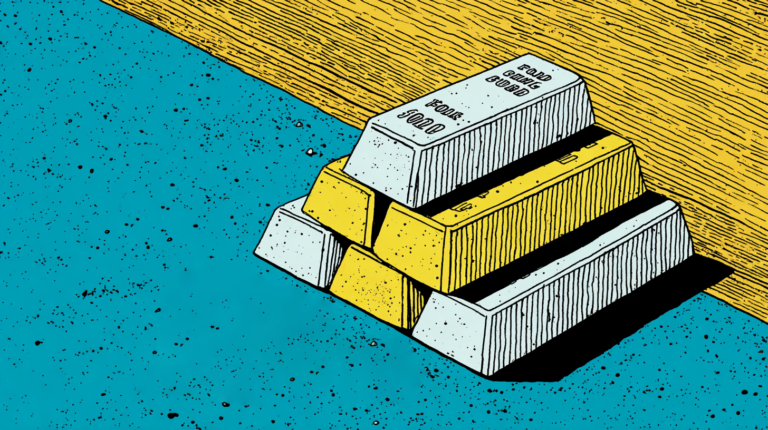

Precious metals are on a surge.
Since the end of January and into the beginning of February this year, the prices of gold and silver have fluctuated drastically. So much so that there is a good chance the price will have changed before I finish writing this article, never mind before it is published. Even so, this has not stopped various diagnoses of gold and silver as more stable, less stable, worth investing in, avoiding at all costs—one viral tweet at the end of January showed one dip in gold equating to $2.5 trillion, “the entire market cap of crypto.”
The reason it fell so drastically (or at least, appeared to) is that a day earlier, gold had soared to a historic high of just shy of $5,500 per troy ounce (t oz), meaning any drop was going to be significant. At the time of writing, it’s sitting at about $5,000 per t oz.
Likewise, over the course of January, silver rose from roughly $85 to $115 per t oz, but has since fallen to $70 as of February 6. This has, in turn, caused some to claim that silver had “crashed” by 10%, wiping out $5 trillion.
It’s not as bad as all that. If one takes a long-term view of the price of gold and silver, over the last year the value of gold has practically doubled, rising from $2,856 per t oz on February 6, 2025, to $5,414 per t oz at the end of January 2026. Likewise, the value of silver has nearly quadrupled in the last year, from $32 per t oz to a high of $116 on January 29 of this year.
But even this is a misleading picture: the rise has not been steady, but incremental, throughout 2025, only really taking off after November 2025. This initial period of steady growth began in mid-2024, when COMEX gold futures rose to roughly $2,500 per t oz, at a time when increased geopolitical tensions, persistent inflation concerns, and falling real interest rates all factored into this initial increase. For many, gold offered a safe haven for global investment to offset an uncertain global economic market, which itself was largely caused by a combination of post-pandemic shockwaves and the (at the time) threats of tariffs from President Trump’s 2024 campaign.
Reaffirming this trend was the continual, grinding growth of gold into 2025, instead of collapsing back to both pre-pandemic and pre-2024 levels. This was a notable shift because gold futures typically surge then consolidate, either sticking at their surge levels or falling back as investors capitalize on the high prices and sell.
Instead, gold proved resilient, with the market absorbing profit-taking while increasing momentum, even continuing to attract the interest of central banks. As analysis from Gold.org put it, “central bank purchases of 863t reached the upper end of our expected 2025 range; they remain historically elevated and geographically widespread but have slowed from their recent pace.”
For silver, much the same can be said, but on a greater scale, as the rate of growth for silver futures has been nearly triple that of gold. Benefiting from a growth in demand for silver from industry—such as electronics and electrification industries—offset by a lack of growth in mine supply, 2024 into 2025 saw silver maintain a steady growth even in a period of broader risk aversion. In other words, limited supply in the face of rapid demand growth saw prices accelerate upwards.
So much so in fact that by the end of last year, silver was beginning to outperform gold on a relative basis. Still pennies on the dollar compared to the price of an ounce of gold, silver’s position in the global economy as a precious metal came to be framed as both a monetary metal and an industrial one, a dual identity that led to significant investment increases.
Then came November 2025: sharp rises followed over the following months, due to a combination of salient factors, though the market for each metal responded differently. For gold, sustained official-sector buying (including Central Banks) moved their role from being merely supportive of the value of gold to being, effectively, price-setters, because of the sheer amount they have invested. At the same time, geopolitical risk accelerated to the point that, at the end of last year, global financial instability was (and continues to be) perceived as systemic rather than periodic, reflecting an increased use in tariffs, non-tariff obstacles, strategic rivalry between nations, and active state-directed financial investment in the form of sovereign wealth funds (SWFs).
This matters most because gold responds most strongly when risk is seen as persistent and unresolvable. In this context, gold was re-valued less as an inflation hedge, and more as a monetary hedge against fiscal strain, currency exposure, and political risk. As the International Monetary Fund (IMF) put it:
Gold’s role as an inflation hedge is both celebrated and misunderstood. Its price tends to rise not merely with inflation, but with the erosion of faith in monetary policy. When real interest rates turn negative—when holding cash or bonds yields less than inflation—gold becomes relatively more attractive… It is not a vehicle of prosperity; it is insurance against prosperity’s absence.
And as the president at Sprott, Inc., Ryan McIntyre, pointed out in Reuters, “central banks remain strong buyers as they diversify foreign exchange reserves and reduce reliance on the US dollar.” Put simply, gold is seen as predictable; the global economy is not.
As for silver, the rise in value has been contemporaneous with gold’s, but not necessarily for the same reasons. In fact, one of those reasons is what you can call “spillover demand,” as investors priced out of gold seek similarly-reliable havens for investment. In the absence of an official buyer base (like the role of the central banks with gold), silver is a lot less predictable and cannot be re-valued as a reserve asset.
In this sense, silver’s value was pulled up by gold’s, riding on its coattails, rather than being attractive in its own right. Historically, when gold experiences a surge and retrenchment, silver follows shortly behind as investors seek an alternative. Nevertheless, there is a reason why silver is seen as the second-best, and not just because it’s the second-place medal: as mentioned above, silver has its own applications beyond being a monetary metal, but silver is also a thinner market with fewer natural stabilizers. As a result, as Reuters reports, a feedback loop was born in which rising value attracted investors and additional flows.
The volatility that gold and silver have seen in the opening weeks of 2026 both mask and reveal a long-term trend in their increased valuation: it masks the fact that both are significantly more sought-after than they were a year ago, yet it reveals that the strategy of precious metals as a backstop against global instability is not immune to market hysteria.