
South America’s trading bloc has outstayed its welcome.
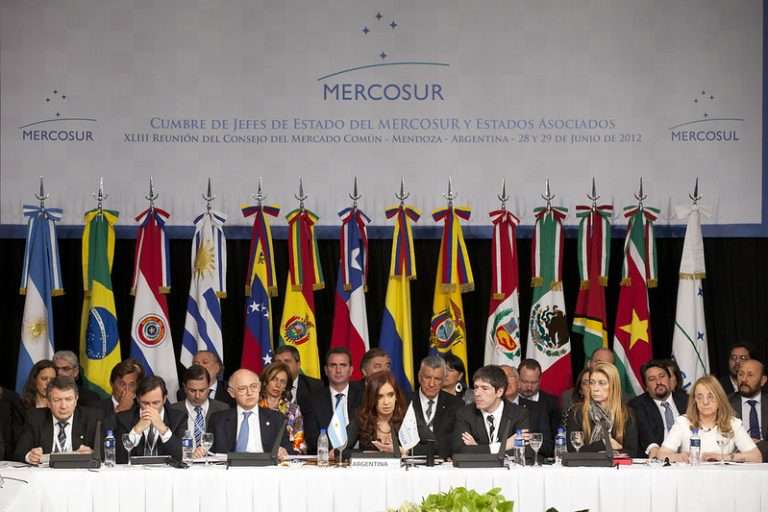
Back in 1991, the idea that South American countries could create a free-trade agreement was revolutionary. The 20th century had been marked by protectionism and failed economic policies across the region. But in a global context of liberalization, Brazil, Argentina, Paraguay, and Uruguay created Mercosur (short for Mercado común del sur or “Southern Common Market”) with the goal of establishing a zero-tariff zone whose members would gradually integrate into the global economy together. Everyone had high hopes. Over thirty years later, though, many are disappointed.
What went wrong with Mercosur? In a nutshell, it has not succeeded in integrating its members into global trade. In fact, instead of helping its members open their economies, the bloc has remained a rather closed customs union. After decades of being in place, the Mercosur mean Common External Tariff rate is still at a relatively high 11.5 percent, with tariffs that can be as high as 35 percent. On average, Mercosur tariffs double those of Chile and are up to four times higher than in the US and the European Union.
The failure of Mercosur to march towards global free trade is the reason the Uruguay government threatened to leave it last year, and why Argentina is now also considering exiting. Unless members can sign free-trade agreements with other countries without restrictions, they say, their countries are better off leaving than staying. Last week, Argentine President Javier Milei stated that Mercosur has “ended up becoming a prison” for its members.
Brazil is the country that stands to lose the most in the case of a Mercosur fracture. Coupled with a combination of free intra-zone trade and common tariffs, the sheer size of the Brazilian economy has meant that its manufacturing industry has enjoyed artificial privileges within Mercosur compared to the rest of the world. The result is that non-Brazilians have to import relatively expensive Brazilian cars, for example, when they could be buying cheaper vehicles from anywhere else in the world. What was sold as a step toward freer trade on the surface has turned out to be rather restricted trade.
Mercosur did try to expand the size of its free-trade bloc, but it has failed at that too, and it is not clear if doing it would benefit its consumers. In its 33 years of existence, Mercosur only incorporated Bolivia and Venezuela, but the latter is currently suspended. After 25 years of negotiations, South Americans finally reached an agreement with the European Union to establish free trade between both zones. But key players like France and Italy have expressed their opposition to the agreement, which casts serious doubts on its ratification. And even if all the Mercosur and EU countries’ parliaments ratify the deal, the implementation period would take over a decade.
As an institution, Mercosur has not been able to emulate the EU, for good or bad. No single common currency has been adopted, despite plans to do so by Brazil and Argentina. This, in light of the European experience, is probably positive, as its existence would make Brazilian hegemony even more obvious and intolerable. But Mercosur has also failed to establish itself as a free-movement zone in terms of people, as border controls are still present. Over the decades, numerous agreements with the goal of easing the movement of people within Mercosur have been signed which are pending implementation or ratification.
Whereas Mercosur members complain that the bloc has turned into a corset, neighboring Chile has signed over 30 free-trade agreements in the past 30 years. The Chilean trade-to-GDP ratio of over 75 percent, which has decisively helped the country make an economic breakthrough in recent decades, cannot be matched by any of the Mercosur economies, particularly the biggest ones: Trade as a share of GDP is below 40 percent for both Brazil and Argentina.
In the meantime, Mercosur also maintains bizarre bureaucratic structures like Parlasur, a parliament which enacts no laws but only recommendations. Parlasur members are elected by voters in all countries and are legally equivalent to federal representatives, with the corresponding cost of electing and maintaining them. But because of the opacity with which it functions, many politicians have “fled” their countries to Parlasur, where they can enjoy the benefits of being in Congress without being actual members of one. Mounting public pressure has forced countries like Argentina to stop all payments to Parlasur “legislators,” but the core issue is still present: For some, it seems like Mercosur is an end in itself.
South Americans looking for growth and prosperity should acknowledge that Mercosur has failed and will not bring free trade to the region. Open economies do much better than closed ones in terms of GDP, but Mercosur citizens are being deprived of the improved standard of living that this entails. More trade is always, at any given time, better.
It may be the time for countries like Argentina and Uruguay to follow Milton Friedman’s advice to “move to free trade unilaterally” in the context of failed negotiations of tariff reductions, even if other countries oppose it or do not reciprocate. Mercosur was supposed to eliminate the cage that its members were in, but instead, it just made the cage a little bigger. Mercosur did not work. It is time to end it.