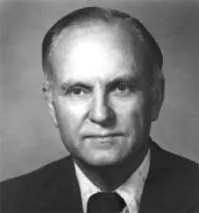
Dr. Sennholz is Professor of Economics at Grove City College, Pennsylvania.
One of the most widely proclaimed objectives of government interventionism is economic stability. The government is to assure full employment, steadily rising consumption, and growth of the economy.
The present recession is another reminder that interventionism often leads to the very opposite of what it sets out to achieve. Indeed it has given our era its economic characteristic: unprecedented instability in the shape of a rapid sequence of booms and recessions.
We are now in the third postwar recession. From 1948 to 1950, industrial production declined some 10 per cent and unemployment rose to 4,684,000 in February of 1950. Three years later, in another recession, industrial production fell by 12 per cent and unemployment climbed to 3,724,000 in March of 1954.
Now, once more, our daily papers are full of gloomy reports on declining commodity prices, declining steel operating rates, lower oil production, fewer freight car loadings, and rising unemployment. The public is at a loss to understand this unplanned decline.
The explanations offered by various “experts” reveal a garbled collection of economic ideas and notions. One explanation traces present difficulties to the “lack of sufficient new orders to maintain current rates of production and shipments.” And this, in turn, is attributed to the cutbacks of outstanding defense orders and the withholding of new armament orders. These experts urge that government spend more on military hardware and ammunition in order to boost the economy.
In the first place, such an explanation contradicts reality. The federal government spent more money on national security in 1957 than in 1956; and the sputniks have caused acceleration of armament spending.
But even if armament spending had declined, total cash expenditures of the federal government were higher in 1957 than in any other year since World War II. They exceeded $79 billion, which was $7 billion more than in 1956 and $9 billion more than in 1955. These facts would suggest that a substantial increase in government spending doesn’t necessarily prevent an economic slump.
Excessive Inventories
Another explanation runs as follows: Businessmen are trying to cut down on unnecessary inventory accumulations. Inventories were rising throughout 1957 in expectation of future sales. But sales have been disappointing on account of wages lost through layoffs.
This reasoning moves in vicious circles. The recession is caused by inventory adjustments, caused by disappointing sales, caused by unemployment, caused by the recession — the recession caused itself! More capacity than orders is the reason for the decline, say others. There has been a growing gap between actual operations and capacity. Manufacturing operations average less than 80 per cent of capacity. Every major industry is operating below the full-employment rate. And it seems likely that factory output will level off while capacity continues to rise, which will further widen the gap between capacity and operations.
This answer must be rejected on grounds that it merely describes a situation. It neither explains the causes for the growing gap between operations and capacity nor analyzes the factors that determine capacity and factory output. It is the most superficial of all answers.
Labor unions offer a simple explanation of their own. Labor is underpaid, they say. Employers are withholding part of the rightful wages, so their employees cannot buy back the product. They therefore recommend higher pay and a shorter work week. In the words of 0. A. Knight, president of the Oil, Chemical and Atomic Workers Union: “We should begin preparing now for a shorter work week to be applied when needed instead of waiting until there are several million unemployed.”
This explanation disregards two hundred years of economic thought and returns to the ancient fallacy of exploitation and class struggle — which has been exploded numerous times but is kept alive because it constitutes the ideological basis of unionism.
In a market economy there can be no exploitation of labor. Competition between actual and potential employers always tends to lift a man’s wages to the point of his productive contribution. If his wage should fall below this point, his services indeed would constitute a bargain. Consequently, many bargain-hunting employers would compete for his services, and this again would lift his wage to the point of his productivity.
If the labor union recommendations were enacted, disaster similar to that of the great depression would engulf the whole economy. Both higher pay and a shorter work week constitute higher business costs. And higher costs make for lower business earnings, or possibly losses, which in turn cause business contractions and unemployment.
Cherchez la Boom
A scientific analysis of the reasons for the present recession must search for more than shrinking backlogs, inventory adjustments, or the old shibboleth of labor exploitation. It must go back to the pleasant state of affairs and the economic policies that preceded today’s recession. It must go back to the boom and the monetary policies that created it.
All three postwar recessions were preceded by feverish booms with soaring prices and wages. According to the Bureau of Labor Statistics, the index of consumer prices rose from 83.4 in 1946 to 102.8 in 1948. Commodity prices rose from 78.7 to 104.4. The 19481950 recession then followed, with 4.7 million unemployed.
The 1953-54 recession was preceded by similar developments. Between 1950 and 1952 consumer prices soared from 102.8 to 113.5 and commodity prices from 103.1 to 111.6.
The present recession was initiated by a similar boom that lasted from 1955 to the summer of 1957. Consumer prices rose from 114.5 in 1955 to 121 in August of 1957. During the same period commodity prices rose from 110.7 to 118.4.
There cannot be any doubt that all three recessions were preceded by feverish booms with rising prices and wages. They were periods of great optimism about the prosperous future, vast expansion of the apparatus of production, and full employment of capital and labor.
The causal connection between booms and recessions is found in the money and credit policies conducted by our monetary authorities. They inflate the money supply which initiates the boom stage of the business cycle. Then, when prices and costs of living rise in reflection of the expanded money supply, our authorities become concerned about the inflation and refrain from further monetary expansion. At this time the symptoms of boom disappear and the economy begins to adjust to the policy of stabilization. Furthermore, the malinvestment and maldistribution of the boom period must be brought back into line with economic reality. The period during which this readjustment takes place is called recession or depression.
Federal Reserve statistics demonstrate the inflationary nature of the monetary policies that created the booms. Between 1946 and 1948 the total adjusted deposits and currency held by all banks rose from about $150 billion to more than $170 billion. During the 19511952 boom period they rose from $177 billion to $195 billion. And during the last boom they rose to $221 billion in July of 1957, with bank loans climbing to $112 billion.
This monetary expansion was achieved through easy-money policies on the part of the Federal Reserve system. Through open-market purchases, lower bank reserve requirements, and lower discount rates, it not only expanded the quantity of currency and deposits, but also facilitated credit expansion on the part of all banks.
When the volume of currency and bank credit is thus arbitrarily increased, the market rates of interest tend to decline. When credit is abundant and interest rates are low, many a businessman is tempted to expand with improvements and new projects that appear profitable. But these very projects whose profitability depends on low interest rates must become unprofitable as soon as the economy begins to adjust to the latest round of inflation. They constitute malinvestments insofar as they withdraw scarce labor and capital from other profitable uses.
Rising Prices and Costs
The economic response to inflation involves feverish business bidding for labor and capital for expansion. Prices of raw materials, wages, and interest rates rise rapidly. They continue to rise until one enterprise after another becomes unprofitable.
The first indications of the coming recession include postponements of expansion plans, lower sales of structural steel, cutbacks of tool and die making and of other production connected with business expansion. Then, other malinvestments become apparent in the shape of “excess capacity,” which simply means that in terms of product prices and business costs the operation is unprofitable. The construction of “excess capacity” during the boom, therefore, was based on certain hopes and expectations of profitableness that were shattered by rising business costs.
The unprofitability of business and the urgent need of funds for fixed obligations induce many companies to reduce their inventories. Unemployment rises and many product prices fall. Business activity declines until the adjustment has run its course to the point that production becomes profitable again.
In an unhampered market economy the readjustment takes the form of falling business costs. Falling product prices and reduced profits, along with competition among workmen, exert a pressure on wages until they decline by a few per cent. Projects constituting malinvestment are abandoned, setting capital and labor free for employment in other profitable enterprises. After business costs are thus reduced, some operations become profitable again. The depressions of the nineteenth century generally involved this kind of readjustment — rapidly enough so that mass unemployment was practically unknown in those times.
But in our time, business costs seem to have lost their facility for downward adjustment. The policies of the government and of labor unions have made wages extraordinarily rigid. Minimum wage laws and various other governmental decrees actually prohibit certain adjustments. And the labor unions exert their tremendous political power to force wage rigidity, if not higher labor costs. They militantly defend all wage increases which the preceding boom and its maladjustments have provided.
The “Built-in Stabilizers”
There is little doubt as to what the political response will be to the present business recession. The “built-in stabilizers” will be activated, and the lot of them can be encompassed in a word: inflation. The only answer which our interventionist government can give to the problem of recession is further inflation. No matter under what label or disguise, inflation tends to release credit, raise product prices, and lower real wages. Consequently, prospects for business profits improve and a new boom is initiated.
This new inflation has already begun. Last November — and again in January — the Federal Reserve system lowered its discount rate in order to encourage bank borrowing and bank credit expansion. Reserve requirements were reduced. And it bought government bonds in the open market in order to increase bank reserves. Futhermore, government officials and politicians contemplate other measures that involve more government spending, or that reduce government receipts while spending remains unchanged. The House Banking Committee is ready to push schemes for federal handouts to “depressed areas.” Other legislators plan stepped-up aid for “slum clearance.” Small business partisans favor handouts to their clients. General tax cuts are being considered simultaneously with big new spending programs. Inflationary financing is supposed to cover growing budgetary deficits.
It remains to be seen whether or not the combination of all these measures will have the desired effect — whether product prices will resume their rise, make business profitable again, and reduce the unemployment. But even if these measures “succeed” once more, the inflation will have its well-known effects. The dollar which already has been more than halved in value since 1940, will continue to lose purchasing power. Debtors again will be favored at the expense of creditors. The people’s savings in the form of life insurance claims, savings accounts, government bonds, and the like, will continue to depreciate. Fixed income receivers will suffer. And the business cycle with its inevitable recession will start all over again.
The Growth of Socialism
But the inevitable consequence that exceeds all others in tragic significance is the growth of socialism. During the three postwar boom periods many people have learned to recognize inflation. Having also learned to rely on government as the source from which all earthly blessings flow, they are clamoring for protection from the disastrous effects of inflation. Vote-conscious planners in Washington are most anxious to “fight” inflation. They are ready to face the problem head-on through compulsory socialistic price and wage controls.
During the last boom President Eisenhower repeatedly discussed the possibility of federal controls over business and labor. The Secretary of State, the Secretary of Labor, and many other high government officials in the Administration and in Congress have proclaimed the desirability of controls. Such talk makes one wonder if the institutions of personal freedom, private property, and a free market can survive another burst of inflation.