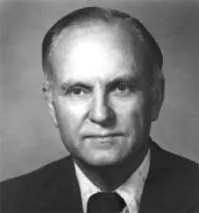
Dr. Sennholz heads the Department of Economics at Grove City College and is a noted writer and lecturer on monetary and economic affairs. This article is reprinted by permission from the July 1978 Issue of Private Practice.
There was a time when Americans wondered about the safety of their bank. In depressions the banks used to close their doors by the hundreds. From August 1931 through February 1932, 2,000 banks with liabilities of over $1.5 billion suspended operations. Many others barely escaped bankruptcy by hurriedly-negotiated mergers. All were forced to curtail their operations sharply. When the depositors were thoroughly scared, they rushed to withdraw their deposits, which forced even more banks to close their doors. To find a reliable, solid bank used to be a difficult task.
Today, most depositors don’t seem concerned over the solvency of their bank. Bankers and government regulators have succeeded in convincing the public that most banks are sound. There is careful government supervision of all banking operations, and federal deposit insurance is said to cover nearly all deposits.
These arguments alone should trigger an instant alarm. In all its regulating, government usually makes matters worse. When politicians and bureaucrats invade an industry and regulate it along political and social lines, service is likely to deteriorate and solvency may be endangered. Why should banking be different from medical care, education, or welfare?
When the New Deal government undertook to reorganize the American banking industry in 1933, the system deteriorated. What used to be an occasional irritant for some became a fatal disease for all. Rushing to the rescue of the hard-pressed banks, the government seized their gold reserves and replaced them with paper money that has been depreciating ever since.
How Banks Fail
Prior to 1933 a few banks had failed to make payment on demand when an economic depression had caught them by surprise, inflicting painful losses on depositors. Since the New Deal rescue action, all depositors have lost at least 80 percent of their savings through inflation, and probably will lose the balance in the not too distant future. The banks are still functioning, seeking deposits and extending credit. But they are prevented by law from protecting their depositors from the ravages of inflation. They must make payments in political paper money only, that is depreciating at accelerating rates, and must invest their assets in depreciating monetary claims. The depositors are victimized every step of the way.
The new monetary order did make it much easier for the banks to stay liquid and solvent. It was more manageable to maintain a reserve of legal tender Federal Reserve money, or to keep on hand a reserve of U.S. Treasury obligations eligible for Federal Reserve discounting, than to maintain a gold reserve for all payment obligations. What used to be a difficult banking function, to safeguard the reserves in gold, became a simple task of compliance with government regulations to make paper payments. The depositors thus were led to believe that their money was safe in banks assisted by the Federal Reserve System and supported by the Federal Deposit Insurance Corporation.
And yet the American banking system today is as vulnerable to crisis as it was in the early 1930s. To hundreds of commercial banks the simple obligation to make prompt payments in paper money, which is available in such abundance, has become as onerous and embarrassing as the gold payment obligation of the past. According to Federal Reserve reports, only 66 percent of the banks it supervises are in satisfactory condition. Roughly one-third have some payment problems. A few have already failed and many more were saved from default by reorganization and refinancing.
It should not surprise us that the cancerous monetary order has finally infected banking. The rapid increase in Federal Reserve money in recent years convinced many bankers that there would always be an abundance of easy money and credit, of which they were determined to get their share. When their deposits did not keep pace with their desire for expansion, they borrowed the money themselves. They sold certificates of deposit, commercial paper, and borrowed in the Eurodollar market. The larger city banks especially learned to rely on “purchased money,” which may account for more than 50 percent of their deposit liabilities.
Unsound Policies of Many Big City Banks
The precarious banking situation of today differs from that of the early 30s in one important respect: then it was the small rural banks that faced payment difficulties when their farm loans defaulted, because American agriculture suffered from the deepest depression. Now it is the big city institutions with their “go-go” bankers that shed all caution in order to partake of the easy-money and help stimulate the national economy. Seeking ever new channels for investment, they often ignored the rudimentary rules of banking soundness.
Many big city banks are over-extended, badly exposed, thinly capitalized, and short on liquidity. With U.S. government blessing and prodding, they loaned more than $20 billion to underdeveloped countries in Africa and Asia. Many of these debtor countries have neither the economic capacity nor the political stability ever to repay their loans. Some would not be able to pay the interest if the banks would not lend them the money.
Guided and prompted by the monetary authorities, the banks made many other mistakes from which they may eventually recover. They lent over $11 billion to real estate investment trusts which own vacant hotels and motels, commercial office buildings, and condominiums still looking for tenants. They lent $6 billion to oil tanker owners whose ships sit idle in the shipyards. However, the dollar inflation and depreciation can be expected to rescue the debtors and their bankers as the loans depreciate and the assets appreciate in price. Once again the depositors will be the ultimate victims.
The New York City banks lent $6.5 billion to the governments of New York State and City. Other urban banks throughout the country extended multibillion-dollar credits to their over-extended spendthrift local governments. New York State and City would have long since defaulted, and their creditors as well, if the federal government had not come to their rescue with billion-dollar loans and guarantees. It makes no sense to blame the bankers for having made such dubious loans. How could they have resisted the political pressure and public demand for “socially desirable” funds and projects? Even in the face of imminent default the political oratory for more bank loans is deafening.
It is impossible to foresee the outcome of this banking dilemma. The banking authorities are doing everything in their power to hide the situation from the American public. The Federal Reserve reassures us again and again that it will be the lender of last resort to “sound” member banks, by which it means all those banks who carefully follow its regulations. It stands ready to supply liquidity, that is, loans, to meet bank liabilities in exchange for temporarily illiquid, but hopefully “sound,” assets. But how sound are New York City bonds or the billion-dollar obligations of Zaire?
Financial Statements
Financial statements by banks are very difficult to interpret, as they violate the most important principles of honest accounting. To hide investment losses, for instance, a bank balance sheet may show the costs of an investment rather than present market value. But financial statements may be useful in finding the problem banks. If bank assets are “classified,” i.e., if they are not disclosed, the asset values listed can be expected to be grossly overstated, reflecting neither current values nor liquidation values. According to customary evaluation methods, a bank with classified assets of over 65 percent of capital is worrisome. As they exceed this conventional limit the danger of banking failure grows accordingly. When seen in this light, some of the big city banks may close their doors at any time.
And yet, we are confident that no lasting harm will come to these banks. The effects and repercussions of a banking collapse would be catastrophic to the U.S. and the world economy. What must not be will not be—as long as the federal government can avoid it. It can postpone the unspeakable temporarily. Admittedly, it has no asset reserves of its own, no wealth, no income that could be used to fill the hole. In fact, it admittedly owes the world at least $800 billion and is suffering huge current deficits. But it has the sovereign power of creating more dollars. It can inflate and depreciate our currency at ever faster rates. Therefore, if Zaire should default or New York go bankrupt, the federal government can be expected to come to the rescue of the beleaguered banks. Of course, such a rescue by the very policy responsible for the sad condition would further enhance federal power and subject the banks to more controls. And the dollar flood that is released for the rescue would inundate us all.
