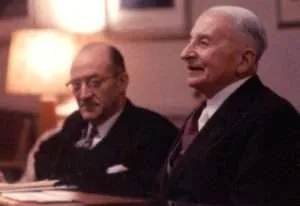
The noted free market economist, Ludwig von Mises, was a native of the old Austro-Hungarian Empire. By 1914, he was in his early thirties and his years of compulsory military service had been all but completed. When World War I broke out, however, he was called to duty immediately. He served throughout the war, a large portion of the time in the cavalry on the eastern (Russian) front where, as he lamented later, he “could rarely find time to read a newspaper.” (Notes and Recollections, p. 66). Shortly before the war ended, Mises was transferred back to Vienna where he had been living previously. He was there when the Central Powers finally collapsed.
War’s end found Europe in turmoil, hunger widespread, national boundaries in disarray, and communist terrorists eager to stir up trouble at every opportunity. As opportunity permitted, Mises returned to his intellectual pursuits. One question uppermost in the minds of many persons at that time was what had caused the strife that had led to the war just ended. This book, first published in German in 1919 and only now translated into English, explores the answer.
As the title indicates, Mises deals with the concepts of “nation,” “state,” and “economy,” their respective similarities and differences. To appreciate the situation in post World War I Europe, with its countless intermingled minorities, many with different languages, dialects, cultures, religions and special interests, an understanding of these concepts is essential. Unfortunately, little attention was paid to the explanations Mises presented in this book. Longstanding international conflicts continued to fester in spite of the attempt to implement in Europe the then- popular idea of national self-determination. As a result, when Hitler came along he had only to stir these issues up again, until in time they erupted into World War II. Mises’ message is important to us today also, for the same issues are at the root of current international conflicts.
Nineteenth-century Europe had been trending toward the freedom ideas of classical liberalism. To understand the origins of German nationalism which led to World War I, therefore, it must be explained how liberalism, always pacifist and anti-militaristic, was overthrown. “[T]he last trace of the liberal spirit had first to disappear from Germany and liberalism had to become regarded as a kind of dishonorable ideology before the people of poets and thinkers could become a weak-willed tool of the [imperialist] war party.” (p. 3) This was accomplished primarily thanks to a combination of interventionists—(1) working class socialists, who favored “democracy” initially, and (2) the bourgeoisie, industrialists and militarist author itarians.
Mises contrasts the principles of classical liberalism with those of the interventionists. “The basic idea of liberalism and of democracy is the harmony of interests of all sections of a nation and then the harmony of interests of all nations (p. 44) . . . . Full freedom of movement of persons and goods, the most comprehensive protection of the property and freedom of each individual, removal of all state compulsion in the school system . . . are the prerequisites of peaceful conditions.” (p. 96) Liberalism stood for the international division of labor, free trade and free migration. Frictions in a truly liberal society can usually be resolved peacefully, through discus sion, debate, election and voluntary agreement.
Authoritarianism and socialism, although nominally opposed to one another, shared quite a few non-liberal, protectionist positions. Because of their opposition to socialism, many entrepreneurs and industrialists aligned themselves with the privileged, authoritarian, class. And many socialists, opposed to monarchy and a privileged nobility, upheld the idea of democracy and “fought for the right to vote, freedom of the press, and the right to form associations and assemblies as long as they were not the ruling party [but when] they came to power they did nothing more quickly than set these freedoms aside.” (pp. 44-45). However, both groups, authoritarians and socialists alike, were interventionist. Both were advocates of national self- sufficiency and protectionism. Both favored a status society in which certain special groups had the power and authority to suppress minorities. And the policies of both led in time to militarism and conquest. The only way to settle controversies under an authoritarian or socialist regime is by resorting to force and authority.
Prior to World War I, Europe was a polyglot patchwork quilt of linguistic and cultural communities, each anxious for independence and the freedom to control its destiny. The non-liberal governments of that day, however, could not grant this independence or freedom to the separate linguistic groups within their borders without relinquishing some of their own power and authority. Mises devotes considerable attention to the role of language as the basis of “nationality” and to the conflicts that arise under non-liberal regimes when different linguistic and cultural groups are geographically intermingled and overlapping. He deals especially with the conflicts among the many different language groups located within the pre-World War I borders of Prussia and Austria-Hungary, conflicts that contributed directly to the start of both World Wars.
Under liberalism, production is expanded as the world becomes ever more closely linked by the widespread division of labor and far-flung international trade. It is a sort of poetic justice that the imperialistic German government, having rejected free market principles, had to turn to free enterprisers during World War I to keep their war machine operating. “War,” Mises wrote in 1919, long before nuclear bombs were even dreamed of, “has become more fearful and destructive than ever before because it is now waged with all the means of the highly developed technique that the free economy has created.” (p. 216) And today, war is even more dreadful to contemplate. It is not surprising, therefore, that many concerned persons now clamor for peace. Unfortunately, however, most of those who agitate for a nuclear freeze or to ban the bomb are “socialists” or “interventionists” who advocate the very government policies that lead to domestic and international conflict. “Philanthropic pacifism,” Mises wrote in 1919, “wants to abolish war without getting at the causes of war.” (p. 88)
Mises explains that the path to lasting peace depends on adopting the freedom philosophy of classical liberalism.
“He who has made the harmony of the rightly understood interests of all strata within a nation and of all nations among each other the basis of his world view can no longer find any rational basis for warfare. He to whom even protective tariffs and occupational prohibitions appear as measures harmful to everyone can still less understand how one could regard war as anything other than a destroyer and annihilator, in short as an evil that strikes all, victor as well as vanquished. Liberal pacifism demands peace because it considers war useless . . . . He who wants to prepare a lasting peace must be a free-trader and a democrat and work with decisiveness for the removal of all political rule over colonies by a mother country and fight for the full freedom of movement of persons and goods . . . . Liberalism rejects aggressive war not on philanthropic grounds but from the standpoint of utility.” (pp. 86-87)
The cause of peace would be better served if, instead of mounting massive protests and demonstrations, concerned persons were to speak up for the repeal of special privileges, subsidies, welfare programs, progressive taxes, protectionist measures, barriers to world trade and free migration, and the like. Such steps would accomplish more toward eliminating the causes of war than picketing at nuclear missile sites.
To those who fail to recognize that the hope for peaceful interpersonal relations rests on utilitarianism and classical liberalism and who, as a result, reproach their advocates for considering only “the satisfaction of material interests and neglecting the higher goals of human striving,” Mises has an answer:
Nothing is more absurd than this criticism. It is true that utilitarianism and liberalism postulate the attainment of the greatest possible productivity of labor as the first and most important goal of policy. But they in no way do this out of misunderstanding of the fact that human existence does not exhaust itself in material pleasures. They strive for welfare and for wealth not because they see the highest value in them but because they know that all higher and inner culture presupposes outward welfare . . . . Not out of irreligiosity do they demand religious freedom but out of deepest intimacy of religious feeling, which wants to make inner experience free from every raw influence of outward power. They demand freedom of thought because they rank thought much too high to hand it over to the domination of magistrates and councils. They demand freedom of speech and of the press because they expect the triumph of truth only from the struggle of opposing opinions. They reject every authority because they believe in man. (p. 215)
This book, written so long ago, offers important insights to us today for understanding current problems. Professor Yeager provides a helpful introduction explaining the European background situation at the time Mises was writing. This early work is a worthy addition to the collection of Mises books available in English. Mises himself realized its importance, for he referred to it as follows in his 1940 recollections:
It was a scientific book with political design. It was an attempt at alienating the affections of the German and Austrian public from National-Socialist [Nazi] ideas, which then had no special name, and at recommending reconstruction by democratic-liberal policy. My book remained unnoticed and was seldom read. But I know that it will be read in the future. (Notes and Recollections, p. 66)
Now that Nation, State, and Economy has been rendered into very readable English by Professor Yeager, perhaps that future is here.