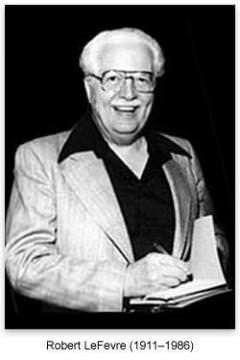
Mr. LeFevre is President of the Freedom School and also has responsibility for the editorial page of the Colorado Springs Gazette Telegraph in which this editorial was first published, May 11, 1959.
The problem of education these days has become insensibly involved with the problem of finding money. Essentially, these are two different problems.
But because, in the past 200 years or more in this country, we have made money-raising and education a wedded couple, it appears most difficult to talk at all about education as a thing separate and distinct from the problems involved in paying for it.
Whenever we begin talking about education as a device for imparting the wisdom of our great minds to younger generations, we are challenged at once: “Yes, but how are you going to pay for it?”
This time we are going to give a very short answer to this question and move on to the subject of education, itself. We will reply that education should be paid for by those who receive the education or by those who are responsible for the ones to be educated. Additionally, education could be (and is) supported voluntarily by those persons of means who wish to put their money to work in this avenue. This would entail the placing of education in the free (and unsubsidized—by compulsive means) market, so that those to be educated become customers in the freest and most noble usage of the word.
But what of education itself? What should it properly be like? To us, education means a drawing out of the student his innermost reality. The competent educator or teacher would concentrate upon the task of reaching the student and in inspiring him with a thirst for truth. A rapport must be reached in which the student recognizes that the instructor is not the fount of wisdom, but rather the bed of a stream, down which the rivers of knowledge may flow if the student expends his own energy. All teachers are nothing but older and more experienced students.
Once this rapport has been reached, certain fundamental facts, the tools of further learning, must be acquired by the student. Without these tools in his hands, the student can learn little.
Moral Absolutes
The first of these tools is a recognition of certain basic principles of life which are self-apparent, coexistent with life itself, and moral in an absolute sense. Even the additional tools of mathematics, reading, writing, spelling, are of less magnitude than a firm grasp of moral certainty, For it should be understood that even the primary subjects are useful and worthy only when they are comprehended within a moral framework. Mathematics relates to truth and truth is always moral. It is morally as well as arithmetically sound to insist that two and two add up to four. To learn to read is not enough. The student must also have moral judgment as to what should be read. To write and to spell are not enough. One must have a moral background in order to know what to write about. And spelling is merely another step in honesty and truth. Words should be presented as they are with full recognition of their growth, application, and meaning. Honesty and truth are impossible otherwise.
Once these basic steps have been taken, the student is not educated. Rather, he has reached the state in his acquired skills that a mechanic has reached when he has mastered the use of wrench, hammer, pliers, levers, screws, and drills. He understands his tools. He is now ready to employ them. Employment for the student begins by the application of his tools to the accumulated wisdom of the past in any and every field. History, science, literature, the arts, all relate to past achievements. The student takes his tools, first his moral certainty, then his skill with figures, words, and thoughts, and conducts an exploration, adding to his store of information the great thoughts, the noble actions, the inspiring record of others who have gone before.
Learn by Working
Finally, as a master mechanic in the realm of knowledge, the student is ready to begin his education. Having learned the basic things; having acquired judgment and a sense of logic; having scaled the peaks of greatness found in his precursors, he is ready to learn. He learns by putting himself to work, totally.
The educated man is the man who is most capable and most skillful in doing work.
Whatever his line of endeavor, that strange and elusive essence which is the individual, can at this juncture truly expend itself. He is no longer a sponge, soaking up the experiences and knowledge of others. He becomes, himself, a unique contributor to the human scene regardless of his bent. Yet, at the same time, he is a more re-ceptive instrument than ever before. The habits of retention are retained and at the same time converted into avenues of expression. Education never ceases. This is true because no man is ever fully educated nor fully at the point where he no longer has to expend his energies. To stop being educated is to stop living. And no one will ever know the degree or extent of man’s capabilities in respect to living and learning.
***
First Things First
More and more people—and with every reason—have come to believe that one trouble with this country’s educational systems is that too much money is spent on unnecessary luxuries and frills, at the expense of educational necessities.
In the light of this, something that happened a short time ago at Portland State College in
It was proposed that certain additions be made to the
In part, the Board’s resolution read: “Facilities for student entertainment and personal services are in abundance in the Portland Metropolitan Area, thereby making it unnecessary and even wasteful for large amounts of state and student funds to be spent in these areas of the college…. The students of
Community after community, the small as well as the large, have gone overboard in building almost unbelievably expensive plants. The primary educational need is to allocate as much of the available money as possible to purposes where it will honestly serve true educational ends—such as salary structures that will make teaching more attractive to competent and ambitious people.
From Industrial News Review by E. Hofer & Sons,