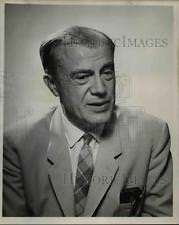
D. WATTS, in addition to his writings and years of college teaching in economics, has served as economic counsel for leading business firms. He is now Director of Economic Education and Chairman of the Division of Social Studies at Northwood Institute.
Northwood Institute, a private, two-year college with campuses at
“As a Man Thinks….” serves as Dr. Watts’ introduction to Philosophy 110: Survey of American Life and Business, designed to develop understanding of private enterprise and to inspire a resolve to develop the personality, character, and skills necessary for individual success in voluntary cooperation.
As we think, so do we act. We act in ways which we believe will give us what we think we need or what we imagine we will enjoy: particular foods, kinds of clothing, types of shelter, forms of romance, popularity with certain persons, leisure, security, or adventure. “A human being always acts and feels and performs in accordance with what he imagines to be true about himself and his environment.”¹
In this respect animals differ from humans. A beaver fells trees and builds a dam by instinct. Inherited instinct directs birds to build nests, badgers to burrow, and bees to make honey. We humans have no such built-in directives. We would quickly perish if we tried to rely for guidance on our few inherited urges or ill-defined instincts. For better or worse, humans live only by virtue of what each individual learns during his own lifetime.
For this learning process, man has nature’s most highly developed nervous system. Still more important, this nervous system is subject to the control by faculties of a forebrain that puts man, so scientists tell us, as far beyond the highest ape as the ape is above the amoeba.
This forebrain records impressions. From these it forms and stores the ideas which ultimately govern human conduct, and it appears to have virtually unlimited storage capacity for every sort of information brought to it by the senses.
But it is much more than a recorder or storehouse. It possesses also the faculty of mind, which uses and directs the brain and nervous system. This mind, or consciousness, has the unique power to select from the recorded impressions and ideas those which it will permit to stimulate the nervous system and activate our muscles.
This power to select the controlling ideas is what we mean by “free will,” or “freedom of choice,” which only humans, so far as we know, possess. Because of it, humans have the power of self-control, or self-government. It makes man responsible for his acts in that he can choose to act or to refrain from acting as instinct-guided animals cannot do.
Your Ideas Control You
As students of cybernetics put it, the human nervous system operates as a “servo-mechanism” to achieve goals set for it by the mind. These goals are mental images which our minds create by use of imagination.
Your nervous system cannot tell the difference between an imagined experience and a ‘real’ experience. In either case, it reacts automatically to information which you give to it from your forebrain. Your nervous system reacts appropriately to what ‘you’ think or imagine to be true.²
This means that humans can control their own learning process as animals cannot. They can learn what they choose to learn. By selecting their own goals they can learn to direct their own “education.”
Increasingly, moreover, individuals must acquire this ability if they are to hold their relative positions in a progressive society. For, as humans progress in cooperation, they make their social environments more complex and more subject to a rapid change. Schools cannot supervise the details of education and re-education necessary to keep pace with changes in the occupational requirements and non-occupational opportunities in progressive societies. Hence, members of such societies must develop initiative and skill in the techniques of teaching themselves. The aim of the schooling process, says Professor Jacques Maritain, should be, therefore, “to guide man in the evolving dynamism through which he shapes himself as a human person—armed with knowledge, strength of judgment, and moral virtues—while at the same time conveying to him the spiritual heritage of the nation and the civilization in which he is involved, and preserving in this way the century-old achievements of generations.”3
Aims of Education
A sketchy list of what we should look for in education, therefore, includes:
1. Skills
a. Manual skills, e.g., sucking, eating, walking, talking, reading, occupational techniques, sports, artistic proficiencies.
b. Personality skills necessary for winning approval and cooperation of fellow humans, e.g., skills in expressing pleasure, gratitude, disapproval, concern for the feelings and interests of others.
2. Moral Traits: habits of industry, thrift, initiative, fidelity, honor and honesty, courage, self-reliance, regard for interests and feelings of others.
3. Wisdom and Foresight: understanding of cause-and-effect relationship in the animate and inanimate realms, including the realm of one’s own physiology and psychology as well as that of social relationships.
4. Learning Ability: adaptability, ability to gain and use new knowledge and to acquire new skills; resourcefulness.
Humans have progressed so far in developing these skills, it is said, that every individual must acquire in his own lifetime more knowledge and skill in living than all other creatures have acquired in the form of instinct during the two billion or more years of plant and animal evolution before the most primitive form of man appeared on the scene one or two million years ago.
Moreover, humans can never, apparently, stop learning. They make for themselves an environment that is vastly more dynamic than that to which animals must learn to adapt, for this human environment includes the actions of their fellows and the dynamic realm of intellectual and nervous change within each individual. This means that humans must acquire the ability to teach themselves so that they can maintain their equilibrium in these two ever-changing worlds. They must learn how to learn, and they must acquire the ability to direct their own learning. They must plan to continue developing and exercising this skill, moreover, long after their physical powers have begun to decline.
This learning process can increase until “cerebral accidents” seriously impair the functioning of the brain. That is, a man of sixty or seventy who knows three or four key foreign languages should learn a new language faster than a youth of 18 who knows only his native tongue. A 60-yearold economist should be able to master the intricacies of the accounting profession faster than a 20-year-old undergraduate, other things (e.g., original I. Q.) being equal.
In this connection, teachers should ponder this paradoxical statement by Jaques Maritain: “In order to reach self-determination, for which he is made, he [man] needs discipline and tradition, which will both weigh heavily on him and strengthen him so as to enable him to struggle against them—which will enrich that very tradition—and the enriched tradition will make possible new struggles….” 4
Passion for Objectivity
What shall we say, then, of the notion that the teacher should not take sides on “controversial” questions—and what questions in the “social sciences” are not controversial today? Should the teacher merely collect and present all possible opinions on these topics, with complete objectivity and with no attempts to help the student make a good choice between the conflicting views?
In what has been called the “modern, mad passion for objectivity” many teachers and schools recoil from a religious, poetical, or moral approach in pedagogy and scholarship. They propose to appeal only to the intellect lest they arouse emotions that, so they fear, may inhibit understanding and misdirect the mind.
But psychologists tell us that the mind cannot function without emotion, and that understanding, consequently, cannot exist without appraisal, or evaluation. Emotions are necessary to stimulate mental activity and the flow of ideas. Ideas, in turn, arouse and alter emotions. All action, including mental activity, is prompted by desire, ambition, purposes, preferences, likes, and dislikes which are evidences of emotion. Objective observation and thought are not unemotional. Instead, they yield significant results only to the extent that emotions inspire the individual to make the effort of concentration necessary to get a clear view of the relevant facts. The emotions to be ruled out, or suppressed, are those which prevent this concentration and accurate interpretation. But the strength of the emotions which prompt the concentrated effort to observe and understand must correspond to the intensity of the concentration and other effort, mental or muscular.
And, because ideas play so large a role in determining human behavior, humans must learn to distinguish the true from the false, the useful from the useless or harmful, the good from the evil, the beautiful from the ugly. They must acquire the habit of choosing the one and spurning the other. They are needlessly handicapped in this learning and retarded in acquiring wisdom if teachers merely present conflicting opinions and profess their own inability or reluctance to choose between them.
Here is the way one writer deals with this doctrine that educators should “present both sides” so evenly weighted that the student may easily decide that either or neither is valid:
That concept is endorsed by the overwhelming majority of persons who arrange the education and information programs for colleges, service clubs, discussion groups, business organizations, and others. They believe in presenting the case for socialism along with the case for the free market. Challenge them and they will reply: “Objectivity and fairness demand that we present the arguments for government ownership even though we ourselves don’t believe in it.”
Do objectivity and fairness demand that they present the case for coin clipping? They say no. Then why do they arrange for speakers and teachers who endorse the monetization of debt? After all, the device of monetizing debt is merely a modern arrangement of the old idea of clipping coins.
Objectivity and fairness aren’t the real reasons a person arranges for the presentation of both sides. The primary reason is this: The person hasn’t made up his own mind! He doesn’t arrange for a defense of coin clipping. He arranges to have the case for monetization of debt presented because he himself hasn’t yet repudiated that method of financing government.
When a person voluntarily arranges for the presentation of socialistic ideas along with free market ideas, you may be sure of this: He hasn’t completely repudiated socialism; he hasn’t completely accepted the ideas of the market and of government restricted to the equal protection of the life, liberty, and honestly acquired property of everyone.
Here is a truism: If the evidence clearly indicates that an idea or policy is untrue or evil, no fair and objective person will voluntarily arrange to have it presented as valid.5
The Myth of Neutrality
Because it is a physical impossibility to depict all facts and opinions in any book, class, or course, every educational effort must be selective. No historian could record everything that happened in any period of time, however short. Insofar as the author of a history has only the educational value of his work in mind, he selects for presentation those facts and supposed relationships which he believes will be especially significant for certain readers and students. The teacher, similarly, insofar as he has only the educational usefulness of his work in mind, will select for recommended or “required” reading by his students, not all available books and articles on the period, but those few which he considers likely to be most effective in producing certain student reactions. The same holds true for authors and teachers in other fields.
In practice, of course, authors of textbooks seldom consider only educational values as they decide what facts and interpretations to present or ignore. Instead, they commonly select facts to support opinions held by the publishers’ editorial advisers, school boards, politicians, teachers, and others who help select textbooks. By the same token, they omit from their accounts any mention of facts and relationships which might support opposing views. Teachers, too, in selecting readings and in their class discussions of the readings must consider the opinions of school boards, superintendents, principals, parents, deans, presidents, and trustees.
We should recognize also that both authors and teachers are prone to economize time and effort by following tradition and to continue presenting facts and opinions long after these have ceased to be significant for new generations of students or accepted as valid by leading authorities in the fields.
Probably no teacher can present “both sides” of a controversy without bias unless he believes either that the controversy is unimportant or that he cannot or dares not “take sides.” But if he believes that the controversy is unimportant, he can scarcely arouse the interest of his students in it; and if he shows that he cannot or dares not differentiate between the true or false, he fails to inspire in his students the attitudes and qualities necessary for human progress.
Northwood Trains for Voluntary
One of the primary duties of a teacher is that of inculcating, by precept and example, the conviction that there is right and wrong, truth and error, beauty and ugliness, and that it is a matter of life and death for students to learn to choose between them. He should inspire faith that there is truth, goodness, and beauty, that it is worth-while to seek them, and that it is possible to find them. To qualify as an effective teacher, therefore, the individual himself must possess and display, to an exceptional degree, this high regard for truth, virtue, and beauty.
Northwood Institute has been established to train students to function efficiently in private business, or “free enterprise.” We should assume that those who founded it, who send their children to it, and who contribute funds for its support believe that employment in private business is a good way to make a living; they believe that the typical operations of banking, finance, advertising, retailing, and the like do not require lying, cheating, stealing, or maiming one’s fellow men. They expect Northwood courses to teach how such operations are carried on. More than this, the thoughtful liberal must surely recognize and teach that only in the voluntary association for the exchange of services—that is, only in voluntary activities of free-enterprise industry, finance, commerce, and the professions—do humans develop those qualities which most distinguish them from animals.
We know, however, that a host of industrious and widely respected authors and professional scholars teach that private business operations—the operations of buying and selling in free markets—are dishonest, predatory, and demoralizing to all who take part in them. They teach that, in free markets, the rich get rich at the expense of the poor, so that the rich get richer while the poor become more wretched and numerous. They teach that employers underpay their employees and that overproduction and unemployment result from the workers’ inability to buy the products of their own labor. Merchants regularly and necessarily cheat their customers in free markets, according to these anticapitalist scholars, and most consumers are so stupid that competition among professional merchants regularly gives greater rewards to the sellers of shoddy goods, poisons, narcotics, and obscene literature than to producers of better-quality articles, nutritious foods, and wholesome publications. These supposed scholars contend that the poor and the common wage earners, consumers, and small producers can get economic justice only if men like themselves acquire and use the coercive power of the state to regulate production and to set the terms of exchange.
Effects of Anti-Business Propaganda
These illiberal ideas have gained increasing acceptance during the past century, and they have had consequences in the return to reactionary policies and political institutions, together with growing disrespect for morality and “The Law.” The parallel between ancient and modern civilizations in regard to individual freedom and the rise of empire is too striking to escape notice by thoughtful historians.
Degenerative influences are always present in every society, and moral philosophers have called attention to them, generation after generation. Sometimes these Cassandra-like warnings may have helped to reverse the trend, so that constructive ideas and actions overcame the demoralizing forces. Humans progress only as they learn to recognize and avoid the mistakes of their forebears. The American scholar or teacher worthy of the title, I believe, must share some of the sentiments and experiences of prophets in other times and places.
It is not without significance that the “modern era” dates from the centuries during which scholars and pedants in the Western world won a measure of release from support and control by emperors, princes, and other political functionaries. Nor is it mere coincidence that reactionary political trends have set in with the revival of political control over teachers, textbook writers, radio, television, and scientific research, a control that takes many forms: public schools, state universities, governmental subsidies for research, and governmental controls over the broadcasting industries.
Means Mistaken for Ends
Scholars, teachers, parents, and politicians have increasingly mistaken certain useful tools and techniques—books, scientific instruments, school buildings, and class meetings—for education. They have come to believe that, given enough of these tools and techniques, education of the young must necessarily follow. Then, in the belief that the end justified any means, they have proposed and instituted increasing coercion—legal but effective—to finance the printing of books, the purchase of scientific equipment, the building of schools, and the hiring of teachers. At the same time they have resorted to increasing coercion to exclude the young from productive enterprise and to herd them into the costly buildings and classrooms by means of child labor laws, wage-hour laws, restrictions on tasks young persons may perform, and truancy laws. As a result, the young are getting more schooling but less and less education.
Moreover, if free enterprise cannot supply the services of education, why should we count on it to supply adequately the services we want from our fellow men in transportation, agriculture, industry, or commerce? Scholars who mistrust the good sense and initiative of their fellow men in educating the young are likely to expect little but folly and bovine inertia from “the masses” in their other activities. They find it easy to believe, therefore, that the same legal coercion that they advocate in schooling the young is necessary to assure right conduct on the part of their elders in the production and distribution of other goods.
Scholars and pedagogues who work in intellectual and financial partnership with politicians in education and research tend to join in movements to increase political intervention in every field of human endeavor. In fact, politicians demand this political support in return for the tax subsidies paid to writers and teachers in public schools and universities. As Henry Adams said, “
As a further result of these statist tendencies in thought and action, we find a spreading tendency among scholars in state institutions to belittle or deny the facts of individual responsibility for human action.
Faulty Rationale
For this denial of mankind’s powers—the powers of reason and self-direction—the statist scholars supply more than one rationale. Proponents of the Marxian rationale (materialistic determinism) reject the Freudian rationale (the libido and the subconscious) in Soviet culture even as they make use of it in their efforts to subvert and dominate thought and morality outside the borders of their own empire.
The pseudo-liberals of American politics often reject the idea of individual responsibility, it appears, merely for the purpose of arguing for the particular nostrum which their favorite politicians happen to propose at the moment. When their political leaders are campaigning for Federal aid to education, they proclaim lack of schooling to be the condition that holds the downtrodden masses in poverty and immorality. This lack they attribute, of course, to the greed or indifference of private enterprise, which has failed to supply the necessary school facilities. When the politicians make slum clearance the political issue, the statist intellectuals find lack of proper housing to be the cause of crime, poverty, ill-health, and ignorance. But always in this view, it is some “social condition” that determines individual conduct, not individual choice and action that make the social conditions.
No single idea, I believe, is more demoralizing, more discouraging to human effort, than this notion that the individual is not responsible for his acts, that he cannot be responsible for them, and that he should not, therefore, be held accountable for them. Springing from this dehumanizing satanism is the general mistrust of individual freedom to be found in the arguments for political nostrums advocated as remedies for the supposed evils or short-comings of voluntary enterprise.
Humans Are Responsible
It may be that the faculty for self-control is itself “merely” an idea or complex of ideas, together with the corresponding development of the autonomic nervous system. But it can transform a life, and as it is associated with understanding of oneself and other humans, as well as of inanimate nature, it has increasing survival value for the individual and for all whom he cherishes.
The demoralizing notion of “social responsibility” and expositions of the “failures of free enterprise,” however, permeate the textbooks which public schools and state universities adopt and use in economics, history, and other social studies. Therefore, the institution which seeks to inculcate understanding of private business and enthusiastic dedication to the ideals and virtues necessary for efficiency in voluntary enterprise cannot use such textbooks except as collateral reading assigned as “horrible examples” of political interference with thought and scholarship.
Yet, we must recognize that choice among nonstatist textbooks is limited and those which are available may be inadequate in various ways. What to do?
In my opinion, we should regard this lack of suitable textbooks as a challenge and an opportunity. In fact, we can recognize the inadequacy of the statist books or of the alternatives only as we become aware of the need and opportunity for something better. That recognition is itself the beginning of wisdom which must make us more effective teachers. But more than this, it should inspire us to take the lead in providing textbooks and using classroom techniques necessary to achieve the success in education which every true teacher covets.
Foot Notes
1 Maxwell Malz, Psycho-Cybernetics (New York, Prentice-Hall, Inc., 1960).)
² Psycho-Cybernetics; p. 29.
3 Education at the Crossroads, p. 10, (emphasis added).
4 Education at the Crossroads, p. 2.
5 Clichés of Socialism, No. 22 (Irvington, N. Y.: The Foundation for Economic Education, 1962).
6 The Education of Henry Adams, Modern Library edition, p. 78.